
AI is changing social media marketing by taking over the slow, repetitive parts of the job: writing first drafts, resizing and repurposing content, sorting through comments, spotting patterns in analytics, and testing ad creative. It is not taking over the parts that need judgment, taste, or a real relationship with your audience. The teams getting the most out of AI in social media marketing are not the ones posting the most AI content. They are the ones who freed up hours each week and spent those hours on strategy and creative work.
That is the short answer. The rest of this guide breaks down exactly what changed, what it looks like in practice on each platform, where AI still gets things wrong, and a step by step way to bring it into your own workflow without your brand starting to sound like everyone else.
Quick takeaways
- AI changes the workflow of social media marketing, not the purpose of it.
- The biggest, most reliable wins are in speed and volume, not in creativity.
- Personalization and ad targeting have improved the most. Customer service automation carries the most risk.
- Brand voice is now a competitive advantage, because generic content is cheap and everywhere.
- Human review is the difference between AI helping you and AI embarrassing you.
What Is AI in Social Media Marketing?
AI in social media marketing means using software that can learn from data to help plan, create, publish, analyze, and promote social content. Instead of following fixed rules, these tools study patterns in large amounts of information and then make predictions or produce something new based on those patterns.
In day to day work, artificial intelligence in social media marketing usually shows up in eight places:
- AI generated content. Captions, hooks, post ideas, video scripts, and images produced from a written prompt.
- Automated scheduling. Tools that recommend posting times based on when your audience is active, then publish for you.
- Audience analysis. Software that groups your followers by behavior, interest, or buying stage instead of just age and location.
- Personalization. Showing different messages, offers, or creative to different segments of the same audience.
- Predictive analytics. Forecasting which post, format, or ad is likely to perform before you commit budget to it.
- Social listening. Scanning mentions, comments, and conversations to track sentiment and spot issues early.
- AI powered advertising. Automated targeting, bidding, budget shifts, and creative testing inside ad platforms.
- Chatbots and customer interaction. Answering common questions, qualifying leads, and routing harder cases to a person.
For the wider view beyond social, a breakdown of what AI marketing actually means shows how the same systems work across email, search, and paid media.
AI vs Traditional Social Media Marketing
The goals have not changed. Reach the right people, give them a reason to care, and turn some of that attention into business. What changed is how much of the work a person has to do by hand.
| Task | Traditional approach | AI powered approach |
| Content research | Manually scroll competitors and save ideas | AI scans and summarizes topics, gaps, and formats |
| Writing | Write every caption from scratch | Write from an AI first draft, then edit for voice |
| Scheduling | Pick times based on habit or guesswork | Tool recommends times based on audience activity |
| Targeting | Broad targeting by age, location, interest | Behavior based segments and predictive audiences |
| Reporting | Pull numbers into a spreadsheet each month | Automated dashboards and pattern summaries |
| Customer replies | Answer every message by hand | AI handles common questions, humans handle the rest |
| Creative testing | Test two or three versions | Test dozens of variations at once |
Notice the pattern in that table. Every row where AI clearly wins is a row about volume or speed. Every row where the human still matters is a row about judgment. That distinction is the most useful thing to hold onto as you read the rest of this guide.
7 Ways AI Is Changing Social Media Marketing
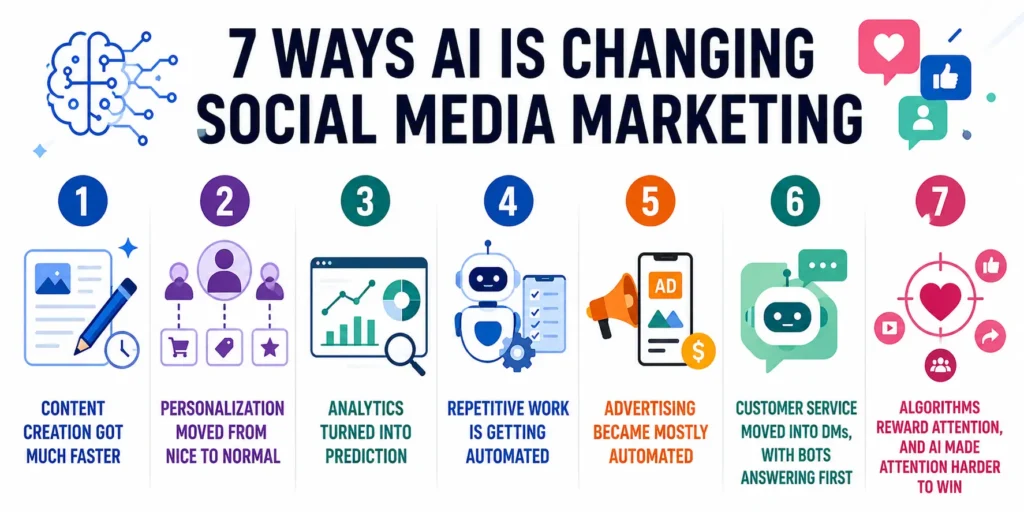
1. Content Creation Got Much Faster
This is where most teams start, and it is where the time savings are easiest to see. AI for social media content can produce caption drafts, hook variations, post ideas, full content calendars, images, and short video concepts in minutes instead of hours.
The change is not that AI writes better than a good marketer. It usually does not. The change is that a blank page is no longer the bottleneck. A marketer who used to spend two hours writing ten captions now spends thirty minutes editing ten AI drafts into something that sounds like the brand.
The other quiet win is repurposing. One long piece of content can be broken into a carousel, five captions, three short video scripts, and a set of story frames. AI handles that reshaping well because it is a structure task, not a creative one. This is also true beyond social. Many businesses use an AI blog content generator to build long form content first, then split it into social posts that all point back to the same page.
A practical way to use it: give the tool your existing best performing posts as examples, tell it what you are promoting, and ask for ten variations. You are not asking it to invent your voice. You are asking it to copy the voice you already proved works. If that base of content is still being built, start by planning content pillars first, which these social media content creation strategies walk through step by step.
Where it goes wrong: teams start publishing first drafts. AI captions have a recognizable rhythm, and audiences pick up on it faster than most marketers expect.
2. Personalization Moved From Nice to Normal
Personalization used to mean putting a first name in an email. In social, it now means different creative, different offers, and different messaging for different groups of people, running at the same time.
AI makes this practical because segmenting an audience by behavior is a data problem, and data problems are what these systems are good at. A tool can group your audience by what they clicked, how long they watched, what they bought before, and how recently they engaged. Then you build a slightly different message for each group.
Why it matters: relevance drives engagement, and engagement drives distribution. A post that speaks directly to a first time visitor will almost always beat a generic post aimed at everyone, because the person reading it feels like it was written for them.
A simple version any small business can run: separate people who have bought from people who have only engaged. Show the first group new products and loyalty offers. Show the second group proof, reviews, and answers to common objections. That is two segments, not twenty, and it already outperforms one message for all.
3. Social Media Reporting
Reporting used to look backward. AI social media analytics increasingly looks forward.
Modern tools can estimate how a post is likely to perform before you publish it, flag which formats are gaining traction with your specific audience, run sentiment analysis on comments to tell you whether the reaction is positive or negative, and summarize a month of data into plain language instead of a wall of charts.
Three uses that pay off quickly:
- Pattern spotting. AI can look at a year of posts and tell you that your carousels outperform your reels on weekdays, which you would probably never notice by eye.
- Sentiment tracking. When a campaign starts getting a negative reaction, you want to know in hours, not at the end of the month.
- Automated reporting. Monthly reports that used to take a day now take an hour, and the time saved goes back into strategy.
One warning. AI is good at telling you what happened and decent at telling you what is likely to happen next. It is not good at telling you why it happened. The why usually requires knowing what else was going on: a holiday, a product launch, a competitor’s campaign, a news event. That context lives with your team. This is exactly the layer where a documented social media marketing strategy matters, because it gives you something to measure results against.
4. Repetitive Work Is Getting Automated
Social media Marketing automation with AI now covers most of the work that used to eat a marketer’s afternoon:
- Scheduling and publishing across platforms
- Resizing and reformatting one asset for several placements
- Drafting replies to common questions
- Pulling reports and building dashboards
- Hashtag and topic research
- Monitoring brand mentions and keywords
- Sorting incoming messages by urgency
The rule that keeps this healthy: automation should handle repetitive work, while humans handle strategy, creative decisions, and sensitive customer conversations. The moment automation touches something emotional, like a complaint or a refund request, you need a person in the loop.
Most teams underestimate how much time is sitting in these small tasks. Add up scheduling, reformatting, reporting, and message sorting across a month and it is often a full week of work. This overview of AI automation services explains how businesses connect these tools together, and this breakdown of business tasks AI can automate is a useful audit of what to hand over first.
5. Advertising Became Mostly Automated
Paid social has changed more than organic social, and it changed faster. Ad platforms now use machine learning to handle targeting, bidding, budget allocation, and creative rotation with limited manual input.
What that means in practice:
- Targeting: you describe the customer or upload data, and the system finds people who resemble them.
- Creative variations: AI generates headline, copy, and image variations so you can test far more combinations than a person could build by hand.
- Predictive performance: the platform estimates which creative will perform and shifts spend toward it.
- Budget optimization: money moves automatically between ad sets based on live results.
The job of the marketer shifted upward. You are no longer adjusting bids all day. You are deciding what to sell, to whom, with what message, and whether the results are actually worth the spend. Feeding the system good creative and a clear goal matters more than manual tuning now.
Keep the difference between organic and paid clear in your head. Organic social builds familiarity and trust over time and costs you effort. Paid social buys attention immediately and costs you money. Most businesses need both, and they work best when the paid creative is built from whatever performed well organically. A full walkthrough of social media advertising covers how to structure that, and if you are deciding where to put budget first, see how Google Ads and Facebook Ads compare.
6. Customer Service Moved Into the DMs, With Bots Answering First
More customers now contact businesses through social messages than through email or phone forms. AI chatbots handle the first response: store hours, pricing, shipping status, booking links, product questions, and basic lead qualification, around the clock.
Done well, this is a real improvement. Fast answers to simple questions are better for everyone, and nobody enjoys waiting nine hours to learn whether something is in stock.
Done badly, it damages trust quickly. Three rules keep it on the right side:
- Make escalation easy. A person should be able to reach a human in one step, without repeating themselves.
- Never automate emotional conversations. Complaints, refunds, and public criticism need a person.
- Be honest about what it is. Pretending a bot is a person costs you more trust than the automation saves.
The useful test: would you be comfortable if a customer posted a screenshot of this conversation publicly? If not, a human should be handling it.
7. Algorithms Reward Attention, and AI Made Attention Harder to Win
Social platforms rank content using machine learning models that predict whether a specific person will engage with a specific post. The main signals are consistent across platforms: relevance to the viewer, engagement, watch time, saves and shares, and how the same viewer behaved before.
Here is the part worth thinking about. When AI made content cheap to produce, feeds filled up. More content chasing the same attention means the bar for what gets distributed rises. The algorithm does not reward you for posting more. It rewards you for holding attention.
So chasing the algorithm is a losing strategy. Making content people actually want to watch is the only durable one, and it happens to be exactly what the ranking systems are trying to measure. There is more depth on the formats and hooks that hold attention in this walkthrough on creating engaging social media content.
How AI Is Changing Each Social Media Platform
The tools are similar across platforms. What differs is where they help most. If you are still deciding where to focus, start with which platform fits your business before spreading yourself across five of them.
AI and Instagram Marketing
Instagram rewards visual quality and watch time, so AI helps most with volume of visual output. Common uses include generating reel concepts and hooks, writing caption variations to test, building carousel outlines, editing and captioning video, and reading audience insights to find which topics hold attention longest.
The trap on Instagram is sameness. When everyone uses the same tools with the same prompts, feeds start to look alike, and your account blends into the background. The accounts that grow still lead with a real point of view, a recognizable style, or a face people know. For the fundamentals, start with the basics of Instagram marketing. For software specifically, here is a comparison of AI tools built for Instagram growth.
AI and Facebook Marketing
Facebook is where AI has taken over the most work, mostly on the advertising side. Automated campaign types now handle audience selection, placement, and budget with minimal setup. AI also supports community management by sorting comments, flagging spam, and drafting replies for group and page admins. Facebook Ad manager is now filled with AI prompts and AI creatives and AI suggestions which not only take away your budget but also, it takes away a lot of manual work. It is important that marketers should know about AI in advertising. For example lets take a example of SEO Services in Alabama Ad, in which we are going to target AEO services in Alabama, GEO Services in Alabama, SEO services and portfolio, whatsapp number, case studies are attached. But then you go to the second page, as the AD manager will ask you to enter the url: and as soon as you enter the url, the whole ad will be created. You have to be creative and set a budget and time, and then AD will start, but here is the key, you should know what AI has done. Many marketers nowadays ask us why your ADs are successful and we are not getting even clicks, forget about leads. And then we told them that what we do is, we make each point of advertisement clear in each section. And that’s why we are getting clicks.
Organically, Facebook still runs on communities and groups, which are conversation driven and harder to automate. This breakdown of Facebook advertising covers why the platform still delivers for local and service businesses.
AI and LinkedIn Marketing
LinkedIn is text heavy and B2B focused, which makes it a natural fit for AI writing tools. Teams use it for post ideation, structuring thought leadership around a real opinion, drafting outreach messages, and researching accounts before a conversation.
The risk here is higher than on other platforms. LinkedIn audiences are professionals who read a lot of posts, and generic AI writing is obvious to them. Use AI to organize your thinking and speed up the draft. Do not use it to invent opinions you do not hold, because the follow up conversation will expose it.
AI and TikTok Marketing
TikTok runs on ideas and pacing, not production polish. AI helps with concept generation, script drafts, hook variations, editing, captions, and analyzing which openings keep viewers watching past the first few seconds.
What AI cannot supply is timing and cultural read. Knowing what feels current, funny, or slightly off is human work. Use AI to produce more attempts, then let a person choose which ones are worth posting.
AI and YouTube Marketing
YouTube is the most search driven platform in the list, which makes AI useful for research as well as production. Common uses include title and description drafts, script outlines, chapter breakdowns, topic research based on what people search, and turning long videos into shorts automatically.
Because YouTube behaves partly like a search engine, the same clarity that helps a video rank also helps it get pulled into AI generated answers elsewhere.
Best AI Tools for Social Media Marketing
Tools change constantly, so it is more useful to think in categories than in brand names. Pick one tool per category, learn it properly, and only add another when you hit a real limit. the best tools for Social media Marketing in different categories are:
Content and copy: ChatGPT, Claude, and Jasper handle captions, scripts, outlines, and repurposing. General purpose assistants are usually enough unless you need brand voice controls built in. Prompting is covered in more detail in this walkthrough on using ChatGPT for content creation.
Scheduling and publishing: Buffer, Hootsuite, Later, and Sprout Social handle calendars, posting times, and approvals. The AI features here are helpful but secondary. Choose based on how your team approves work.
Design and visuals: Canva and Adobe Firefly cover templates, resizing, background removal, and image generation. For most small teams, template consistency matters more than image generation.
Video: CapCut, Runway, and VEED handle editing, auto captions, clipping long video into shorts, and basic effects. Auto captioning alone is worth it, since most social video is watched on mute.
Analytics and social listening: rather than naming tools that change every year, judge them on four things: does it connect to every platform you use, does it explain patterns in plain language, can you export a report a client or manager can read, and does it track sentiment and not just volume.
For a wider comparison across marketing functions, see this roundup of the top AI tools for digital marketers. Solo operators and contractors may find this list of AI tools for freelancers closer to their budget.
What AI Does Well, and Where People Still Matter
| AI is better at | People are better at |
| Processing large amounts of data | Understanding context and timing |
| Producing many variations quickly | Making the creative call on which to use |
| Handling repetitive tasks | Building real relationships |
| Spotting patterns in numbers | Explaining why the pattern happened |
| Working at scale, at any hour | Handling complex or emotional situations |
| Drafting from a clear brief | Deciding what the brief should be |
The takeaway is simple. AI should support social media marketers, not replace them. The role itself is shifting toward editing, strategy, and quality control, which is a more senior version of the same job. For anyone hiring or planning a team, this overview of the social media manager role and this list of skills social media marketers need reflect where the work is heading.
The Real Risks of AI in Social Media Marketing
For Social media Marketing, these five problems account for most of the trouble businesses run into.
Generic, Forgettable Content
This is the most common problem and the most damaging one over time. AI tools are trained on similar data and produce similar output, so if you and your competitors all publish first drafts, your content becomes interchangeable. Nobody unfollows you over one bland post. They just slowly stop noticing you.
Fix: feed the tool your real material. Customer questions, sales objections, actual project details, your own opinions. Specifics are what AI cannot invent for you.
Inaccurate Information
AI tools produce confident wording regardless of whether the underlying claim is right. They can invent statistics, misstate policies, and get product details wrong. On social media, a wrong claim spreads fast and gets screenshotted.
Fix: never publish a number, claim, date, or product detail that a human has not verified. Treat AI output as a draft written by a fast intern who never says “I am not sure.”
Loss of Brand Personality
The more you automate, the more your brand drifts toward a neutral middle. Voice is one of the few things a small business can own that a bigger competitor cannot copy easily, so it is a bad thing to give away for convenience.
Fix: write a one page voice guide with real examples of how you sound and how you do not, and paste it into every prompt.
Privacy and Data Handling
Pasting customer names, contact details, contracts, or private conversations into a public AI tool can put you on the wrong side of your own privacy policy and of regulations like GDPR. This is a bigger issue in healthcare, finance, legal, and any business handling sensitive records.
Fix: decide what data may never go into an external tool and write it down. Businesses handling regulated data often move to a private LLM setup so information stays inside their own environment.
Over Automation
Automating too much makes a brand feel like a vending machine. Comment sections and DMs are where trust gets built, and handing all of that to a bot removes the part of social media that is actually social.
Fix: pick a clear line. Everything routine can be automated. Anything with emotion, money, or a public audience needs a person.
How Businesses Can Adapt to AI Powered Social Media Marketing
Here is the practical part. Six steps, in order.
1. Start With Strategy, Not Tools
The most common mistake is buying software before deciding what problem it solves. Write down your goal, your audience, your main offer, and your posting plan first. AI makes an existing strategy faster. It does not create one for you. Small businesses working with limited time should read up on AI marketing for small businesses before choosing tools.
2. Use AI to Assist, Not to Replace
Give AI the work your team dislikes: first drafts, reformatting, scheduling, sorting, reporting. Keep the work your team is good at: choosing what to say, deciding what to publish, and talking to customers.
3. Build and Document Your Brand Voice
Write down your tone, the words you use, the words you avoid, your typical sentence length, whether you use humor, and how formal you are. Include three example posts you are proud of. This document is what turns generic AI output into something recognizable as yours.
4. Keep a Human Review Step
Every post, ad, and customer reply that matters gets human eyes before it goes out. This is not optional, and it is also what protects you when a tool gets something wrong. It is worth naming who owns that review so it does not quietly get skipped during a busy week.
5. Test AI Assisted Content Against Your Existing Content
Do not assume AI content performs worse or better. Run both for a month and compare engagement, saves, shares, click through, and conversions. You will usually find AI helps most in some formats, like carousels and repurposed content, and least in others, like personal storytelling.
6. Track Business Results, Not Just Likes
Engagement is a signal, not a goal. Track engagement rate, website traffic from social, leads, sales, cost per lead, conversion rate, and customer retention. If AI doubles your output but none of those numbers move, the extra output is costing you time, not earning it.
A Simple 30 Day Plan to Bring AI Into Your Social media Marketing Workflow
If the list above feels like a lot, run it in this order over one month.
Week 1: Audit and document. List every recurring social task and how long it takes. Write your one page brand voice guide. Decide what data will never be pasted into an external tool.
Week 2: Automate one thing. Pick the single most repetitive task, usually scheduling or reformatting, and hand it over. Do not change anything else. You want a clean read on whether it helped.
Week 3: Add AI to drafting. Use AI for first drafts only, with your voice guide in every prompt. Keep your normal review process. Compare the time it takes to publish a post against your Week 1 numbers.
Week 4: Measure and decide. Look at time saved and at performance. Keep what worked, drop what did not, and only then consider adding a second tool.
Most teams find their real win in Week 2, not Week 3. The time savings from automation are immediate and easy to measure. The content quality gains take longer and depend heavily on how good your prompts and your review process are.
How to Measure Whether AI Is Actually Helping
Set a baseline before you change anything, or you will never know what the tools did.
| What to measure | Why it matters | How to check |
| Hours spent per post | The clearest AI benefit is time | Time tracking for two weeks before and after |
| Posting consistency | More output only counts if it is sustained | Posts published per week over three months |
| Engagement rate | Tells you whether quality held up | Platform analytics, same period comparison |
| Saves and shares | Strongest signal of genuine value | Platform analytics by format |
| Click through to site | Connects social to business results | Analytics traffic from social sources |
| Leads and cost per lead | The number that decides budget | CRM or form submissions by source |
| Response time in DMs | Measures the automation, not the content | Platform inbox reporting |
If engagement rate drops while output rises, that is the warning sign. It usually means quality slipped, and the fix is a stronger review step, not a better tool.
Common Mistakes to Avoid
- Publishing first drafts. The most common and most visible mistake.
- Buying five tools at once. You will learn none of them well. One per category is plenty.
- Automating comments and DMs completely. This is where trust is built or lost.
- Using AI to fake expertise you do not have. Audiences and search systems both reward genuine experience, and it is hard to fake convincingly.
- Measuring only vanity metrics. Follower count is the easiest number to grow and the least connected to revenue.
- Hiring based on tool lists. If you are outsourcing, judge on process and reporting, not on which software an agency owns. These steps on how to choose a social media marketing agency cover what to ask.
Where This Is Heading
A few shifts look reasonably safe to plan around, without needing a prediction about any specific tool.
Video generation keeps improving. Producing short video will keep getting cheaper, which means video volume rises and the value of a distinctive idea rises with it.
Advertising becomes mostly automated. Manual campaign management is already fading. Creative quality and offer strength become the main levers you control.
Search and social keep blending. People increasingly ask AI assistants for recommendations instead of browsing. That makes clear, well structured, genuinely useful content valuable in a new way, because it can be quoted in an answer. That is the same shift behind AI search optimization.
Human content becomes a differentiator. As AI content volume rises, anything obviously made by a real person, with a real face and a real opinion, stands out more than it used to.
For the broader picture across every marketing channel, see what is expected from the future of AI in digital marketing.
Final Thoughts
AI in social media marketing is a workflow change more than a strategy change. It makes content creation, personalization, analytics, advertising, and automation faster. It does not decide what your brand stands for, which customers are worth pursuing, or what is worth saying this week.
The businesses that get real value from it are not the ones replacing people with software. They are the ones using software to clear the repetitive work off a marketer’s desk so that person can spend more time on strategy, creative decisions, and actual conversations with customers. That is the whole opportunity, and it is available to a two person team just as much as to a large one.
Businesses that want help building a social strategy that uses AI for efficiency while keeping the human judgment that makes content worth following can start with Alpha Digital’s social media marketing management services, or book a free marketing audit to see where things stand before changing anything.
FAQs
How is AI changing social media marketing?
AI in social media marketing is changing, automating content drafting, scheduling, reporting, audience segmentation, ad targeting, and first line customer replies. The strategy and creative decisions still sit with people. In practice, marketers spend less time producing and more time editing, planning, and analyzing.
How can AI be used for social media marketing?
The most common uses are writing caption and script drafts, generating post ideas and content calendars, repurposing one piece of content into many formats, scheduling posts at better times, analyzing performance patterns, testing ad creative, and answering routine customer questions through chatbots.
Can AI create Social media Marketing posts?
Yes, AI can create complete Social media Marketing posts including captions, hashtags, and images. Whether you should publish them without editing is a different question. AI drafts tend to be generic and sometimes factually wrong, so they work best as a starting point that a person shapes into the brand’s voice.
Will AI replace social media marketers?
No. AI replaces specific tasks, not the role. Strategy, brand judgment, creative direction, relationship building, and handling sensitive situations all still require a person. What is changing is the mix of work, with more time on editing and strategy and less on production.
What are the best AI tools for social media marketing?
There is no single best tool. Pick one per category: a writing assistant such as ChatGPT or Claude, a scheduler such as Buffer or Later, a design tool such as Canva, a video editor such as CapCut, and an analytics platform that connects to your channels. Learn one properly before adding another.
Is AI social media marketing effective for small businesses?
Yes, and often more so than for large teams, because the constraint for a small business is usually time rather than ideas. A single owner or a two person team can use AI to keep posting consistently, which is the hardest part of social media for small businesses. Start with automating scheduling and repurposing.
How can businesses use AI without losing their brand voice?
Write a one page voice guide with real examples of your tone, your vocabulary, and the phrasing you avoid, then include it in every prompt. Feed the tool your best performing past posts as reference. Keep a human editing step before anything publishes, and use your own customer stories and opinions as the raw material rather than asking AI to invent them.