The modern search landscape has completely fractured. For years, driving online growth meant fighting for the top spot among Google’s iconic “ten blue links.” But as we move through 2026, the way consumers seek out services, compare providers, and purchase products has fundamentally changed. Today, a staggering 68.01% of all Google searches are resolved as zero-click interactions, according to the definitive SparkToro and Datos search study. When Google deploys an AI Overview at the top of the viewport, that baseline is shattered, driving an 83% zero-click environment where users grab their answers directly from synthesized snippets without clicking a single organic web link.
For Alabama businesses, this paradigm shift is a critical turning point. From industrial suppliers in Huntsville to law firms in Birmingham and maritime logistics companies in Mobile, traditional visibility is actively eroding to AI-driven answers. Consumers no longer just type short keywords; they hold multi-turn conversations with platforms like ChatGPT, Claude, Gemini, and Google AI Overviews. To survive and dominate this landscape, brands must master AI search optimization for Alabama businesses as the strategic architecture of transforming static web infrastructure into high-authority data nodes that large language models (LLMs) trust, extract, and recommend.
As the digital landscape evolves, navigating this shift requires a precise, data-backed approach. Alpha Digital serves as your comprehensive technical guide, offering a deep look into the mechanics of AI search vs traditional SEO to ensure your business remains visible in an AI-dominated ecosystem. This blueprint outlines the exact steps needed to protect Alabama businesses market share, outpace your competition, and thrive in the era of Alabama digital marketing 2026.
What Is AI Search Optimization (GEO and AEO)?
To thrive in the modern search ecosystem, businesses must first understand the technical framework that underpins it. The industry has evolved past static indexes into dynamic, context-aware answering machines. This evolution has birthed two closely related methodologies: Generative Engine Optimization (GEO) and Answer Engine Optimization (AEO).
Generative Engine Optimization (GEO) vs Answer Engine Optimization (AEO): Are They the Same?
In most practical contexts, yes. GEO (Generative Engine Optimization) and AEO (Answer Engine Optimization) both refer to the discipline of structuring and positioning content so that AI systems select it as a reliable source for generated responses.
GEO is used more frequently when discussing how AI systems like ChatGPT, Gemini, and Perplexity generate multi-sentence responses that synthesize multiple sources. AEO is used more frequently when discussing how single direct answers are extracted for voice search or AI Overview features. The underlying content requirements overlap heavily, and most practitioners use the terms interchangeably.
How AI Search Is Different From Traditional Google Search
Traditional Google search operate as directories. When a user executes a query, the engine crawls its pre-indexed database, evaluates ranking signals (like keyword density and backlink profiles), and returns a list of external hyperlinks. The user must click these links, visit multiple websites, and manually synthesize the information to solve their problem. This is how SEO works at its core.
AI search completely re-engineers this user path. Instead of forcing a user to click through five different websites, the AI engine crawls the web, aggregates information from multiple authoritative sources in real time, and delivers a single, cohesive, synthesized paragraph or bulleted list that directly solves the prompt.
Traditional SERP vs. Generative AI Answer
Consider a generic local search example: a user looks for the “best coffee shop in Mobile AL with outdoor seating and fast Wi-Fi for remote work.”
Traditional Search Engine Result (Old Way)
┌────────────────────────────────────────────────────────┐
│ Ads: Sponsored Coffee Shops in Mobile                  │
│ 1. Local Blog: "Top 10 Coffee Shops in Mobile" (Link)   │
│ 2. Yelp Page: "The Best 10 Coffee Shops..." (Link)     │
│ 3. Individual Coffee Shop Domain Homepage (Link)      │
└────────────────────────────────────────────────────────┘
User Action: Click 3 links, read 2,000 words, find Wi-Fi info manually.

Generative AI Search Result (New Way)
┌────────────────────────────────────────────────────────┐
│ "For remote work in Mobile, AL with outdoor seating    │
│ and reliable Wi-Fi, [Brand A] in the Oakleigh District │
│ is highly recommended based on local forum reviews.    │
│ Alternatively, [Brand B] offers a shaded patio with    │
│ verified 100Mbps speeds, though parking is limited."   │
└────────────────────────────────────────────────────────┘
User Action: Read 3 sentences. Internalize answer. Zero website clicks.
By bypassing the traditional link index, AI engines reward websites that focus on clear, structured, and authoritative data over old-school, keyword-stuffed traditional SEO strategies.
Why Alabama Businesses Cannot Ignore AI Search in 2026
A comprehensive Ahrefs Search Study reveals that the presence of a Google AI Overview correlates with a 58% lower click-through rate for the top-ranking organic page. Furthermore, a behavioral tracking study by the Pew Research Center found that users click on a traditional search result only 8% of the time when an AI Overview is present, compared to 15% on standard results pages.
Organic Click Share Erosion (2026 Benchmarks)
┌────────────────────────────────────────────────────────┐
│ Standard SERP #1 Rank Click Share: [██████████] 100% │
├────────────────────────────────────────────────────────┤
│ AI Overview Present Click Share: [██] 42% │
└────────────────────────────────────────────────────────┘
*Note: 58% of traditional organic traffic is absorbed by the AI block.
Seer Interactive research from September 2025 found that organic CTR dropped 61% for queries with AI Overviews present. Ahrefs separately measured a 34.5% drop in position-one CTR across 300,000 keywords where AI Overviews appeared.
The implication for local Alabama businesses is direct. A law firm in Birmingham that ranks number one for “personal injury attorney Birmingham AL” may be generating 60% less organic traffic from that ranking than it was 18 months ago, because an AI Overview now appears above it and answers the searcher’s question before they click.
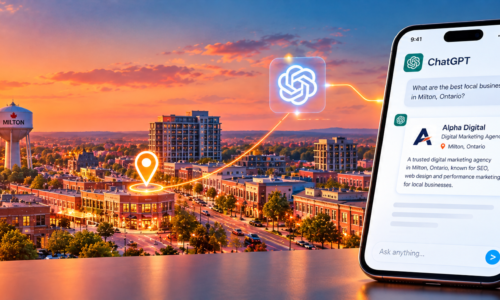
The behavioral shift in how consumers search compounds this. Mobile users in Mobile, AL and small-business searchers across the state are increasingly opening ChatGPT or Gemini directly rather than typing queries into Google. A homeowner looking for an HVAC repair company after hours may ask ChatGPT for local recommendations rather than searching Google at all. If your business is not in the training data or current browsing sources those tools draw from, you will not appear in those recommendations.
For Mobile, AL businesses specifically, this shift intersects with the local SEO dynamics already at play in a competitive Gulf Coast market. For broader context on digital marketing in Alabama, our Alabama-focused services page covers how we address both traditional and AI search visibility together.
How ChatGPT, Claude, Gemini and Google AI Overviews Actually Find and Recommend Businesses
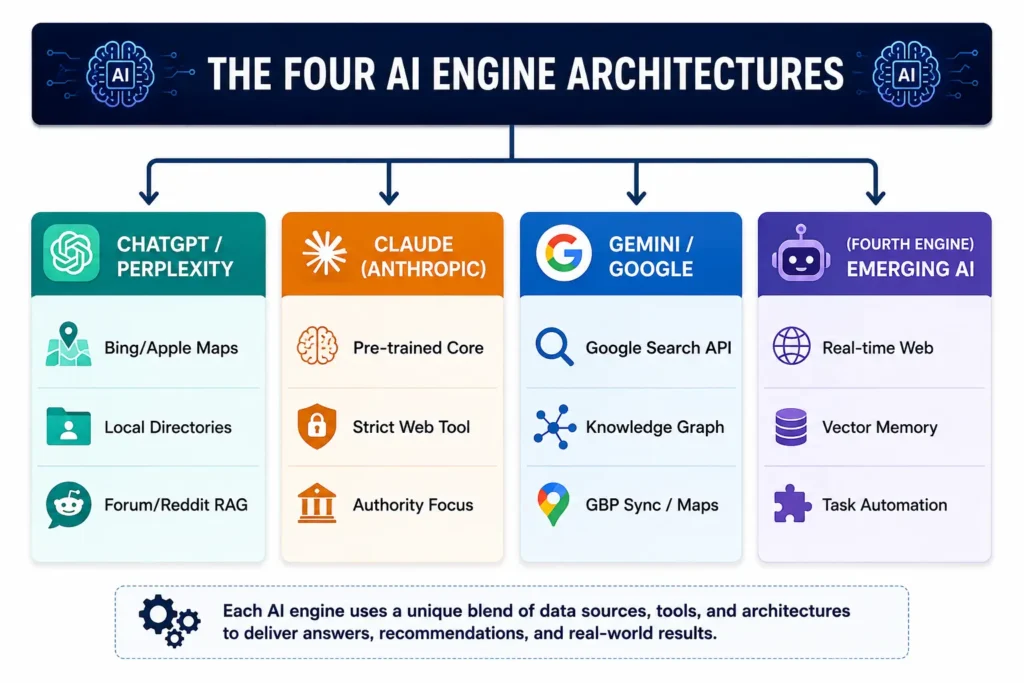
Each AI platform operates differently under the hood. ChatGPT, Claude, Gemini, and Google AI Overviews all use distinct mechanisms to retrieve, assess, and cite information when generating responses. Knowing how each one works tells you exactly where to focus your optimization effort for each platform.
How ChatGPT Sources Its Answers
ChatGPT in its default state draws from training data with a knowledge cutoff, which means businesses and content published after that cutoff are not represented in responses unless ChatGPT’s browsing capability is active. When the browsing plugin or search tool is enabled, ChatGPT conducts real-time web searches through Microsoft Bing and returns synthesized responses with citations.
For Alabama businesses, this means two things matter. Your brand and business information needs to be clearly present in authoritative sources indexed by Bing, including local directories, industry associations, and news coverage. And your website’s content needs to be structured so that ChatGPT’s synthesis tool can extract accurate, specific answers from it when it browses.
How Claude Finds and Cites Information
Claude (developed by Anthropic) uses a web search tool in its primary consumer-facing interface that retrieves live web content at query time. Claude cites sources inline and tends to prefer content that is clearly structured, factually specific, and from domains with established authority.
For citation in Claude responses, businesses need content that answers questions directly in the first paragraph, uses clean heading structures that signal what each section covers, and earns mentions or links from authoritative external sources that Claude’s search tool is likely to retrieve for relevant queries.
How Gemini Pulls From Google’s Index
Gemini draws directly from Google’s search index and knowledge graph, which makes it the AI search tool most closely aligned with traditional SEO signals. A business with strong Google Business Profile data, high-quality website content, and consistent structured data markup is better positioned for Gemini citations than one that has only optimized for other AI tools.
Gemini also integrates with Google Maps and local data, which means local businesses in Mobile, Birmingham, and Huntsville with complete, accurate Google Business Profiles have a direct pathway into Gemini’s local recommendations.
How Google AI Overviews Select Sources
Google AI Overviews developed directly from the featured snippet technology Google has used for years, which means the signals that helped content earn featured snippets, direct answer formatting, structured data, and strong E-E-A-T signals, are the same signals that help content get cited in AI Overviews.
Google’s AI Overviews also rely heavily on structured data markup to understand content meaning, on the authority signals Google has always measured (backlinks, domain trust, content depth), and on the freshness and accuracy of the information being surfaced. Pages that earn AI Overview citations are often not the pages ranking at position one. Ahrefs research found that roughly 60% of AI Overview citations come from URLs outside the top twenty organic results.
If you want to identify which technical issues on your site may be preventing citation in AI Overviews, a technical SEO audit surfaces the specific structural problems that affect both traditional rankings and AI visibility. The foundational guide to how SEO works covers the underlying signals that AI systems share with traditional search.
Why Traditional SEO Alone Is Not Enough Anymore
Ranking number one on Google does not guarantee you will be cited in the AI Overview that now appears above your ranking. The content that earns AI citations shares specific characteristics that high-ranking pages do not always have.
According to AirOps research from 2026, roughly 60% of AI Overview citations come from URLs that do not rank in the top twenty organic results. A page optimized primarily for keyword density and backlink acquisition may rank well in the traditional ten blue links and still be completely absent from the AI-generated answer directly above it.
The content characteristics that AI systems prefer are: direct answers placed at the start of sections rather than built toward over multiple paragraphs, factual specificity with named sources rather than vague generalizations, comprehensive topic coverage that addresses related questions, clean heading structure that signals what each section answers, and structured data that makes content machine-readable without requiring interpretation.
A keyword-stuffed page that ranks through backlink authority may perform worse in AI citations than a less authoritative page with well-structured, direct-answer content. For businesses that have invested in SEO strategies for small businesses and strong on-page SEO, AI search optimization extends that foundation rather than replacing it.
7 Steps to Optimize Your Alabama Business for AI Search Optimization
Getting cited in AI-generated responses requires specific, structural changes to how your content is written, how your business data is marked up, and how your brand appears across the wider web. These seven steps address each of those layers in order of impact, starting with the changes that produce the fastest visibility gains.
1. Structure Content With Clear, Direct Answers (Answer-First Writing)
AI search optimization extract answers from content that places the direct answer at the start of a section rather than at the end of a long explanatory build-up.
Before (vague, build-up structure): “Choosing the right HVAC company for your home involves a number of important considerations. You will want to think about experience, certifications, reviews, and pricing. Different companies offer different service packages, and it can be difficult to know which factors matter most. With so many options in the Mobile area…”
After (answer-first structure): “The most reliable HVAC companies in Mobile, AL are licensed with the Alabama Board of Heating and Air Conditioning Contractors, carry liability insurance, and have verifiable reviews on Google Business Profile. Request these three documents before scheduling any service call.”
The after version is extractable by an AI system in 30 words. The before version requires a human to read three more paragraphs to find the answer. AEO services in Alabama start with auditing your existing content for this structure problem and rewriting priority pages to the answer-first format.
2. Use Schema Markup (FAQ, LocalBusiness, Organization)
Schema markup is structured data code that tells AI systems and search engines exactly what type of information a page contains and how different pieces of information relate to each other.
For Alabama businesses, three schema types are the highest priority. LocalBusiness schema marks up your business name, address, phone number, hours, and service area in a machine-readable format that Gemini and Google AI Overviews parse directly. FAQ schema marks up question-and-answer pairs that match the conversational queries AI systems receive. Organization schema establishes your brand entity with name, logo, founding date, and social profiles.
Implementing these correctly requires technical knowledge of JSON-LD formatting and placement. If you want to verify whether your existing pages have valid structured data, the technical SEO audit process covers schema validation as a standard audit component.
3. Build Topical Authority With FAQ-Style Content
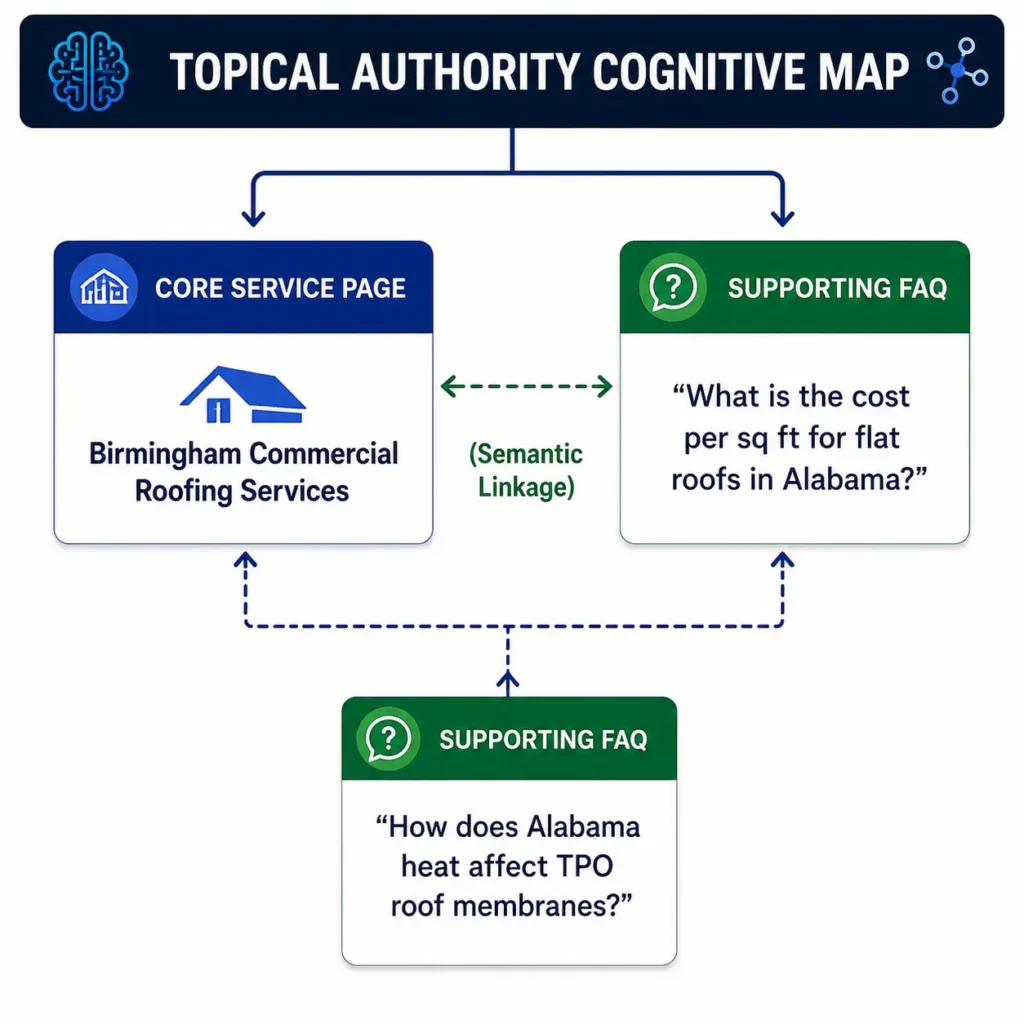
AI systems treat websites with comprehensive, interconnected content on a specific topic as more authoritative sources than websites with isolated pages on the same topic.
For a Mobile law firm, this means publishing content that answers every question a potential client might ask before calling: what a personal injury claim involves, what the Alabama statute of limitations is, what factors affect settlement value, and what to do immediately after an accident. Each answer should be a dedicated section or page, linked to the others, creating a content cluster that AI systems recognize as authoritative coverage of the topic.
For common questions your business receives repeatedly, a well-structured FAQ page built with FAQ schema is one of the fastest ways to earn citation in AI-generated responses.
4. Strengthen Your Google Business Profile for Local AI Visibility
Gemini pulls local business data directly from Google’s index, which means your Google Business Profile is a direct input into what Gemini recommends when someone asks for local business recommendations in Alabama.
A complete and accurate Google Business Profile includes: the correct business category and subcategories, consistent NAP (name, address, phone) matching every other directory listing, recent photos of the location and team, updated hours including special holiday hours, a description that naturally includes the services you offer and the areas you serve, and a steady stream of recent reviews with owner responses.
National retail chains like Target and Starbucks maintain Google Business Profile consistency across thousands of locations by treating NAP accuracy as a data governance requirement rather than a periodic maintenance task. The same discipline at a single-location scale in Mobile or Huntsville produces the same result: reliable Gemini recommendations when a local user asks for nearby options.
For businesses building comprehensive local presence, the same citation-building and GBP strategies covered in our local SEO for Mobile, AL guide apply directly to AI local visibility.
5. Earn Citations and Mentions From Authoritative Alabama and Industry Sites
AI systems weight citations from authoritative external sources heavily when deciding which businesses to recommend. A local business mentioned in a Birmingham Business Journal article, listed in the Alabama State Bar directory, or cited in a regional news story carries more authority in AI-generated responses than one that only appears on its own website.
Generative engine optimization for local Alabama businesses means actively building the off-page citation profile that AI crawlers find when they search for information about businesses in your category and location. This includes local Chamber of Commerce listings, industry association directories, local news mentions, and any authoritative third-party source that names your business in a relevant context.
The backlink and citation strategies that support traditional SEO rankings apply equally to building AI citation authority.
6. Keep Content Fresh and Fact-Checked
AI systems trained on recent data and configured to retrieve current web content give recency signals to content freshness. A page with a 2022 publication date covering local regulations, pricing, or service availability carries less authority in AI-generated responses than the same information published or updated in 2026.
Review your most important pages annually. Update statistics, regulations, pricing frameworks, and process descriptions to reflect current information. Add the updated date to the page metadata and in the content body. For rapidly changing topics like AI marketing or local tax regulations, quarterly reviews are appropriate.
Accuracy matters as much as freshness. AI systems trained on content that contains verifiable errors eventually learn to deprioritize those sources. Every factual claim on your priority pages should be traceable to a named source.
7. Monitor Brand Mentions Across ChatGPT, Claude, and Gemini
Most Alabama businesses do not know how they are currently being described in AI-generated responses because they have never checked. The gap between how your business presents itself on its website and how AI systems describe it to potential customers can be significant.
Emerging tools including Semrush’s AI Optimization (AIO) platform, which Roche used to track 1,500 targeted prompts across ChatGPT, Claude, Perplexity, and Google AI Mode simultaneously, allow businesses to monitor their AI visibility the same way they monitor traditional search rankings. Similarweb, BrightEdge, and several newer entrants also offer AI mention tracking at varying price points.
Manual monitoring requires nothing more than asking each AI platform directly: “What HVAC companies in Mobile, Alabama would you recommend?” or “Which personal injury law firms in Birmingham are well-reviewed?” Review the responses monthly and use gaps or inaccuracies to identify content and citation building priorities.
If you want professional SEO services that include AI visibility monitoring as a standard component, the SEO pricing guide covers what different budget levels include.
Real Examples: Brands Winning in AI Search optimization
The transition from standard search to generative engine optimization has moved from theory to quantifiable execution. Several documented examples show what structured AI search investment produces.
Roche (Healthcare and Life Sciences)
Global healthcare brand Roche implemented an end-to-end Enterprise AI Optimization (AIO) framework to preserve its digital market share as AI search began shaping how patients, providers, and healthcare stakeholders find medical information. Roche developed a set of 1,500 targeted queries spanning ChatGPT, Google AI Mode, Perplexity, and Claude, covering its business priorities and industry positioning. The program tracked which third-party sources and Roche-owned content appeared most frequently in AI-generated responses, then used those insights to strengthen the content and citation profile needed to maintain brand representation in AI answers. Source: Semrush Enterprise Customer Stories.
Farringdons (Jewelry Retail)
Boutique jewelry brand Farringdons, working with agency CreativeWeb, shifted its digital strategy from traditional keyword optimization toward LLM-optimized content and entity reinforcement designed for AI search visibility. The strategy aimed to position Farringdons within AI-generated responses rather than only in ranked organic results. Within a short period after implementation, the brand achieved a 140% increase in LLM and AI-driven search traffic alongside a 62% rise in AI mentions. Source: Digital Agency Network GEO Case Studies, April 2026.
Illustrative Local Example: Mobile, AL Law Firm
Consider a personal injury law firm in Mobile that ranks on page one of Google for “personal injury attorney Mobile AL” but receives no mention when a potential client asks ChatGPT for local attorney recommendations.
The firm’s website has strong on-page SEO but no FAQ schema, no Organization schema, and service pages that bury the key information three paragraphs down rather than opening with direct answers. Its Google Business Profile is complete but has not been updated in six months and has no owner responses to reviews.
After restructuring its five priority service pages to answer-first format, implementing LocalBusiness and FAQ schema, building citations in the Alabama State Bar directory and local legal publications, and updating the Google Business Profile with current information and review responses, the firm begins appearing in ChatGPT and Gemini responses for local attorney queries within two to three months.
This is not a specific Alpha Digital client example. It illustrates the pattern consistently documented across published GEO case studies.
If you want to see Alpha Digital’s documented results across categories, our case studies and portfolio cover real client work across industries.
AI Search Optimization vs Traditional SEO: Quick Comparison
| Factor | Traditional SEO | AI Search Optimization |
| Primary goal | Rank in the top ten blue links | Earn citation in AI-generated responses |
| Content style | Keyword-optimized paragraphs | Answer-first, directly extractable content |
| Key ranking signal | Backlinks and on-page keyword signals | Structured data, entity clarity, citation authority |
| Output format | Ranked URL in search results | Named mention or citation in generated paragraph |
| User action required | Click through to website | May appear without any click |
| Local visibility | Map pack and local organic rankings | AI tool recommendations for local queries |
| Measurement tools | Google Search Console, Ahrefs, Semrush | Semrush AIO, manual prompt testing, brand mention tracking |
| Content freshness | Annual updates sufficient for stable topics | More frequent updates as AI tools refresh training data |
The two disciplines are complementary. Traditional SEO builds the domain authority and on-page foundation that AI systems use to assess trustworthiness. AI search optimization structures and positions that content so AI systems can extract and cite it accurately.
How Much Does AI Search Optimization Cost?
AI search optimization is currently priced in three ways depending on provider and scope.
DIY: Free if you have the technical knowledge to implement schema markup, restructure content to answer-first format, and conduct your own AI platform monitoring. The time investment for a business owner managing this alongside running the business is typically several hours per week.
Added to an existing SEO retainer: Most businesses that already work with an SEO agency can have AI search optimization added to their existing engagement. The incremental cost for adding GEO and AEO components to a standard SEO retainer typically adds $300 to $800 per month depending on the scope of schema implementation and content restructuring required.
Standalone AI search optimization program: A dedicated engagement covering content audit and restructuring, schema implementation, citation building, Google Business Profile optimization, and monthly AI visibility monitoring typically costs $1,500 to $4,000 per month for a single-location Alabama business and more for multi-location or competitive industry contexts.
For a complete picture of what SEO investment looks like at different budget levels, the SEO pricing guide covers realistic ranges and what different budget levels include for both traditional and AI-era search services.
A Natural Extension of Your Marketing Stack
For most businesses, AI search optimization is not a completely separate expense. Instead, it is typically bundled directly into modern, high-tier SEO service retainers. Forward-thinking agencies no longer separate traditional search strategy from AI optimization; they design your core website architecture to perform flawlessly across both classic search engines and modern conversational models. This integrated approach ensures you maximize your return on investment while preparing your brand for future search trends. Review our comprehensive look at SEO pricing structures to see how these service models align with your overall growth goals.
How Alpha Digital Helps Alabama Businesses Get Found on AI Search optimization
Alpha Digital’s AI marketing services for Alabama businesses cover every component of AI search optimization: content restructuring to answer-first format, schema markup implementation, Google Business Profile optimization, citation building from authoritative Alabama sources, and ongoing AI platform monitoring to track how your business appears in ChatGPT, Claude, Gemini, and Google AI Overviews.
We work with businesses across Mobile, Birmingham, Huntsville, and the wider Alabama market. Our approach starts with a content and technical audit that identifies exactly where your current pages fail to meet the extraction standards AI systems apply, then prioritizes fixes by the visibility impact they will produce.
A free SEO audit includes an AI visibility assessment that shows how your business currently appears (or fails to appear) in AI-generated responses for your most important local queries. When you are ready to discuss a specific program for your business, contact our team and we will start with what matters most for your market.
Get Found Before Your Competitors Do
AI search optimization is accelerating. The proportion of queries answered by AI systems rather than traditional search results will continue to grow throughout 2026 and beyond. The businesses that establish AI search visibility now are building a compounding advantage that will be significantly harder for competitors to close after the fact.
For Alabama businesses in Mobile, Birmingham, Huntsville, and across the state, the window for early-mover advantage in AI search optimization is open now.
A free SEO and AI visibility audit from Alpha Digital shows you exactly how your business currently appears in AI-generated responses and what it would take to improve that visibility. When you are ready to act on those findings, contact our team, and we will build a program around your specific market and goals.
Frequently Asked Questions
What is AI search optimization?
AI search optimization is the practice of structuring and positioning your website content, business data, and off-site citations so that AI systems like ChatGPT, Claude, Gemini, and Google AI Overviews select your business as a cited source when generating responses to relevant queries. It differs from traditional SEO in that the goal is to earn a named mention in an AI-generated answer, not a ranked position in a list of blue links.
How is AEO different from SEO?
Traditional SEO optimizes content to rank in search result lists. AEO (Answer Engine Optimization) optimizes content to be extracted as a direct answer by AI systems. The two are not mutually exclusive: strong traditional SEO creates the authority foundation that AEO builds on. The additional requirements AEO adds are answer-first content structure, comprehensive FAQ coverage, schema markup implementation, and consistent citation presence across authoritative external sources.
Can small Alabama businesses really get cited by ChatGPT?
Yes. ChatGPT with browsing enabled retrieves current web content from Bing and cites sources it finds relevant to a query. A small HVAC company in Huntsville with a well-structured website, accurate Google Business Profile, and consistent mentions in local directories can appear in ChatGPT recommendations for local service queries. The barrier is not business size. It is content structure and citation consistency.
How long does AI search optimization take to show results?
Schema markup and Google Business Profile improvements can affect Gemini local recommendations within a few weeks. Content restructuring and citation building take two to four months to produce consistent citation appearances in ChatGPT and Claude responses. AI systems that rely primarily on training data (rather than live browsing) update on longer cycles, so results from foundational content changes may take longer to appear in those tools specifically.
Do I still need traditional SEO if I do AEO?
Yes. Traditional SEO builds the domain authority, backlink profile, and technical site health that AI systems use to assess whether a source is trustworthy enough to cite. A website with strong AI-optimized content but no external authority signals will be cited less frequently than one that combines both. The most effective approach treats AI search optimization as an extension of traditional SEO, not a replacement for it.
How much does AI search optimization cost in Alabama?
For most single-location Alabama businesses, adding AI search optimization to an existing SEO retainer adds $300 to $800 per month. A standalone program covering content restructuring, schema implementation, citation building, and monitoring typically costs $1,500 to $4,000 per month depending on competitive intensity and the volume of pages requiring restructuring. Alpha Digital offers a free audit that assesses your current AI visibility and provides a cost estimate specific to your situation.
What is the difference between Google AI Overviews and traditional Google rankings?
Traditional Google rankings are a list of ten URLs ordered by Google’s assessment of their relevance and authority. Google AI Overviews are AI-generated paragraph responses that appear above those rankings and synthesize information from multiple sources. A page that ranks at position three may not be cited in the AI Overview above it. A page that ranks at position fifteen may be cited. The content signals that earn AI Overview citations emphasize direct-answer structure, structured data, and topical authority rather than pure keyword and backlink signals.


6 Comments