
Writing content that ranks on Google can feel confusing, especially if you are new to SEO. Fortunately, tools like ChatGPT can make the process faster and more efficient. ChatGPT can help you generate ideas, create outlines, develop headings, improve drafts, and support different parts of your SEO workflow.
However, AI should support your strategy rather than replace human expertise. Effective SEO content still needs accurate information, genuine value, strong search intent alignment, editing, and a clear understanding of the audience.
This beginner’s guide explains how to use ChatGPT for content creation and SEO while maintaining quality, accuracy, and strong E-E-A-T signals.
Why Use ChatGPT for SEO and Content Creation?
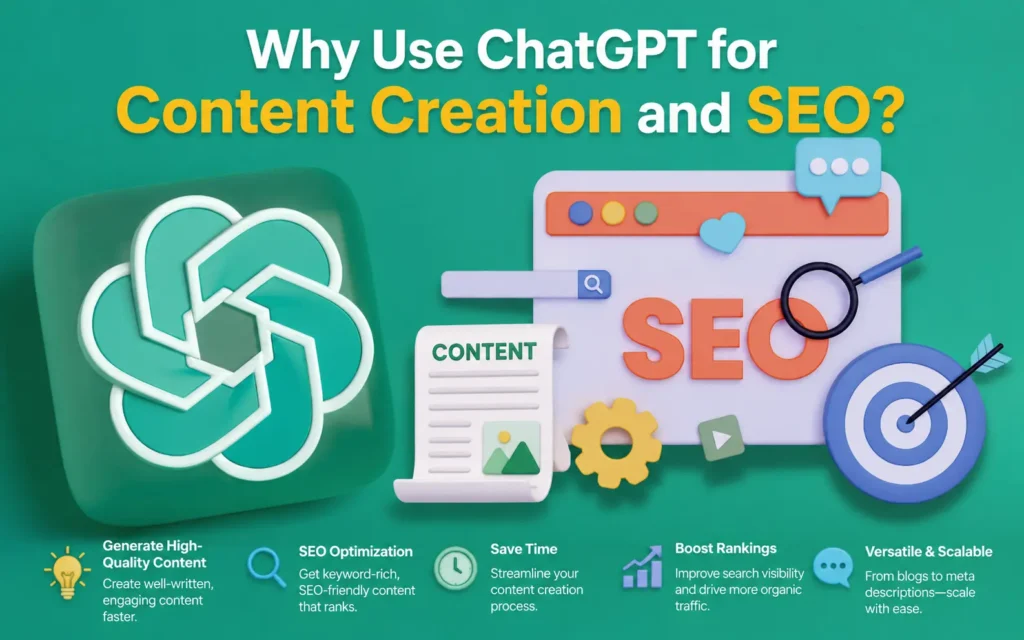
Using ChatGPT for SEO content can provide several benefits. It can reduce the time required for research and drafting while helping content teams maintain consistency across multiple articles and pages.
Here are some reasons:
First, It Helps You Save Time
Instead of staring at a blank page for hours, you can quickly get ideas, outlines, and even full paragraphs. This is especially useful if you create content regularly, like blog posts or web pages.
Second, ChatGPT Can Improve Your SEO
ChatGPT can help you organize keywords and identify ways to incorporate them naturally into your content.
You can provide your primary keyword and related terms and ask for suggestions for headings, FAQs, supporting topics, and content gaps.
However, keyword placement should never come before search intent. Your goal should be to create the most useful resource for the searcher rather than repeating a keyword unnecessarily.
For a broader understanding of optimization, you can also explore this guide to on page SEO strategies.
Third, It Helps With Creativity
Sometimes, coming up with new ideas or fresh ways to explain a topic can be hard. ChatGPT can provide suggestions that you might not have thought of, helping you make your content more engaging.
Finally, ChatGPT Supports Consistency
If you need multiple pieces of content that sound similar or follow a specific tone, the AI can help maintain that style across all your posts.
Step-by-Step Guide to Creating SEO-Friendly Content with ChatGPT
Creating SEO-friendly content with ChatGPT is easier than it sounds. By following a few simple steps, you can generate high-quality content that ranks well on Google. Here’s how to get started:
Keyword Research Integration
Keywords are the foundation of SEO. Before you start writing, make a list of target keywords you want to rank for. You can use tools like Google Keyword Planner, Ahrefs, or SEMrush to find popular and relevant keywords. Once you have your keywords, include them in your ChatGPT prompts.
For example, you can ask ChatGPT, “Write a blog post about [keyword] that is easy to read and SEO-friendly.” This helps the AI understand your focus and generate content that naturally includes your keywords.
Generating Blog Outlines and Headlines
One of the most useful features of ChatGPT is its ability to create outlines. You can ask it to suggest headings, subheadings, and structure for your article.
For example, a prompt could be, “Create an outline for a blog about [keyword] with H2 and H3 headings.” This saves time and ensures your content is organized and readable. You can also ask ChatGPT for multiple headline options to pick the most engaging one for your audience.
Writing High-Quality, Optimized Content
After creating your outline, ChatGPT can help expand each section into a first draft.
Give the tool specific instructions about your target audience, tone, content depth, terminology, examples, and primary keyword.
However, do not treat the first AI-generated draft as the finished article.
Review the content carefully and add your own expertise, examples, data, opinions, case studies, experiences, and relevant sources. These additions can make the content more useful and demonstrate genuine expertise.
You can also use ChatGPT to draft supporting SEO elements such as:
- SEO title ideas
- Meta descriptions
- FAQ questions
- Image alt text
- Internal link suggestions
- Content briefs
- Content refresh ideas
- Social media captions
For a complete overview of SEO fundamentals, you can also read what SEO is and why it is important.
Editing and Fact-Checking AI-Generated Content
Even though ChatGPT is powerful, it is not perfect. Always review the content for grammar, accuracy, and SEO optimization. Fact-check statistics, examples, and claims before publishing.
You can also improve the readability and tone to match your brand voice. Editing ensures your content is trustworthy and maintains high EEAT standards.
Tools and Plugins to Enhance ChatGPT for SEO
Using ChatGPT for SEO content becomes even more powerful when you combine it with the right tools and plugins. These tools can help you plan, optimize, and track your content for better search rankings.
Here are some of the best options:
1. SurferSEO
SurferSEO analyzes top-ranking pages and helps you optimize your content for keywords, structure, and length. You can use ChatGPT to generate content and then plug it into SurferSEO to make sure it matches SEO best practices.
2. Ahrefs
Ahrefs is great for keyword research, backlink tracking, and competitor analysis. You can use it to find high-potential keywords and then feed those keywords into ChatGPT prompts to generate targeted content.
3. SEMrush
SEMrush offers a full suite of SEO tools, from keyword research to content audit. You can use it to identify content gaps, track your rankings, and refine your ChatGPT-generated content to improve SEO performance.
4. Grammarly or Hemingway Editor
While ChatGPT produces readable text, tools like Grammarly or Hemingway Editor help you polish grammar, readability, and tone. This ensures your content is professional, clear, and engaging.
5. SEO Plugins for CMS
If you publish content through WordPress, plugins such as Yoast SEO and Rank Math can help manage titles, meta descriptions, sitemaps, schema, and other SEO elements.
ChatGPT can assist with drafting these elements, but they should still be reviewed and implemented according to the specific requirements of each page.
You can also explore our guide to key on page SEO strategies for a broader optimization workflow.
Common Mistakes to Avoid When Using ChatGPT for SEO
While ChatGPT is a powerful tool, beginners often make mistakes that can hurt their SEO results. Here are some common mistakes you should avoid:
1. Over-Reliance on AI
ChatGPT can generate content quickly, but it cannot replace your expertise. Always review and refine the content to ensure it is accurate, trustworthy, and aligned with your brand voice.
2. Ignoring Search Intent
Your content should match what people are actually searching for. Even if ChatGPT produces a well-written article, it may not fully consider the searcher’s intent. Always adjust the content to meet the needs of your audience.
3. Neglecting On-Page SEO Elements
Keywords alone are not enough. Make sure to optimize meta titles, meta descriptions, headings, and internal links. ChatGPT can help draft these, but you must implement them correctly for SEO success.
4. Publishing Without Editing
Never publish AI-generated content as-is. Fact-check all information, correct grammar, and improve readability. Editing ensures your content is professional, reliable, and aligns with Google’s EEAT standards.
Final Thoughts
Using ChatGPT for SEO content can save time, support creativity, and make content production more efficient. However, the strongest results come from combining AI with proper keyword research, search intent analysis, human expertise, fact-checking, editing, and a strong internal linking strategy.
ChatGPT should help you work faster, not remove the human element from your content.
Use AI to generate ideas, organize information, create initial drafts, identify optimization opportunities, and support repetitive tasks. Then use your own expertise to improve the content and make it genuinely valuable.
When AI and human expertise work together, you can create content that is useful for readers, aligned with search intent, and better prepared for modern search.
If you want to strengthen your overall SEO strategy, explore our SEO services to see how professional SEO can support content, technical optimization, keyword research, and organic growth.
FAQs
Can ChatGPT replace human content writers for SEO?
No. ChatGPT is a tool that helps generate content faster, but it cannot replace human expertise. Editing, fact-checking, and ensuring accuracy are still essential for high-quality SEO content.
How accurate is ChatGPT for SEO content creation?
ChatGPT can create readable and structured content, but it may occasionally provide incorrect facts or miss context. Always verify information and adjust the content for search intent.
What are the best prompts to use ChatGPT for SEO content?
Effective prompts include your target keyword, desired content length, and tone. For example, “Write a 1000-word blog post about [keyword] for beginners with SEO-friendly headings.”
Is ChatGPT free for content creation?
There is a free version of ChatGPT with limited features, but using paid plans or API access provides more advanced capabilities and longer content generation.
Can ChatGPT help with keyword research?
Yes, ChatGPT can suggest related keywords, long-tail phrases, and content ideas. However, pairing it with SEO tools like Ahrefs or SEMrush ensures more accurate and data-driven keyword research.

5 Comments