
Choosing the best social media marketing agency can have a major impact on your brand’s visibility, reputation, customer engagement, and revenue. With businesses competing for attention across Instagram, Facebook, LinkedIn, TikTok, YouTube, and other platforms, simply posting regularly is no longer enough.
The right agency should understand your audience, industry, competitors, business objectives, content requirements, advertising opportunities, and performance data. More importantly, it should be able to connect social media activity with measurable business outcomes.
The wrong agency can do the opposite. Poorly targeted campaigns, generic content, inconsistent communication, inflated engagement numbers, and unclear reporting can consume your marketing budget without producing meaningful growth.
That is why choosing a social media marketing agency should be treated as a strategic business decision rather than simply comparing monthly prices.
This guide explains the 10 most important steps to help you evaluate agencies, ask the right questions, compare proposals, identify warning signs, and select a partner that can support sustainable brand growth.
What Does a Social Media Marketing Agency Do?
A social media marketing agency helps businesses build, manage, and grow their presence across social media platforms.
Depending on the agency and your requirements, its services may include social media strategy, content creation, graphic design, video production, community management, influencer marketing, paid social advertising, social media optimization, analytics, reporting, and campaign management.
A professional agency should not simply ask, “What should we post today?”
It should ask:
Who are we trying to reach?
What problem does the audience have?
What makes the brand different?
Which platforms matter most?
What type of content supports the customer’s journey?
What business result should social media generate?
How will performance be measured?
This strategic approach separates professional social media marketing from simply maintaining a social media account.
For businesses looking at the wider picture, a coordinated digital marketing strategy can connect social media with SEO, paid advertising, content marketing, conversion optimization, and other acquisition channels.
Why Choosing the Right Social Media Marketing Agency Matters
Social media is often one of the first places potential customers encounter a brand.
A customer might see an Instagram Reel, visit your profile, read customer comments, click through to your website, compare your products with competitors, and eventually make a purchase.
That means your social media presence contributes to several stages of the customer journey.
A capable agency can help you:
- Increase brand awareness
- Build a recognizable brand identity
- Generate qualified leads
- Improve audience engagement
- Increase website traffic
- Support product launches
- Generate sales
- Strengthen customer relationships
- Manage online reputation
- Improve paid advertising performance
- Turn existing content into social assets
- Measure marketing performance
However, these outcomes depend heavily on the agency’s strategy, experience, execution, communication, and ability to understand your business.
The following 10 steps can help you evaluate those qualities before signing a contract.
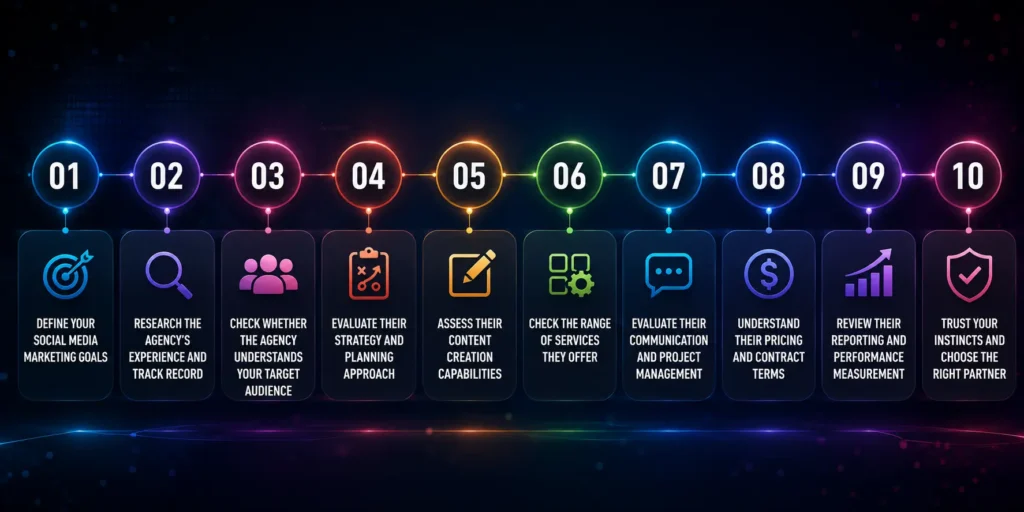
1. Define Your Social Media Marketing Goals
Before searching for a Social Media Marketing Agency, define what you actually want social media to achieve.
An agency cannot create an effective strategy if your business has not established clear objectives.
For example, your primary goal might be:
- Increasing brand awareness
- Generating qualified leads
- Increasing ecommerce sales
- Growing website traffic
- Building an online community
- Increasing engagement
- Promoting a new product
- Improving customer retention
- Supporting local business growth
- Establishing thought leadership
Your goals should influence the agency you choose.
A company focused heavily on ecommerce sales may need an agency experienced in product advertising, conversion optimization, catalog campaigns, retargeting, and creative testing.
A B2B technology company may require a completely different approach centered around LinkedIn, thought leadership, lead generation, case studies, and educational content.
Do not begin the selection process by asking, “How many posts will you create?”
Start by asking, “What business outcome are we trying to achieve?”
That question immediately changes the quality of the conversation.
Set Measurable Social Media KPIs
Your Social Media Marketing Agency should help translate broad objectives into measurable key performance indicators.
Depending on your goal, these could include:
- Qualified leads
- Cost per lead
- Conversion rate
- Revenue generated
- Return on ad spend
- Website sessions
- Profile visits
- Engagement rate
- Video watch time
- Saves and shares
- Follower growth
- Click-through rate
Follower count can be useful, but it should rarely be your only success metric.
A brand with 10,000 highly relevant followers can generate more business than an account with 100,000 followers who have little interest in the company’s products or services.
2. Research the Agency’s Experience and Track Record
Experience should be evaluated carefully rather than accepted at face value.
Look at the agency’s website, portfolio, case studies, client industries, team expertise, and published content.
An agency that claims to specialize in social media should be able to demonstrate how it has approached real marketing challenges.
Look for evidence such as:
- Previous campaigns
- Client case studies
- Before-and-after performance
- Creative examples
- Industry-specific experience
- Testimonials
- Strategy examples
- Advertising results
- Content campaigns
- Long-term client relationships
A portfolio shows what an agency has produced. A case study should ideally explain why it produced it and what happened afterward.
For example, “We created 30 Instagram posts” tells you very little.
“We redesigned the content strategy around educational Reels, customer proof, and product demonstrations and measured the resulting increase in qualified traffic” gives you much more useful information.
You can also review an agency’s portfolio and previous digital projects to understand the types of brands and marketing challenges it has worked with.
Industry Experience Is Valuable, But Not Everything
An Social Media Marketing Agency does not necessarily need to have worked exclusively within your industry.
Strategic marketing skills can transfer between industries.
However, industry experience becomes particularly useful when your business has:
- Complex regulations
- A specialized audience
- Long sales cycles
- Highly technical products
- Local market requirements
- Strong competition
- Strict brand guidelines
Ask the agency what it learned from previous clients rather than simply asking how many clients it has served.
3. Check Whether the Agency Understands Your Target Audience
A social media strategy should be audience-first.
Before recommending content or advertising campaigns, an agency should want to understand your customers.
A strong agency will ask questions about:
- Customer demographics
- Geographic markets
- Buying behavior
- Customer pain points
- Purchase motivations
- Existing customers
- Competitors
- Average order value
- Sales cycle
- Customer objections
- Preferred communication channels
For example, a fashion retailer targeting young consumers may rely heavily on short-form video, creator collaborations, visual storytelling, and user-generated content.
A B2B software company selling enterprise solutions may need educational content, LinkedIn thought leadership, webinars, customer case studies, and lead-generation campaigns.
The platforms may overlap, but the strategy should not be identical.
Ask How They Conduct Audience Research
Do not settle for “We know your audience.”
Ask how they know.
An agency might use:
- Existing customer data
- Social media analytics
- Competitor research
- Search behavior
- Customer interviews
- Website analytics
- Social listening
- Advertising data
- Industry research
This demonstrates whether the strategy is based on evidence or assumptions.
4. Evaluate the Agency’s Content Strategy
Content is at the center of social media marketing.
However, effective content is not simply a collection of attractive graphics.
Your agency should be able to explain what each content type is designed to accomplish.
For example:
Educational content can establish expertise.
Customer stories can build trust.
Product demonstrations can reduce purchase uncertainty.
Behind-the-scenes content can humanize the brand.
Short-form videos can increase discovery.
Testimonials can provide social proof.
Interactive content can encourage engagement.
Promotional content can support conversions.
A strong strategy balances these purposes instead of turning every post into an advertisement.
If you want to understand how content fits into a wider marketing strategy, explore this guide on creating engaging social media content.
Ask for a Content Calendar Example
Before signing a contract, ask the agency to show you an example of how it would structure content.
You do not necessarily need a complete month of custom content before hiring them.
Instead, ask for a strategic example showing:
- Content themes
- Platform differences
- Posting frequency
- Content formats
- Campaign integration
- Promotional balance
- Calls to action
- Content objectives
The purpose is to determine whether the agency has a repeatable strategy rather than simply a list of post ideas.
5. Evaluate Their Platform-Specific Expertise
Different social platforms behave differently.
An agency should understand those differences instead of publishing identical content everywhere.
Instagram is highly visual and can be effective for brands using Reels, Stories, carousels, creator collaborations, product content, and community engagement.
Facebook can remain valuable for community building, local businesses, older demographics, retargeting, groups, and paid advertising.
LinkedIn is particularly important for B2B companies, professional services, recruitment, technology, consulting, and thought leadership.
TikTok
TikTok can be powerful for discovery and short-form entertainment, educational content, trends, product demonstrations, and creator-led campaigns.
YouTube
YouTube provides opportunities for both long-form educational content and short-form video through YouTube Shorts.
The right agency should recommend platforms according to your audience and objectives rather than trying to force your business onto every available network.
Being active on five platforms is not automatically better than being excellent on two.
6. Ask How They Measure Social Media Performance
One of the most important questions to ask a social media marketing agency is:
“How will you prove that your work is producing results?”
A professional agency should have a clear reporting process.
Reports may include:
- Reach
- Impressions
- Engagement
- Follower growth
- Website traffic
- Leads
- Conversions
- Revenue
- Cost per acquisition
- Advertising spend
- Return on ad spend
- Video performance
- Audience growth
However, the numbers should be connected to your business objectives.
For example, if your goal is lead generation, reporting thousands of impressions without showing qualified leads does not provide a complete picture.
Beware of Vanity Metrics
Vanity metrics can look impressive without necessarily contributing to business growth.
Examples include:
- Large numbers of impressions with no conversions
- Follower growth from irrelevant audiences
- High likes but low website traffic
- Viral content unrelated to the product
- Engagement from users outside the target market
These metrics are not useless, but they should be interpreted in context.
A good agency should explain what the numbers mean and what it intends to change based on the results.
7. Understand Their Paid Social Advertising Capabilities
Organic social media and paid advertising can complement each other.
If your agency also manages paid campaigns, evaluate its experience with:
- Meta Ads
- Instagram advertising
- LinkedIn Ads
- TikTok Ads
- YouTube advertising
- Retargeting
- Lookalike audiences
- Conversion tracking
- Creative testing
- Landing page optimization
- Budget allocation
Ask how the agency tests advertising creative.
A professional paid social strategy may involve testing different:
- Hooks
- Headlines
- Images
- Videos
- Offers
- Calls to action
- Audience segments
- Landing pages
The objective is not simply to spend more money.
It is to understand which combinations generate the strongest business results.
For businesses combining paid social with search advertising and other channels, a broader performance digital marketing strategy can create a more connected acquisition system.
8. Examine Communication, Reporting, and Account Management
Even an excellent strategy can fail if communication is poor.
Before signing, determine:
Who will manage my account?
Who creates the content?
Who approves posts?
How frequently will we communicate?
How quickly will questions be answered?
How are urgent issues handled?
How often will strategy meetings happen?
What happens if our priorities change?
You should know who is responsible for your account and how information will move between your business and the agency.
Establish an Approval Process
A clear approval workflow prevents unnecessary delays.
For example:
- Agency develops the content plan.
- Creative assets are produced.
- Content is submitted for review.
- Client provides feedback.
- Revisions are completed.
- Final content is approved.
- Content is scheduled or published.
- Performance is measured.
The exact process can vary, but responsibilities should be clear.
9. Review Pricing, Contracts, and What Is Actually Included
Price matters, but comparing agencies only by monthly cost can be misleading.
Two agencies charging different amounts may be offering completely different levels of service.
A proposal should clearly explain what you receive.
Look for details about:
- Strategy
- Number of platforms
- Number of posts
- Reels or video production
- Graphic design
- Copywriting
- Community management
- Paid advertising
- Influencer campaigns
- Reporting
- Account management
- Meetings
- Content revisions
- Photography or video production
- Ad spend
- Contract length
Most importantly, determine what is not included.
For example, an agency may charge a management fee while advertising spend is billed separately.
Another agency may include creative production but charge additional fees for video shoots.
These details should be clear before you sign.
Do Not Automatically Choose the Cheapest Agency
The cheapest proposal may appear attractive initially but can become expensive if it produces little value.
Instead, compare:
Cost → Scope → Expertise → Strategy → Execution → Reporting → Expected business outcome
A higher-priced agency can potentially deliver greater value if its strategy produces stronger results.
Likewise, a more expensive agency is not automatically better.
The goal is to find the strongest relationship between investment and expected business value.
10. Look for a Long-Term Strategic Partner
The final step is to determine whether the agency can grow with your business.
Social media marketing is rarely a one-month project.
Your audience changes.
Platforms change.
Algorithms change.
Competitors launch campaigns.
New content formats appear.
Customer expectations evolve.
Your business itself may also change.
The agency should therefore be capable of testing, learning, and adapting.
Ask what happens after the first 90 days.
A strong agency should be able to explain how it will:
- Analyze initial results
- Identify winning content
- Remove ineffective approaches
- Test new creative concepts
- Refine audiences
- Improve advertising campaigns
- Expand successful campaigns
- Adjust the content calendar
- Connect social performance with broader marketing goals
The objective should be continuous improvement rather than simply completing a monthly posting quota.
How to Compare Social Media Marketing Agencies
Once you have shortlisted several agencies, create a simple evaluation framework.
Consider scoring each agency from one to five across:
| Evaluation Area | What to Look For |
| Strategy | Clear connection between social activity and business goals |
| Experience | Relevant portfolio and proven campaign experience |
| Content | Strong creative quality and strategic thinking |
| Audience Research | Evidence-based understanding of customers |
| Platform Expertise | Platform-specific strategies |
| Paid Advertising | Testing, tracking, optimization, and conversion focus |
| Reporting | Clear business-focused metrics |
| Communication | Defined account management and response process |
| Pricing | Transparent scope and fees |
| Long-Term Fit | Ability to adapt and scale |
The agency with the highest score is not automatically the right choice.
Use the framework to identify strengths, weaknesses, and questions that require clarification.
Questions to Ask Before Hiring a Social Media Marketing Agency
Before signing an agreement, ask these questions:
What is your process for developing a social media strategy?
Look for an answer involving research, audience analysis, competitor analysis, positioning, content planning, execution, measurement, and optimization.
Which social platforms do you recommend for our business and why?
The agency should explain its recommendation based on your customers and goals.
How do you measure success?
The answer should go beyond follower growth and likes.
Can you show examples of results from previous clients?
Look for measurable outcomes and context rather than generic testimonials.
Who will manage our account?
You should know who is responsible for strategy, content, communication, and reporting.
How much content will you create each month?
Clarify formats and platforms rather than only counting posts.
Do you manage paid advertising?
If yes, ask whether ad spend is separate from the management fee.
How do you handle negative comments or customer complaints?
This is particularly important for businesses with active communities.
How often will we receive reports?
Understand what information will be provided and how often.
How do you adapt when a campaign does not work?
The agency should have a testing and optimization process rather than simply continuing the same approach.
Red Flags to Watch for When Choosing an Agency
Not every agency is equally reliable.
Be cautious if an agency:
Guarantees Viral Content
No legitimate agency can guarantee that a specific post will go viral.
Content performance depends on audience behavior, platform distribution, creative quality, timing, competition, and many other variables.
Guarantees a Specific Number of Followers
Follower guarantees can encourage low-quality acquisition tactics.
Relevant audience growth is much more valuable than an arbitrary follower target.
Focuses Only on Vanity Metrics
If the agency talks constantly about likes and followers but cannot explain how its work generates leads, sales, traffic, or brand value, ask deeper questions.
Uses the Same Strategy for Every Client
Your industry, audience, positioning, competitors, budget, and objectives are unique.
A copied content calendar is not a strategy.
Cannot Explain Its Reporting
You should understand what is being measured and why.
Hides Contract Terms
Pricing, deliverables, ownership, cancellation terms, advertising spend, and revision limits should be transparent.
Promises Instant Results
Some social campaigns can produce rapid results, particularly paid advertising, but sustainable brand growth normally requires testing and consistent execution.
Social Media Marketing Agency Should Work With SEO and Content Marketing
Social media should not operate as an isolated marketing channel.
Your social strategy can support other digital channels by distributing blog content, promoting landing pages, strengthening brand awareness, supporting campaigns, and generating audience insights.
For example, a business might publish an SEO-focused article, turn the key insights into LinkedIn posts, create an Instagram carousel, produce a short video, and use paid social to promote the strongest-performing content.
This creates more value from one piece of research and keeps messaging consistent across channels.
A strong SEO strategy can also help your website capture organic search traffic while social media increases awareness and engagement.
For businesses that want to understand the wider role of social media, social media management can become part of a broader marketing system rather than a standalone posting service.
How AI Is Changing Social Media Marketing Agency
Artificial intelligence is changing how agencies research audiences, generate content ideas, analyze performance, personalize campaigns, and automate repetitive workflows.
AI can help marketing teams:
- Generate content variations
- Analyze large datasets
- Identify audience patterns
- Create campaign concepts
- Automate reporting
- Repurpose existing content
- Assist with customer responses
- Identify content opportunities
- Support advertising optimization
However, AI should support strategy rather than replace human judgment.
A strong agency combines technology with creative thinking, brand knowledge, editorial judgment, and audience understanding.
Businesses interested in the broader application of AI can also explore AI automation services for small and medium businesses to understand how automation can extend beyond social media.
What Should a Good Social Media Strategy Include?
A comprehensive strategy should normally include:
Brand Positioning
What does your brand stand for and why should customers choose you?
Audience Definition
Who are you trying to reach?
Competitive Research
What are competitors doing successfully and where are the opportunities?
Platform Selection
Where does your audience spend time?
Content Pillars
What recurring subjects will your brand discuss?
Content Formats
Which combination of Reels, videos, carousels, images, Stories, articles, and other formats makes sense?
Publishing Schedule
When and how frequently will content be published?
Community Management
How will comments, messages, reviews, and mentions be handled?
Paid Advertising
Which campaigns will support awareness, consideration, and conversion?
Measurement
Which KPIs determine whether the strategy is working?
Optimization
How will the strategy change based on performance data?
This framework helps turn social media from random activity into a structured marketing channel.
How Long Does It Take to See Social Media Marketing Agency Results?
There is no universal timeline.
Results depend on your industry, audience size, competitive environment, content quality, advertising budget, existing brand awareness, offer, website experience, and strategy.
Organic social media growth generally requires consistent publishing and community building.
Paid advertising can generate traffic and leads much faster, but performance still depends on creative quality, targeting, offer strength, tracking, and conversion experience.
The most useful approach is to establish a baseline before the campaign begins and measure improvement over time.
Instead of asking only, “How many followers will we gain?”
Ask:
“How will our business performance change over the next three, six, and twelve months?”
Should You Hire a Social Media Marketing Agency or Build an In-House Team?
Both options can work.
An in-house team gives you direct control and can be valuable when social media is central to your daily operations.
An agency provides access to multiple skill sets without requiring you to hire separate specialists for strategy, design, copywriting, video, paid advertising, analytics, and community management.
The right choice depends on your budget, internal resources, business stage, and marketing complexity.
Some companies also use a hybrid model where internal employees provide brand knowledge while an external agency provides strategy, creative production, advertising, or specialized expertise.
Why a Full-Service Digital Marketing Partner Can Be Valuable
Social Media Marketing Agency rarely exists independently from other marketing channels.
A customer might discover your brand through Instagram, search for your company on Google, visit your website, read a blog, see a retargeting advertisement, and finally contact your sales team.
If every channel is managed independently, the customer experience can become fragmented.
A full-service partner can coordinate social media with SEO, paid advertising, content marketing, website development, AI automation, and conversion optimization.
For businesses looking for this broader approach, Alpha Digital’s digital marketing services combine multiple channels into a coordinated growth strategy.
Why Choose Alpha Digital for Social Media Marketing Agency?
Choosing an agency should ultimately come down to whether its capabilities match your business needs.
Alpha Digital approaches digital marketing as a connected growth system rather than treating social media as an isolated posting service. Its broader services include digital marketing, SEO, advertising, content, AI, web development, and related growth solutions.
The agency’s digital marketing offering includes social media management, content creation, advertising, email marketing, PPC, influencer marketing, and conversion optimization, allowing businesses to coordinate social campaigns with other acquisition channels.
Its portfolio also includes work across different industries and business types, which can be useful when evaluating whether an agency has experience adapting strategies to different audiences and commercial objectives.
For businesses considering AI alongside marketing, Alpha Digital also develops AI automation systems that can support marketing workflows, reporting, lead qualification, and social content processes.
The important point is not simply choosing an agency because it offers many services. The right partner should demonstrate how those services connect to your specific objectives and how performance will be measured.
Final Thoughts
Choosing the best social media marketing agency requires more than comparing prices or looking at the number of followers an agency has generated for previous clients.
The right partner should understand your business, research your audience, develop a platform-specific strategy, create valuable content, manage campaigns professionally, measure meaningful results, communicate clearly, and continuously improve its approach.
The 10 steps in this guide give you a practical framework:
- Define your social media goals.
- Research the agency’s experience.
- Evaluate its understanding of your audience.
- Review its content strategy.
- Check platform-specific expertise.
- Examine measurement and reporting.
- Evaluate paid social capabilities.
- Assess communication and account management.
- Review pricing and contract terms.
- Look for a long-term strategic partner.
Do not choose an agency because it promises the biggest number.
Choose the agency that can explain why its strategy should work, how it will execute that strategy, what it will measure, and how it will respond when the data says something needs to change.
That is what turns social media marketing from an expense into a measurable business growth channel.
FAQs
What does a social media marketing agency do?
A social media marketing agency develops and manages social media strategies for businesses. Depending on the agreement, services can include content strategy, copywriting, graphic design, video creation, publishing, community management, social media advertising, influencer marketing, analytics, reporting, and campaign optimization.
How much does a social media marketing agency cost?
The cost varies significantly depending on the number of platforms, content volume, creative requirements, advertising management, industry, agency expertise, and scope of work. Businesses should compare the total scope and expected value rather than selecting an agency solely because it has the lowest monthly fee.
How do I know if a social media agency is good?
Look for evidence of strategic thinking, relevant experience, strong creative work, transparent reporting, clear communication, measurable case studies, and an understanding of your audience. A good agency should be able to explain how its activities connect to your business objectives.
Should a small business hire a social media marketing agency?
A small business can benefit from an agency when it lacks the internal time, skills, or resources to manage social media effectively. An agency can provide access to strategy, content, design, advertising, analytics, and other specialists without requiring a full in-house marketing department.
How many social media platforms should my business use?
There is no universal number. Your business should prioritize platforms where your target customers are active and where your team or agency can consistently produce quality content. Being highly effective on two platforms is often better than being inconsistent across six.
What should I ask a social media marketing agency before hiring?
Ask about its strategy development process, previous results, team members, content production, platform expertise, reporting, paid advertising capabilities, communication process, contract terms, ownership of creative assets, and how it handles underperforming campaigns.
Should a social media agency guarantee followers?
Be cautious about follower guarantees. A specific follower number does not necessarily translate into business growth. The more meaningful question is whether the agency can attract the right audience and convert attention into engagement, leads, customers, or other business outcomes.
How long should I work with a social media marketing agency?
Social media marketing generally works best as an ongoing process because strategies require testing, measurement, optimization, and adaptation. A short initial engagement can be useful for testing a strategy, while longer partnerships provide more time to build brand recognition and learn from performance data.
Should social media marketing include paid advertising?
Paid advertising can complement organic social media by expanding reach, targeting specific audiences, retargeting website visitors, promoting products, and generating leads. Whether it should be included depends on your objectives, audience, budget, and offer.
Can an agency manage both organic social media and paid advertising?
Yes. Many agencies provide both services. Having one team manage both can make it easier to connect organic content insights with paid creative testing and campaign performance.
How important is video for social media marketing?
Video is highly important across many social platforms, particularly short-form video. However, video should serve a purpose rather than being created simply because it is popular. Educational videos, demonstrations, testimonials, behind-the-scenes content, and customer stories can all support different stages of the buying journey.
Should my social media agency also handle SEO?
Not necessarily, but coordination between social media and SEO can be valuable. SEO can attract people actively searching for solutions, while social media can build awareness, engagement, and brand familiarity. A coordinated strategy can allow both channels to support the same business goals.
How does AI affect social media marketing?
AI can help with research, content ideation, personalization, reporting, audience analysis, automation, and campaign optimization. However, human strategy remains important because AI-generated output still requires brand judgment, fact checking, creativity, and context.
What is the biggest mistake businesses make when hiring a social media agency?
One of the biggest mistakes is choosing an agency based primarily on price, follower promises, or the number of posts included each month. Businesses should instead evaluate strategic capability, relevant experience, creative quality, communication, reporting, and the agency’s ability to connect social media activity with measurable business outcomes.
Is a social media marketing agency worth the investment?
It can be, provided the agency’s strategy and execution produce sufficient business value relative to the investment. The best way to evaluate this is by establishing clear objectives and measuring meaningful outcomes such as qualified leads, sales, revenue, website traffic, customer acquisition costs, or other relevant KPIs rather than relying solely on engagement numbers.