
Running a small business in 2026 is exciting, but it also comes with challenges. Customers expect fast responses, personalized experiences, useful content, and convenient communication across multiple channels. At the same time, small businesses often have limited budgets and small teams handling everything from sales and customer service to marketing and operations.
This is where artificial intelligence can make a real difference.
AI Marketing for Small Businesses is helping companies automate repetitive tasks, understand customers more effectively, create better content, improve advertising, and make data-driven decisions without requiring a large marketing department.
AI is no longer limited to major corporations with expensive technology and specialist teams. Affordable tools are now available to businesses of almost every size.
The goal is not to replace marketers or business owners. Instead, AI gives small teams better tools to work faster, reduce repetitive work, and focus more attention on strategy, creativity, and customer relationships
What Is AI Marketing for Small Businesses?
AI Marketing for Small Businesses means using artificial intelligence and automation technologies to improve marketing activities such as customer analysis, content creation, email campaigns, search engine optimization, social media management, advertising, and lead generation.
Traditional marketing often requires teams to manually collect information, analyze campaign results, segment customers, and test different messages. AI can process large amounts of information much faster and identify patterns that may be difficult to notice manually.
For example, an AI marketing system can identify which products a customer has viewed, determine which type of content receives the most engagement, and recommend the best time to communicate with that customer.
This makes marketing more data-driven and personalized.
Businesses interested in broader AI strategies can also explore our guide to AI marketing and how it is changing modern digital marketing, which explains how artificial intelligence is transforming the way businesses attract and convert customers.
Why AI Marketing Matters for Small Businesses in 2026
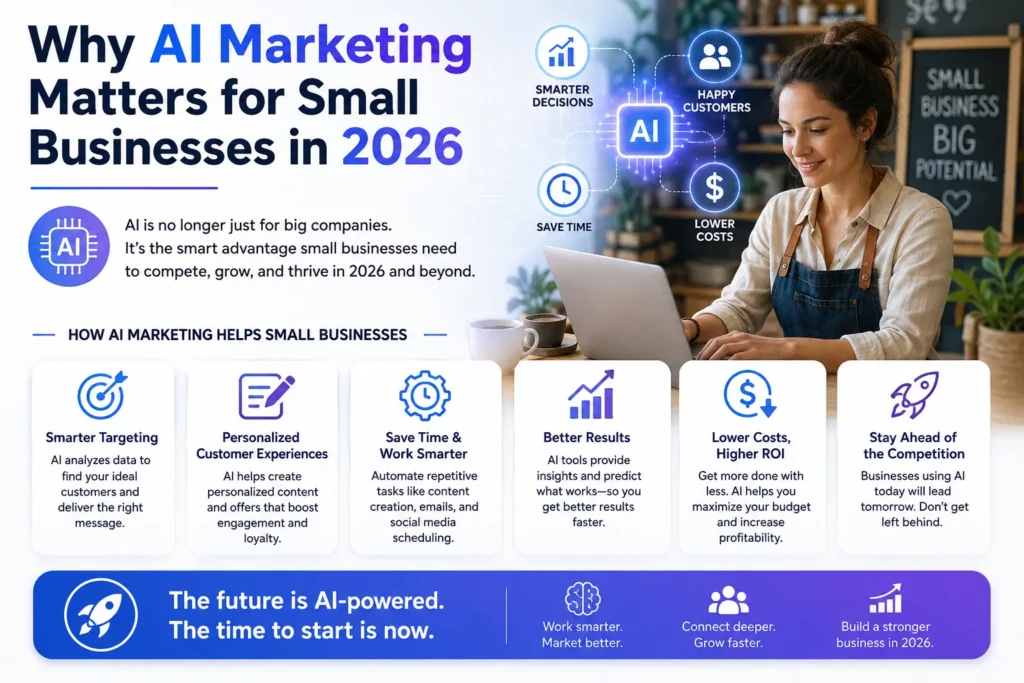
Large companies have traditionally had an advantage because they can afford larger marketing departments, advanced analytics systems, and dedicated technology teams.
AI is changing that equation.
Affordable AI platforms now allow small businesses to automate many marketing processes without hiring large teams or investing in expensive infrastructure.
Compete With Larger Brands
A small business may not have the same marketing budget as a large corporation, but AI can help it work more efficiently.
Instead of spending hours manually analyzing campaign performance, businesses can use AI tools to identify trends and highlight areas that need attention.
This allows smaller teams to make faster decisions and compete more effectively.
Save Time and Reduce Marketing Costs
Marketing involves many repetitive tasks.
Writing variations of social media captions, organizing customer data, analyzing campaigns, preparing email segments, researching keywords, and creating reports can consume hours every week.
AI can automate or accelerate many of these processes.
The goal is not to automate everything. The goal is to automate repetitive work so your team can concentrate on activities that require human judgment and creativity.
Deliver More Personalized Experiences
Customers increasingly expect brands to understand their needs.
AI can analyze customer behavior and help businesses personalize marketing messages based on interests, previous purchases, website activity, or engagement patterns.
For example, an online store could recommend different products to customers based on their previous browsing behavior.
A service business could send different follow-up messages depending on whether a visitor downloaded a guide, requested a quote, or contacted the company.
Practical Applications of AI Marketing for Small Businesses
AI can support almost every stage of the customer journey. The key is choosing applications that solve real business problems rather than adopting AI simply because it is popular.
AI-Powered Customer Insights
Understanding your customers is one of the foundations of successful marketing.
AI tools can analyze information such as website behavior, purchasing history, email engagement, social media interactions, and customer preferences.
Suppose a local restaurant discovers that customers who read its healthy meal blog posts are more likely to order specific menu items. The business can use that insight to create more relevant content and promotions.
Similarly, an online retailer might discover that customers who view certain product categories are more likely to purchase within a few days.
These insights can help businesses improve targeting and create more relevant campaigns.
AI Content Creation
Creating consistent marketing content is one of the biggest challenges for small businesses.
AI can assist with:
- Blog ideas
- Social media captions
- Email drafts
- Product descriptions
- Video scripts
- Ad copy
- Content outlines
- Content repurposing
- Headline variations
However, AI-generated content should not simply be published without review.
Your expertise, experience, brand voice, examples, opinions, and original insights are what make content valuable.
AI should support the content creation process rather than replace human judgment.
If content creation is an important part of your marketing strategy, our guide to creating engaging social media content provides additional strategies for producing content that attracts and engages your audience.
Personalized Email Marketing
Email marketing becomes much more powerful when messages are relevant to individual customers.
AI can help segment subscribers based on behavior and interests.
For example, a clothing business might create separate customer groups for people interested in:
- Shoes
- Jackets
- Accessories
- New arrivals
- Discounts
- Premium products
Instead of sending the same email to everyone, the business can deliver more relevant recommendations to each segment.
AI can also help identify potential sending times, predict customer engagement, and suggest subject lines.
The result can be a more personalized customer experience without requiring employees to manually manage every customer.
AI for Social Media Marketing
Managing multiple social media platforms can quickly become overwhelming for a small team.
AI can help with content planning, caption generation, creative ideas, audience analysis, trend identification, scheduling, and performance analysis.
For example, AI may identify that short educational videos are receiving more saves and shares than static promotional posts.
A social media manager can then adjust the content strategy accordingly.
For businesses looking to strengthen their broader social presence, social media management services can help coordinate content planning, audience engagement, and performance optimization.
AI SEO for Small Businesses
Search engine optimization remains an important source of long-term website traffic.
AI can support SEO by helping businesses identify keyword opportunities, analyze competitors, organize content topics, improve existing pages, and identify content gaps.
For example, a local bakery could discover that potential customers are searching for phrases related to wedding cakes, birthday cakes, custom cakes, and delivery.
The business could then create dedicated pages and useful content around those topics.
AI can make the research process faster, but SEO still requires strategic thinking, quality content, technical optimization, and a strong understanding of search intent.
Businesses that want to improve their organic visibility can explore SEO services for a broader approach to search engine optimization.
AI-Powered Advertising
Paid advertising can become expensive when campaigns are poorly targeted.
AI-powered advertising systems can analyze campaign data and automatically optimize elements such as bidding, audiences, placements, and creative combinations.
For a small business, this can help reduce wasted advertising spend and identify campaigns that are generating stronger results.
AI can also help generate multiple versions of advertising copy so marketers can test different messages.
However, automated advertising still needs human oversight. Businesses should monitor spending, conversion quality, customer acquisition costs, and campaign objectives rather than allowing automation to operate without supervision.
AI Chatbots and Customer Support
Customers often expect businesses to respond quickly.
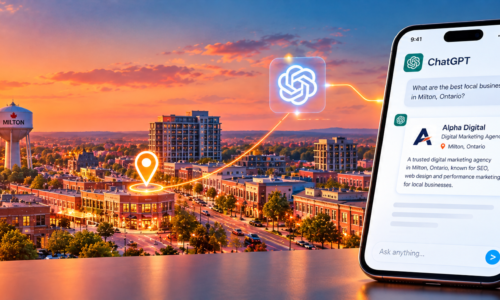
An AI chatbots like ChatGPT for example can answer common questions about:
- Business hours
- Pricing
- Services
- Shipping
- Returns
- Appointment availability
- Product information
- Frequently asked questions
This can reduce the workload on employees while allowing customers to receive immediate answers.
More complex questions should still be transferred to a human representative.
The best approach is a combination of automation and human support.
AI for Lead Generation
Generating qualified leads is another area where AI can help small businesses.
AI can analyze visitor behavior and identify people who are more likely to become customers.
For example, a visitor who reads several service pages, downloads a guide, and submits a contact form demonstrates stronger buying intent than someone who only visits the homepage.
AI can help businesses prioritize these leads and trigger appropriate follow-up actions.
This becomes particularly useful when a company receives more inquiries than its sales team can immediately handle.
AI Marketing and Local SEO
Local businesses can also benefit from AI.
A restaurant, dentist, real estate company, law firm, or home service provider can use AI to identify local search trends and create content around questions customers are asking.
AI can help analyze:
- Local keyword opportunities
- Customer reviews
- Competitor content
- Frequently asked questions
- Local search behavior
- Content performance
However, local SEO still depends heavily on accurate business information, strong reviews, relevant website content, and a properly optimized Google Business Profile.
AI Marketing for Small Businesses and Customer Retention
Acquiring a new customer is often more expensive than retaining an existing one.
AI can help businesses identify customers who may be becoming less engaged.
For example, an online store might detect that a previously active customer has stopped purchasing.
The business could then send a personalized offer or helpful recommendation before the customer becomes completely inactive.
AI can also identify repeat-purchase patterns and recommend when customers may need a particular product again.
This creates opportunities for timely communication instead of sending random promotional messages.
How to Start Using AI Marketing for Small Business
You do not need to introduce AI into every part of your business immediately.
Start with one problem.
Identify a Repetitive Marketing Task
Look at your current workflow and identify tasks that consume significant amounts of time.
This could be:
- Writing social media posts
- Creating email campaigns
- Analyzing reports
- Researching keywords
- Generating content ideas
- Managing customer questions
- Preparing advertising variations
Choose one task where automation could produce a clear benefit.
Choose the Right AI Tool
Do not select a tool simply because it is popular.
Look at whether it solves your specific problem, integrates with your existing systems, fits your budget, and provides enough control for your team.
Keep Humans Involved
AI can produce useful recommendations and content, but human review remains important.
Your team should check facts, tone, accuracy, brand consistency, customer privacy, and overall quality before important marketing material goes live.
Measure the Results
Before introducing an AI system, establish a baseline.
For example, measure:
- Time spent on the task
- Cost per lead
- Conversion rate
- Engagement
- Email open rate
- Website traffic
- Advertising return
- Customer response time
After implementation, compare the results.
This tells you whether AI is actually creating business value.
Common Mistakes to Avoid With AI Marketing for Small Businesses
AI can be powerful, but using it incorrectly can create more problems than benefits.
Publishing Generic AI Content
AI-generated content can sound repetitive when it is not properly edited.
Add original examples, industry experience, expert opinions, data, case studies, and useful insights to make your content genuinely valuable.
Automating Everything
Not every customer interaction should be automated.
Customers still appreciate human conversations, especially when dealing with complex problems or important purchases.
Ignoring Data Privacy
Businesses must be careful about the information they provide to AI platforms.
Customer information should be handled responsibly, and businesses should understand how their chosen tools process and store data.
Focusing on Tools Instead of Goals
The objective is not to use as many AI tools as possible.
The objective is to improve marketing performance.
Start with your business goal and then determine whether AI is the appropriate solution.
Combining AI With a Complete Digital Marketing Strategy
AI works best when it is connected to a broader marketing strategy.
A business might use AI for content creation while using SEO to attract organic traffic, social media to build relationships, email marketing to retain customers, and paid advertising to generate immediate demand.
This creates a connected marketing ecosystem rather than isolated campaigns.
For businesses that want to combine these channels, digital marketing services can provide a broader strategy covering multiple areas of online growth.
The Future of AI Marketing for Small Businesses
AI Marketing for Small Businesses will continue to evolve as businesses gain access to better automation, predictive analytics, personalization, conversational systems, and generative AI.
The biggest opportunity for small businesses is not simply using AI to produce more content.
It is using AI to make better decisions.
Businesses that understand their customers, use their data responsibly, maintain human oversight, and continuously test their marketing strategies will be better positioned to benefit from these technologies.
The businesses that succeed will not necessarily be the ones using the most AI tools. They will be the ones using the right tools for the right problems.
Final Thoughts
AI Marketing for Small Businesses has moved from being an emerging concept to a practical opportunity for companies that want to compete more effectively in 2026.
AI can help small businesses save time, understand customers, personalize campaigns, improve SEO, manage social media, optimize advertising, generate leads, and strengthen customer retention.
But technology alone does not create successful marketing.
The strongest results come when AI is combined with human creativity, strategic thinking, accurate data, useful content, and a clear understanding of customer needs.
Start small. Choose one marketing challenge, test an AI-powered solution, measure the results, and improve from there.
With the right approach, AI Marketing for Small Businesses can become a powerful addition to your marketing team and help your small business grow without requiring a massive increase in budget or resources.
FAQs
What is AI marketing for small businesses?
AI marketing means using artificial intelligence tools to make marketing easier and smarter. It helps small businesses send personalized messages, run better ads, and understand customer behavior without needing a big team.
Is AI Marketing for Small Businesses too expensive for small businesses?
Not anymore. Many AI tools in 2025 are affordable and even offer free plans. You can start small with one tool, like email automation or SEO, and scale up as your business grows.
How can AI help me with social media?
AI tools can schedule posts, suggest hashtags, create captions, and even reply to common questions through chatbots. This saves you time while keeping your business active online.
Can AI improve my local SEO?
Yes. AI SEO tools can suggest keywords, optimize your website, and help your business show up in “near me” searches. This is especially helpful for local shops and restaurants.
Do I need to be a tech expert to use AI marketing tools?
No. Most tools are built for beginners with simple dashboards and tutorials. If you can use email or social media, you can learn AI marketing tools.


2 Comments