
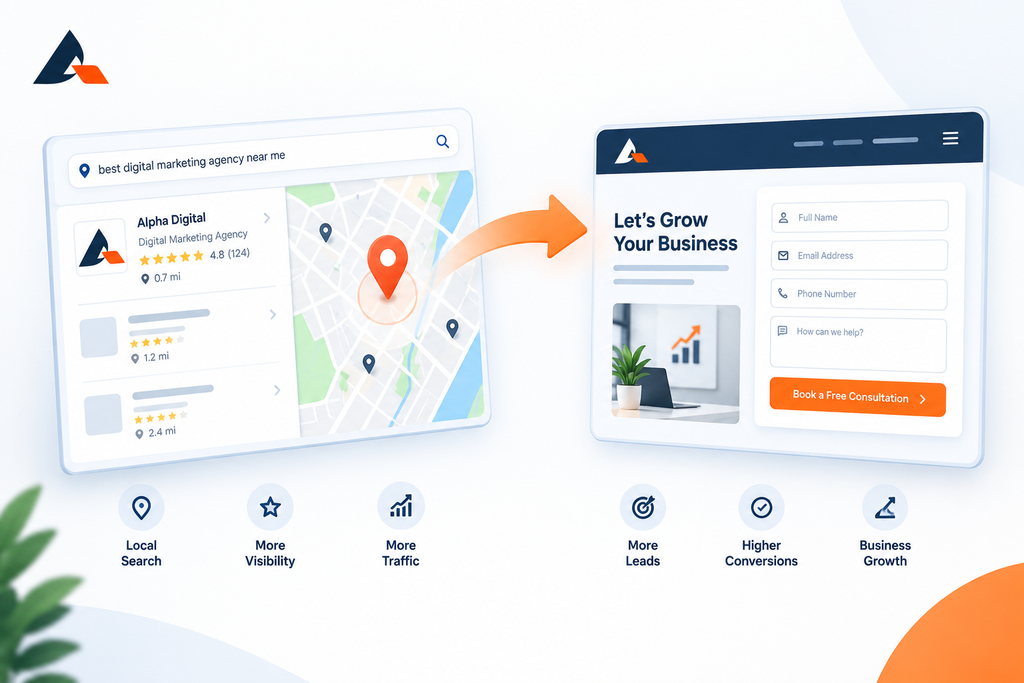
To Rank on Local Search You Should have a strong business profile which should be optimized, having good reviews, services listed, NAP consistency, posts, offers and Photos completed. To rank on local search means showing up when someone nearby types a real question into Google, asks an AI Overview for a recommendation, or searches a map for a business like yours. It is not one setting or one trick. It is a mix of a complete Google profile, real reviews, honest content, and a page that is actually built to turn a visit into a call, a form, or a booking.
This guide breaks that process into seven concrete steps, covers how AI Overviews and answer engines have changed what “ranking” even means, and explains how to design every page so it converts once someone finds it. Every step here works the same way whether a business runs one location or ten, inside the United States or beyond it.
Why Ranking on Local Search Means More Than a Map Pin
Search has quietly changed the finish line. Recent research puts the share of Google searches that end without a click at well over half, and that number climbs above 80 percent once an AI Overview appears on the results page. A person searching nearby often gets an answer, a phone number, or a business name directly on the screen and never opens a website at all.
That is why three disciplines now work together instead of one. SEO ranks a page in classic search and Google Maps. AEO, answer engine optimization, gets a business named directly inside an answer box instead of buried in a list of links. GEO and LLMO, generative and large language model optimization, get a business mentioned by AI tools like AI Overviews, ChatGPT, and Perplexity when someone asks for a recommendation. A business trying to rank on local search using only one of these three is optimizing for a shrinking slice of actual searches.
7 Ways to Rank on Local Search and Turn Visibility Into Customers
1. Complete and Verify Every Google Business Profile
Google Business Profile signals are commonly cited as close to a third of the total weight behind local ranking, which makes this the first place to spend real effort. Every physical location needs its own complete, verified profile. Never merge two addresses into one listing, and never build a profile for a location that does not genuinely exist. A pattern that shows up often with brands running several offices, sometimes across more than one country, is a profile left half finished at a second or third location while the main office gets all the attention.
Pick the primary category with care since it decides whether a location even shows up for a given search. Fill in hours, services, and a plain description written the way a real customer would describe the business, then add real photos of the actual location and team. Keep hours updated the moment anything changes, since stale hours are one of the fastest ways a listing gets buried or a customer shows up to a locked door. Businesses reviewing their AI search optimization for Alabama businesses or working through an AEO strategy in Mobile, Alabama start with this exact profile work before touching anything else. A profile this complete is often the single fastest way to rank on local search before any other change on this list.
2. Win the Map Pack With Relevance, Distance, and Prominence
Google ranks the local map pack on three factors: relevance, distance, and prominence. Relevance is how well a profile matches the search. Distance is how close the business sits to the person searching, which is mostly fixed. Prominence is how well known and well reviewed the business is, both online and in the real world.
Since distance cannot be changed, the real work happens in relevance and prominence, through a complete profile, honest local content, and a steady flow of real reviews. Businesses that have already worked through ranking in Google Maps with local SEO services in Miami or a Miami local SEO growth guide know this is not a one time project. The same three pillars apply just as much to a local SEO guide for Mobile, Alabama or a plan built around local SEO for Mobile, Alabama businesses. The market changes. The three ranking factors do not.
3. Build Real Location Pages, Not City Name Templates
A page that only swaps in a city name while everything else stays identical reads as thin content to Google and to the person reading it. It will not rank, and it will not convert either.
Every location page needs something real: staff details specific to that site, services that genuinely differ there, and local context nobody could fake from another city. Compare how distinct pages usually read in practice. A page built for Brickell covers different foot traffic and competition than one built for Wynwood, Doral, or Coral Gables, because each neighborhood has its own character and its own search behavior. Businesses researching how their content strategy should scale across locations often start with multi location SEO content strategy before writing a single page, and the broader mechanics of managing more than one address at once live inside local SEO for multi location businesses. Pages built this way are what let a brand rank on local search in more than one city at once, instead of just the one where it started.
4. Keep NAP Details Consistent Everywhere
NAP stands for name, address, and phone number, and it needs to match character for character across a website, a Google Business Profile, Bing listings, and every directory a business appears on. A small mismatch, like a suite number missing in one place, can quietly hurt ranking at that entire location.
Most directories and GPS systems pull business data from a small number of large data providers rather than managing listings by hand. Fixing one directory manually can get overwritten the next time that directory refreshes from its original source, so the more durable fix is correcting the data at the source and letting it flow downstream. Prioritize Google, Apple Maps, Facebook, and Bing first, then work through a shorter list of relevant directories instead of chasing every listing site that exists. A proper SEO audit or a review of an existing backlink and citation strategy usually surfaces exactly where business details have drifted out of sync.
5. Turn Reviews Into a Local Ranking Asset
Reviews sit right behind the Google Business Profile itself as a ranking factor, and they are the first thing most people check before ever visiting a website. Ask for a review right after a good experience, when satisfaction is highest, and send a direct link to the review form itself rather than a vague request to leave feedback somewhere.
Respond to every review, not only the negative ones. A specific, genuine reply reads as more real than a copied response, and for a negative review, acknowledging the actual issue without getting defensive matters more than trying to get it removed. Google only takes down reviews that break its own policies, such as being fake, spam, or unrelated to the business, so a thoughtful public response usually does more for reputation than a removal request ever will. Some local SEO researchers point to roughly 150 reviews at a single location as a rough point where AI tools begin naming that business directly in local recommendations, tracked through resources like AI Overview traffic quality. Treat that as a general benchmark, not an exact number, but one more reason review volume matters at every address, not just the brand average. Review volume shapes prominence directly, which is exactly why it matters this much to rank on local search consistently, not just once.
6. Structure Content for AI Overviews and Answer Engines
An AI system pulling together an answer does not read a page start to finish the way a person does. It scans for the sentence that answers the question cleanly on its own, without needing the paragraph before or after it to make sense. Open every section with a plain, self contained statement, state the business by name instead of a pronoun, and put the direct answer first, with the reasoning after it.
Schema markup helps here too. FAQ schema, LocalBusiness schema, and Organization schema each hand an AI system structured facts it can trust without parsing a full paragraph to find them. The mechanics behind what actually counts as an AI citation matter because a page can rank on page one and still never get quoted directly, while a page ranking lower sometimes gets picked simply because it answered the exact question in one clear sentence. Google’s spam policy update on May 15, 2026 made this official, stating that manipulating AI generated answers now carries the same penalty as manipulating regular rankings, which means the honest path and the effective path are finally the same one.
7. Design Every Page to Drive Actual Conversions, Not Just Traffic
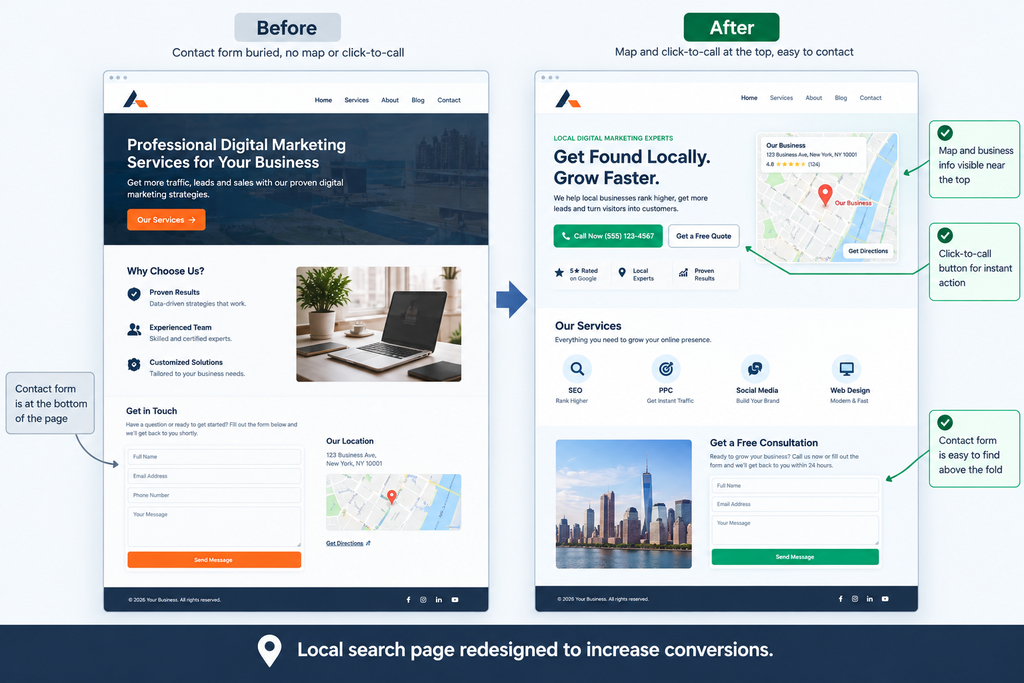
Ranking on local search is only half the job. A page that ranks but buries the phone number, hides the address, or makes someone hunt for a contact form is wasting the visibility it worked hard to earn. Every local page needs a click to call number near the top, a clear map or directions link, and one obvious next step, whether that is booking a call, requesting a quote, or filling out a short form.
Match the page to buyer intent rather than a generic pitch. Someone searching for a service nearby, right now, is closer to ready than someone reading a general explainer, so the page they land on should sound like it too. A complete SEO services guide for the USA or a broader SEO strategy for Miami businesses both work because the ranking effort and the conversion path were planned together from the start, not bolted on after the fact. None of this replaces the ranking work covered above. It just makes sure the effort to rank on local search actually pays off once someone lands on the page.
Common Mistakes That Keep Businesses Off Local Search
Leaving a Google Business Profile half finished at a second or third location
Publishing location pages that only change the city name
Letting NAP details drift out of sync across directories over time
Chasing more reviews overall while ignoring one location that is quietly struggling
Writing content only for search engines and forgetting the actual reader
Ranking a page well, then hiding the phone number or contact form on it
Any single one of these can quietly undo the work it takes to rank on local search in the first place. A business can have a strong on page SEO checklist in place and still lose ground if the basics above are left unattended.
How Alpha Digital Helps Businesses Rank on Local Search
Alpha Digital runs this same process across four verified offices in the United States, Canada, and Pakistan, with Google Business Profiles confirmed in more than one of them. The approach covers the full path: profile setup, map pack ranking, real location content, review management, and structuring pages so both AI tools and real customers can act on what they find. The AI search optimization built for Milton, Ontario and the Miami restaurant Google Maps ranking case study both follow this same framework, adjusted for a different market each time.
A free SEO audit is the simplest way to see where a specific location currently stands on local search. Past results are on view in the portfolio and case studies, and questions about a specific market or industry can go through the contact page directly.
Frequently Asked Questions
What does it mean to rank on local search?
It means showing up when someone nearby searches for a business like yours, whether that is a map pack result, a direct answer from an AI Overview, or a mention inside a tool like ChatGPT or Perplexity.
How long does it take to rank on local search?
Profile and citation fixes can show movement within a few weeks. Building real prominence through reviews and genuine local content usually takes a few months of steady work rather than a single push.
Does ranking on local search guarantee more customers?
No, not by itself. A page that ranks well but hides the phone number or contact form still loses the customer at the last step. Ranking and conversion have to be planned together.
Do I need a separate Google Business Profile for every location?
Yes. One profile per physical address, never merged and never created for a location that does not genuinely exist.
Can a small business with only one location still compete on local search?
Yes. A single, well built profile with genuine reviews and a real location page often outranks a larger competitor that spread its effort too thin across many addresses.
Does local search ranking work the same way outside the United States?
Yes. The same core rules for Google Business Profile, reviews, and page structure apply anywhere Google Maps operates, including Canada and Pakistan.
How does AI Overviews change how businesses should rank on local search?
Content has to answer the exact question in one clear sentence near the top of the page, backed by schema markup and a verified, consistent business profile, since that is what an AI tool checks before naming a business directly in its answer.
Ranking on local search is not a single fix or a one time project. It is a complete profile at every location, real content instead of a template, honest reviews, and a page built to turn that visibility into an actual customer once someone finds it. This blog is Published and updated in September 2026. Research and analysis by the Alpha Digital SEO team, reviewed by Arsalan Ali, Senior SEO Specialist at Alpha Digital.