
Backlinks are the backbone of your website’s authority. Without them, even well-optimized pages struggle to rank because Google needs third-party signals to trust your content.
This guide covers the best off-page SEO tips that actually move the needle in 2026, from earning quality backlinks to building AI visibility, fixing local citations, and protecting your site from toxic links after Google’s June 2026 update.
If you want to know where your backlink profile stands right now, get a free SEO audit before you spend another dollar on off-page SEO.
What Is Off-Page SEO?
Off-page SEO covers everything that happens outside your own website that affects where you rank in search results. The biggest factor is backlinks, but off-page also includes brand mentions, social signals, local citations, and increasingly, citations in AI-generated answers.
It sits alongside on-page SEO in the same way a building sits on its foundations. On-page work structures your content and signals relevance. Off-page work builds the authority that tells Google your content is worth trusting. Both matter. Neither works well without the other.
If you want to understand the full picture of why SEO matters for your business before going deeper into off-page tactics, that context helps.
Why Off-Page SEO Still Matters in 2026
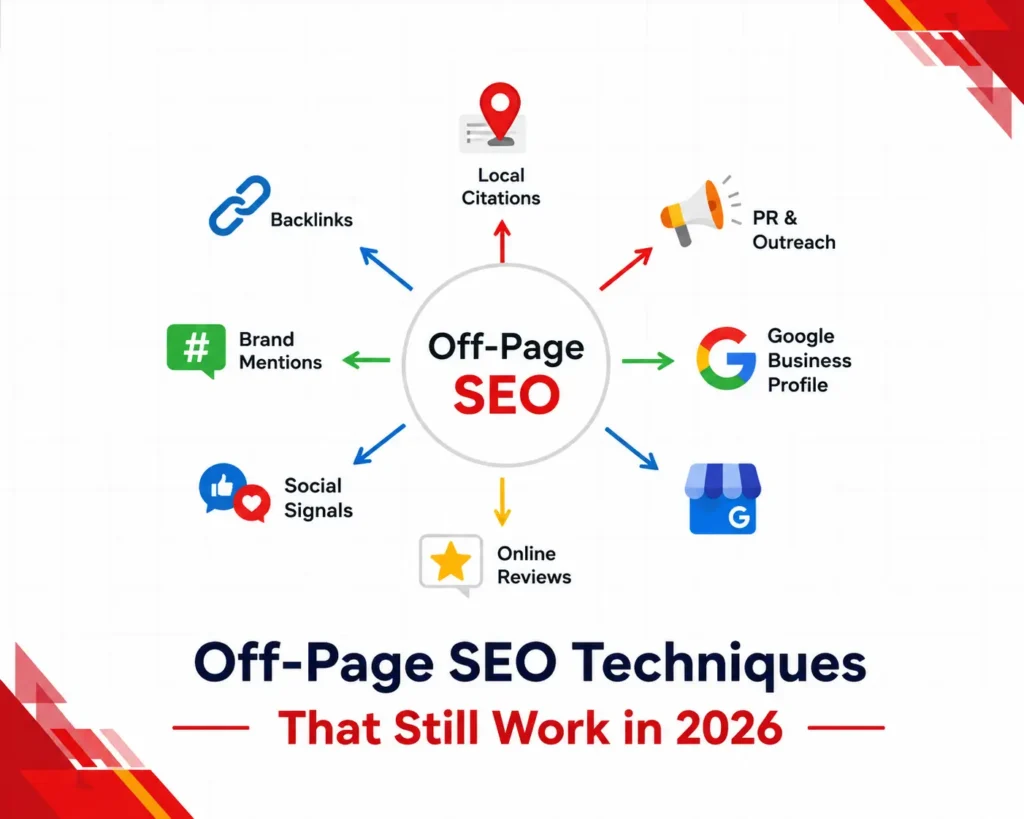
Google’s algorithm has hundreds of ranking signals, and backlinks remain among the strongest. A 2026 analysis of top-ranking pages across competitive industries consistently shows that domain authority, built primarily through external links, is what separates page one from page two results when on-page quality is comparable between competitors.
Off-page SEO also takes longer than on-page to show results, which is exactly why starting it earlier matters more. A link you earn today contributes to your domain’s authority for years. A competitor who builds a strong backlink profile now is compounding that advantage every month.
The long-term SEO strategy case for off-page is straightforward: paid traffic stops when the budget runs out, but domain authority built through quality backlinks keeps working. For the full picture of how off-page fits into a broader search strategy, our SEO services guide covers each channel in detail.
Best Off-Page SEO Tips
Focus on Quality Over Quantity
The single most damaging mistake in off-page SEO is chasing link volume without checking link quality. A hundred links from irrelevant, low-authority websites produce no ranking benefit and, after Google’s June 2026 update, active penalty risk.
One link from a reputable industry publication, a well-known local news site, or a strong directory in your niche is worth more than fifty links from sites that exist primarily to sell links. When evaluating a potential link source, check its Domain Rating (DR) in Ahrefs, its Domain Authority (DA) in Moz, its Authority Score (AS) in Semrush, and whether it has real organic traffic. A high-DR site with zero traffic is often a sign of a manipulated link profile.
The sites worth pursuing links from are the ones that your target audience actually reads. If a link from a website would send genuinely interested visitors to your page, it will also help your rankings. If it would send no one, the link is not worth the risk.
Professional SEO services that handle link building should be able to name every source they target and explain why it is relevant to your business. If they cannot, ask them to.
Focus on AI Visibility and Generative Engine Optimization
Off-page SEO in 2026 extends beyond Google and Bing. When ChatGPT, Gemini, Claude, and Perplexity generate answers to user questions, they pull from websites that have already built strong authority signals. Getting cited in an AI-generated response is becoming a meaningful traffic and brand awareness channel.
Generative engine optimization (GEO) and answer engine optimization (AEO) are the disciplines that address this. The websites most likely to receive ChatGPT citations are the ones with comprehensive, well-structured content on their topic, strong backlink profiles from legitimate sources, and consistent entity associations across the web. In other words, the same things that help you rank on Google help you get cited by AI systems.
Building off-page signals specifically for AI visibility means getting mentioned and linked to by authoritative sources in your industry, not just any directory. It means publishing content that other sites want to cite as a reference. It means building a brand presence that AI systems recognize as a credible source.
The future of AI in digital marketing covers where this is heading. AI tools for SEO shows which tools are currently most effective for tracking and building AI visibility. And if you want to understand how to use ChatGPT for SEO content that earns these kinds of citations, that guide covers the practical workflow.
Publish Quality Content Built for Off-Page Outreach
The fastest way to earn quality backlinks is to publish something other people want to link to. That sounds obvious, but most websites publish content that is useful to their own audience without being genuinely link-worthy from the perspective of other site editors and journalists.
Link-worthy content has one of three qualities. It provides original data or research that people cite as a source. It gives a definitive answer to a question that has no clear best-available resource yet. Or it tells a story or makes an argument specific and credible enough that industry publications want to reference it.
Generic blog posts written primarily for keyword targeting rarely earn unsolicited links. A survey of 500 small business owners about their marketing budgets, a tool that calculates something useful for free, or a comprehensive guide that is genuinely more complete than anything else on the topic will.
How to use AI to generate high-converting blog content shows how to use AI tools to produce link-worthy content faster. Creating engaging social media content covers how to distribute that content once it is published to maximize the reach that produces organic link mentions.
Build Different Types of Backlinks
A natural backlink profile includes different types of links from different types of sources. A profile that is 90% guest posts, or 90% directory listings, or 90% any single link type reads as manipulated to Google’s algorithms.
Guest posting remains one of the strongest link building tactics when done properly. Publishing genuinely useful content on relevant industry publications earns an editorial link within the content, builds brand awareness with a new audience, and contributes to topical authority. The key word is relevant. A guest post on a site that covers the same audience as yours is valuable. A post on a site assembled purely to host outreach content is not.
Web 2.0 backlinks from platforms like Medium, Substack, and LinkedIn articles can supplement your profile when they link to authoritative content rather than thin posts written only for the link.
Directory submissions to legitimate, curated directories in your industry or location contribute to both off-page authority and local citation consistency. Random directory submission at volume produces low-value links and occasionally triggers spam filters.
Image SEO backlinks come from publishing original images, infographics, or visual data that other sites want to embed with attribution. A well-designed infographic explaining a complex process can earn dozens of natural links from sites that use it in their own content.
Voice search SEO relates to off-page indirectly: voice search results pull heavily from Google’s featured snippets and local search results, both of which are influenced by your domain authority and local citation signals.
Keyword research tools help identify which topics in your industry have link-building potential. On-page SEO strategies show how to structure the pages those links should point to.
Local Off-Page SEO for USA Businesses
For businesses serving a specific city or region, local off-page SEO produces some of the fastest and most measurable ranking improvements available. Google uses a separate set of signals for local search results, and many of them are off-page.
Local backlinks come from local sources: Chamber of Commerce listings, local news coverage, sponsorship mentions on community websites, and links from other local businesses that serve a complementary audience. A plumber in Mobile, Alabama getting a link from the Mobile Area Chamber of Commerce website sends a much stronger local relevance signal than the same plumber getting a link from a national trade publication.
Local citation consistency matters too. Your business name, address, and phone number need to match exactly across every directory where your business appears. Inconsistencies across Google Business Profile, Yelp, Bing Places, Apple Maps, and industry-specific directories send conflicting signals that weaken your local authority.
Our local SEO guide for Mobile, Alabama covers the citation-building process in detail for businesses in that market. Our local SEO for Miami businesses guide covers the same ground for Miami-Dade, where the competitive landscape and citation sources differ significantly.
Google’s June 2026 Algorithm Update: What Changed for Backlinks
Google’s June 2026 update tightened enforcement of its existing link spam policies in ways that have produced visible ranking drops for sites with manipulated backlink profiles.
The core of the update focuses on link schemes, which Google defines broadly as any link built with the primary purpose of influencing PageRank rather than providing genuine editorial value. This includes paid links without proper disclosure, links from sites created primarily to host outreach content, large-scale guest posting on irrelevant sites, and links from private blog networks.
The update also increased scrutiny on security signals. Sites linking to or from compromised domains now face faster action. If your backlink profile includes links from hacked websites, those links are actively harmful rather than neutral.
The practical response to the June 2026 update is a backlink audit. Run your profile through Semrush, Ahrefs, or Google Search Console’s link report. Identify links from irrelevant, low-quality, or suspicious sources. For the worst offenders, use Google’s disavow tool to instruct Google to ignore them. Disavow is not a magic fix and should be used carefully, but a profile with significant toxic links benefits from it.
Our SEO audit process guide covers how to assess your current link profile systematically. Our in-depth SEO analysis guide goes further on identifying and responding to algorithm-related ranking changes.
Benefits of Off-Page SEO Services
The case for investing in professional off-page SEO services comes down to three things: the results are real, they compound over time, and getting it wrong carries risk that takes months to undo.
Domain authority growth through quality link building produces ranking improvements across your entire site, not just the pages the links point to. As your domain’s authority increases, pages that were previously stuck on page two begin to reach page one without additional on-page work.
Organic ranking benefits from strong backlinks also tend to be more durable than rankings earned through on-page optimization alone. A competitor who matches your content quality but has a weaker backlink profile will struggle to consistently outrank you.
Rayseen Store is a direct example of what consistent off-page SEO produces: stronger organic product rankings and reduced reliance on paid advertising as domain authority built over time. More results across categories are documented in our case studies.
Start with our SEO services page to understand what a complete off-page program includes.
Why USA Businesses Need USA-Specific Off-Page SEO Services
Off-page SEO is not one-size-fits-all across markets. A backlink profile built primarily from international sources provides weaker local relevance signals for businesses competing in US markets.
Google uses geographic link signals as part of how it assesses local relevance. For a business targeting customers in the USA, links from US-based publications, directories, and industry organizations carry more weight than equivalent links from overseas sources. Local USA backlinks, combined with US citation consistency across Google Business Profile and major US directories, build a stronger local authority signal than a globally distributed link profile.
SEO services USA covers how we approach off-page specifically for US markets. For businesses based in the Southeast and building a local authority signal, digital marketing agency Alabama shows our regional approach. Our digital marketing agency USA page covers national campaigns.
Alpha Digital Free SEO Audit: Start With Your Backlink Profile
Before you build new links, know what your existing profile looks like. A backlink audit shows you which links are helping, which are neutral, and which may be actively hurting your rankings after the June 2026 update.
Alpha Digital’s off-page SEO services include a free SEO audit that covers your full backlink profile: the number of referring domains, the quality distribution of those domains, your AS, DR, and DA scores, the anchor text distribution across your links, and any toxic or spammy links that should be addressed before new link building begins.
The audit is the starting point for every off-page engagement we take on because building new links on top of a compromised profile produces slower results and greater risk than addressing the existing profile first.
Conclusion
Off-page SEO builds the authority that makes every other part of your SEO work better. Quality backlinks, local citations, AI visibility, and a clean link profile after Google’s 2026 updates all contribute to rankings that hold and compound over time.
If you want to know where to start, contact us to discuss your current backlink profile and what a realistic off-page strategy looks like for your business. Or explore our full SEO services to see what a complete organic growth program covers.
Frequently Asked Questions
How long does it take for off-page SEO to work?
Off-page SEO results typically appear three to six months after a consistent link building program begins. New links take time to be discovered and indexed by Google, and authority gains accumulate gradually rather than appearing immediately. The timeline depends on how competitive your market is, how strong your existing domain authority is, and the quality of the links being built. Local citation improvements and Google Business Profile signals often move faster than broad domain authority gains.
Are links to social media sites considered backlinks?
Social media links are nofollow in most cases, meaning they do not pass PageRank directly the way editorial backlinks do. They are not considered traditional backlinks for ranking purposes. However, social media profiles do contribute to brand presence, entity signals, and the discovery of your content by people who may then link to it from their own websites. A strong social media presence supports off-page SEO indirectly without being a direct ranking factor.
Is guest posting still a good idea in 2026?
Guest posting on genuinely relevant publications with real audiences remains one of the most effective off-page tactics in 2026. The approach Google penalizes is large-scale guest posting on sites that exist primarily to host outreach content, with thin articles written only for the link. A guest post that adds real value for the host site’s readers, on a site your target audience actually reads, earns an editorial link that contributes to authority. The difference between good guest posting and bad guest posting is relevance and editorial standards.
What is the best way to track off-page SEO?
Semrush and Ahrefs are the standard tools for monitoring your backlink profile. Both show referring domains, new and lost links, anchor text distribution, and authority scores for linking domains. Google Search Console’s link report shows which external sites link to your pages according to Google directly. Set up a monthly review of new links acquired, links lost, and changes to your AS, DR, and DA metrics. Tracking these over time shows whether your off-page strategy is building authority or stalling.
How much does off-page SEO cost in the USA?
Off-page SEO pricing in the USA ranges from $500 to $2,000 per month for local citation building and basic link outreach, to $2,000 to $6,000 per month for active link building programs including digital PR, guest posting, and niche edits. Enterprise campaigns in competitive industries can cost more. Our SEO pricing guide covers realistic cost ranges and what different budget levels actually deliver.
What is the difference between DA, DR, PA, and AS?
These four metrics come from different tools and measure different things. DA (Domain Authority) is Moz’s 1-100 score predicting how well a domain ranks in Google. DR (Domain Rating) is Ahrefs’ 0-100 score measuring the strength of a domain’s backlink profile specifically. PA (Page Authority) is Moz’s score for individual pages rather than whole domains. AS (Authority Score) is Semrush’s composite metric combining backlink profile strength, organic traffic, and spam signals. None of them are Google metrics. They are third-party estimates useful for comparing link sources, not absolute measures of ranking power.
Can bad backlinks hurt my rankings after the June 2026 update?
Yes. The June 2026 update increased enforcement against manipulative link schemes, and sites with significant proportions of toxic or spammy backlinks have seen measurable ranking drops. Links from private blog networks, hacked sites, and low-quality directories built for link selling are the most common sources of penalty risk. Run a backlink audit to identify your toxic links, then use Google’s disavow tool for the worst offenders. Disavow does not produce immediate ranking recovery but removes the negative signals that are suppressing your rankings.

4 Comments