
If you have ever Googled your own business and wondered why a competitor keeps showing up above you, you already know the value of search visibility. The next question most business owners ask is simple: how much does it cost to fix that?
SEO Marketing is one of the most searched topics in digital marketing, and also one of the most misunderstood when it comes to seo pricing. There is no single price tag that applies to every business. Costs range from a few hundred dollars a month to tens of thousands, depending on what you actually need.
Why SEO Pricing Is So Hard to Pin Down
One of the first things people notice when shopping for SEO is how wide the price range is. You might see one agency quoting $300 a month and another quoting $5,000 for what sounds like the same service. That gap is not random. It reflects real differences in scope, strategy, and deliverables.
The Key Factors That Affect SEO Agency Cost
Several things influence what you will pay for SEO:
Your industry and competition level.
A local bakery trying to rank in a small city has very different needs from an e-commerce brand competing nationally. The more competitive your market, the more time and effort SEO takes.
Your starting point.
A brand new website with no content and no backlinks needs a lot more foundational work than an established site that just needs ongoing optimization.
Your goals and timeline.
Faster results in tough markets require more resources. Aggressive goals cost more than a slow and steady approach.
The agency’s experience and location.
An experienced SEO team in North America will charge more than a freelancer overseas. That gap in cost often reflects a gap in quality, accountability, and strategic depth, though not always.
The Main SEO Pricing Models Explained
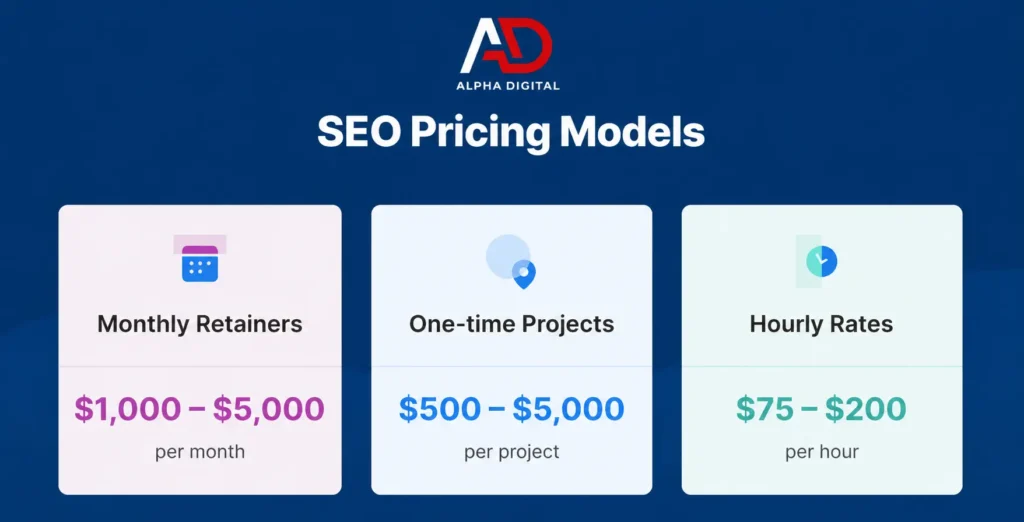
Before looking at numbers, it helps to understand how SEO services are typically structured. There are three main models you will come across.
Monthly Retainer
This is the most common way to buy SEO. You pay a set fee each month in exchange for ongoing work: keyword research, content creation, link building, technical fixes, and reporting. A monthly retainer works well for businesses that want consistent progress over time.
Most serious SEO campaigns run on this model. It gives the agency enough time to build momentum and gives you a predictable cost to plan around.
Project Based Pricing
Some businesses need a one-time piece of work done, like a technical SEO audit, a site migration, or a content strategy document. Project-based pricing covers a defined scope of work for a flat fee. It is useful when you have a specific problem to solve rather than an ongoing need.
Hourly Consulting
Hourly rates are common for smaller engagements or when you want expert advice without committing to a full package. This works well for businesses that have an in-house team but need guidance from an outside specialist.
If you are looking at affordable SEO pricing for your business, most agencies offer tiered retainer plans that bundle services together at different price points. These make it easier to get started without a large upfront commitment.
What Are Realistic SEO Pricing in 2026?
Here is a realistic look at what businesses typically pay for SEO based on size and need. These ranges reflect the current market and are based on general industry data, not a single source.
Small Business SEO
Monthly retainer: $500 to $2,000 per month
At this level, you are typically getting local SEO work, basic keyword targeting, some content production, and monthly reporting. It is suitable for local service businesses, restaurants, small e-commerce shops, and professional services.
For businesses like Deejo’s Cafe in Islamabad, local SEO at this range made a clear difference. The cafe ranked higher on Google Maps and saw more foot traffic as a direct result of targeted local search work.
Mid-Size Business SEO
Monthly retainer: $2,000 to $6,000 per month
At this level, you can expect a more comprehensive strategy. This includes regular content production, active link building, technical SEO management, and more detailed competitive analysis. It is a good fit for growing brands, regional businesses, and companies with multiple service areas.
Enterprise or Competitive Market SEO
Monthly retainer: $6,000 to $20,000+ per month
Large platforms and businesses in highly competitive industries need more resources, more content, and more strategic depth. At this level, SEO pricing in 2026 often includes dedicated account teams, in-depth technical work, and large-scale content programs.
For reference, platforms like iFit, which serves 6 million users, and Airtasker, with 4 million users, operate at this scale and require enterprise-level SEO investment to maintain and grow their organic presence.
How Much to Spend on SEO
A general rule used in the industry is to budget between 5% and 15% of your target revenue for all digital marketing combined, with a meaningful portion of that going toward SEO if organic traffic is a priority for your growth strategy.
What Do You Actually Get for the Money?
This is where a lot of business owners feel uncertain. SEO is not a physical product you can hold. So what exactly are you paying for?
Core SEO Deliverables
Keyword research.
Finding the actual words and phrases your potential customers type into Google. This shapes everything else in the strategy.
On-page optimization.
Updating your website pages so they are structured in a way that search engines can understand. This includes title tags, headings, meta descriptions, internal linking, and content quality.
Technical SEO.
Making sure your website loads fast, works properly on mobile, has no broken links, and is easy for search engine crawlers to index.
Content creation.
Writing blog posts, landing pages, and other content that targets the keywords your audience searches for. Good content builds trust with both Google and real readers.
Link building. Earning links from other reputable websites back to yours. Google treats these as signals of trust and authority.
Reporting. A monthly summary showing what changed, what improved, and what the next steps are.
When Alpha Digital worked with Inktel, a business process outsourcing company, the SEO program covered keyword strategy, content alignment, and ongoing optimization. The result was stronger search placement across key outsourcing topics and more qualified leads finding the platform organically.
How to Measure SEO ROI Before You Spend
One of the most practical questions to ask before committing to SEO is: what return can I realistically expect?
SEO ROI does not show up overnight. Most campaigns take three to six months to show meaningful results, and longer in more competitive markets. But once rankings are established, organic traffic tends to compound over time in a way that paid advertising does not.
A Simple Way to Think About SEO ROI
Start with what a new customer is worth to your business. If one new customer is worth $500 and SEO brings in 20 new customers a month, that is $10,000 in monthly value from organic traffic. If you are paying $2,000 a month for SEO, the math works clearly in your favor.
You can also look at it from a cost-per-click comparison. If you are currently paying $5 per click on Google Ads and your SEO campaign targets the same keywords, ranking organically means getting those same clicks without paying for each one individually.
For Hakem AI, an insurance comparison platform, targeted SEO increased organic traffic from users actively searching for insurance help. For Rayseen Store, a footwear brand, improved rankings meant more shoppers found the site through search rather than paid ads, reducing overall customer acquisition costs.
Calculating SEO ROI requires looking at traffic value, lead volume, and conversion rates together. It is not one single number, but it is very measurable when tracked properly.
Red Flags to Watch Out for When Buying SEO
Not all SEO services deliver what they promise. Knowing what to avoid will save you from wasting money and potentially hurting your website’s standing with Google.
Warning Signs in SEO Proposals
Guaranteed rankings.
No one can guarantee a specific ranking on Google. Search engines make hundreds of algorithm updates a year. Any agency promising a number one ranking for a specific keyword is either oversimplifying or not being honest.
Very low prices with vague deliverables.
A $99/month SEO package with no clear explanation of what work is being done is almost always a red flag. Real SEO requires time and skilled labor. Prices that seem too good to be true usually are.
Lack of transparent reporting.
A credible SEO partner will show you exactly what they are doing and what results it is producing. If an agency cannot or will not show you data, that is a serious concern.
Black-hat tactics.
Some services use shortcuts like buying low-quality backlinks or stuffing pages with keywords. These can produce short-term gains but often lead to Google penalties that are difficult and expensive to recover from.
No discussion of your business goals.
Good SEO starts with understanding what you are actually trying to achieve. If an agency jumps straight to a package without asking about your customers, your market, or your revenue goals, they are likely selling a template rather than a strategy.
Final Thoughts
SEO pricing in 2026 varies a lot, but the core principle stays the same: you are paying for a process that builds long-term visibility in search results. When done right, it brings in customers who are already looking for what you offer, without paying for every click.
The right budget depends on your goals, your competition, and how quickly you want to grow. A local business can see real results at a few hundred dollars a month. A scaling brand or a competitive market demands more investment to move the needle.
The most important thing is to work with a team that understands your business, tracks results clearly, and builds a strategy grounded in your actual goals, not just vanity rankings.If you want to know exactly where your site stands right now and what it would take to improve, book a free SEO audit with the Alpha Digital team. We will show you what is working, what is holding you back, and what a realistic path forward looks like.
Frequently Asked Questions
How much does SEO cost per month for a small business?
Most small businesses pay between $500 and $2,000 per month for SEO. This covers local keyword targeting, basic on-page work, and monthly reporting. The right amount depends on your competition level and goals. A local service business needs less investment than an online store competing in a national market.
Is SEO worth it for a small business in 2026?
Yes, for most small businesses SEO is worth it. It brings in customers who are already searching for what you offer, without paying for every click like you do with ads. Results take a few months to build, but once rankings improve, the traffic tends to stay and grow over time without extra spend.
What is the difference between cheap SEO and quality SEO?
Cheap SEO often means low-effort work like automated link building or thin content with no real strategy behind it. Quality SEO involves proper keyword research, original content, technical fixes, and honest reporting. The difference shows up in your rankings and in how long those results actually last.
How long does it take to see results from SEO?
Most SEO campaigns take three to six months to show noticeable results. Newer websites or highly competitive markets can take longer. SEO is a long-term investment, not a quick fix. The longer it runs consistently, the stronger and more stable your rankings tend to become.
Should I do SEO or run paid ads?
Both serve different purposes. Paid ads give you fast visibility but stop the moment you stop paying. SEO builds organic rankings that last longer and compound over time. Many businesses benefit from running both together, using paid ads for immediate traffic while SEO builds a more sustainable foundation for long-term growth.



3 Comments