
Local SEO for healthcare practices is the work of making a clinic show up when someone nearby searches for care. That means the Google Map Pack, Google Maps, Bing listing and the regular search results that change based on where a person is standing. For a practice in Alabama, this matters more than national ranking ever will, because almost nobody drives from Huntsville to Mobile for a dermatologist. So, you must be ranking if someone searches for a “pediatrician in Birmingham” or “urgent care in Huntsville”, because nobody is going to drive from Huntsville to Mobile for a dermatologist.
This guide explains how local SEO for healthcare practices works for medical practices, what actually moves the needle, and how to keep it running month after month.
Table of Contents
- What Is Local SEO for Healthcare Practices
- Why Local SEO Matters for Patient Acquisition
- How Patients Search for Healthcare Providers
- What You Can and Cannot Control in Google Search
- Core Local SEO Ranking Factors for Medical Practices
- How to Optimize a Google Business Profile
- Building Location Pages That Rank and Convert
- Provider Pages and Their Role in Local SEO
- Service and Condition Pages for Local Search
- Reviews and Reputation Management for Medical Practices
- Citations, NAP Consistency, and Local Links
- Showing Up in Voice Search and AI Answers
- Tracking Calls, Leads, and Local SEO Performance
- How to Manage Local SEO for Healthcare Providers
- Choosing a Healthcare Marketing Partner in Alabama
- Final Takeaways and Next Steps
- Frequently Asked Questions
What Is Local SEO for Healthcare Practices
Local SEO for healthcare practices is the set of steps that helps a clinic appear in search results tied to a specific place. A general AI SEO strategy tries to rank a page across a whole country. Local SEO tries to rank a location in a city, a suburb, or a few ZIP codes.
The difference shows up in the results themselves. Search for something like “urgent care near me” and Google puts a map at the top with three business listings under it. That block is called the Map Pack, and it sits above the normal blue links. Most clicks on a local search go there.
Local SEO for healthcare practices adds a layer that other industries do not deal with. Patient privacy rules limit what a practice can say publicly, insurance networks shape who can even become a patient, and each provider in a group is a searchable name of their own. The basics of search still apply, and why search visibility matters for any business does not change. The execution just has more rules around it.
Why Local SEO Matters for Patient Acquisition
Patients pick doctors the same way they pick restaurants now. They search, they look at the map, they read a few reviews, and they call whoever looks closest and most trusted. A practice that does not appear in that first screen is not competing. That is why local SEO for healthcare practices should focus on visibility before broader traffic goals.
Three things make local search unusually valuable for a medical practice. These benefits are at the heart of local SEO for healthcare practices:
The intent is immediate. Someone typing “walk in clinic open now” is not researching. They are deciding in the next ten minutes.
The distance filter does the qualifying. A person searching from Daphne is a person who can realistically show up at a Daphne office. There is no wasted reach.
The traffic keeps coming. A well-built profile and a strong set of pages keep producing calls long after the work is done. Paid ads stop the day the budget stops.
For a practice using local SEO for healthcare practices in a competitive Alabama market like Birmingham or Huntsville, local search is often the difference between a full schedule and a half-empty one.
How Patients Search for Healthcare Providers
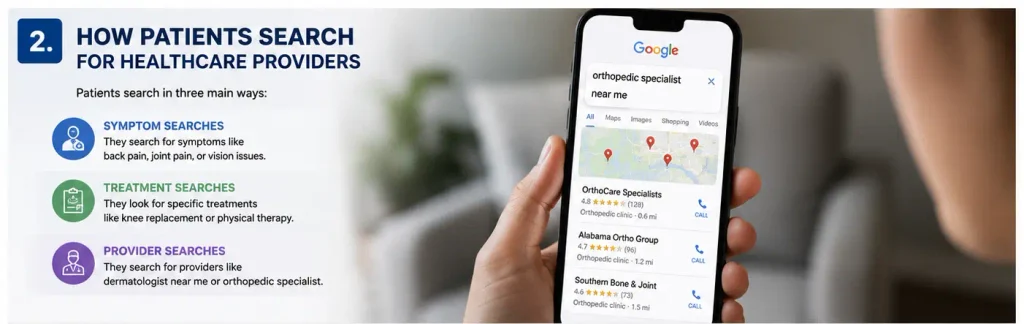
Patient searches fall into three buckets. A clear local SEO for healthcare practices plan should address all three. A practice that only covers one of them leaves the other two on the table.
Symptom searches
These come first, before a patient knows who to see. Things like back pain, joint pain, vision issues, or a rash that will not clear up. The person is trying to figure out what is wrong and who treats it.
Content that answers these questions well brings in patients months before they book. It also builds the topical depth that helps every other page on the site rank.
Procedure and treatment searches
Now the patient knows what they need. Knee replacement, cataract surgery, physical therapy, allergy testing. These searches carry high intent and usually name a city: “cataract surgery Mobile AL” or “physical therapy near me.”
Provider and practice searches
The narrowest group. “Dermatologist near me,” “orthopedic specialist in Montgomery,” “orthopedic surgeon Tuscaloosa,” or the name of a specific doctor a friend recommended.
Name searches matter more than most practices expect. A patient who hears a doctor’s name at a dinner party will search that name, and whatever comes up first shapes the first impression. If a third-party directory outranks the practice’s own page, the practice loses control of that moment.
What You Can and Cannot Control in Google Search
Local SEO for healthcare practices has a fixed part and a flexible part. Knowing which is which saves a lot of wasted effort.
Cannot be controlled:
- Distance. Google weighs how far a practice is from the searcher. An office in Fairhope will not rank in Birmingham, and no amount of optimization changes that. The honest answer is to rank hard where the office actually is.
- What competitors do. Rankings shift when a nearby practice invests in reviews or launches new pages.
- Algorithm updates. Google changes how it weighs signals several times a year.
- What patients write in reviews. Responses are possible. Rewrites are not.
- Third-party directory listings. Healthgrades, Vitals, and insurance directories will rank for provider names whether a practice likes it or not.
Can be controlled:
- Every field on the Google Business Profile
- The structure, speed, and content of the website
- How consistent the practice name, address, and phone number are across the web
- How many new reviews come in each month, and how fast they get a reply
- Which services and conditions get their own pages
The controllable list is where local SEO for healthcare practices work belongs. A practice that spends its energy on the first list stays frustrated.
Core Local SEO Ranking Factors for Medical Practices
Google describes the local SEO for healthcare practices ranking system in three parts: relevance, distance, and prominence. Relevance is how well a listing matches the search. Distance is geography. Prominence is how well known and well regarded the practice is.
Here is how local SEO for healthcare practices translates into practical work, roughly in order of impact.
| Factor | What it covers | Why it matters |
| Google Business Profile | Primary category, services, hours, photos, description, Q&A | The single heaviest input into Map Pack ranking |
| Reviews | Volume, star rating, how recent they are, reply rate | Feeds prominence and drives the click once ranked |
| On-page location signals | City names in titles, headings, and body copy where they are true | Tells Google where the practice actually serves |
| Location pages | One real page per physical office | The landing spot for every city-level search |
| NAP consistency | Identical name, address, phone everywhere online | Inconsistency quietly suppresses everything else |
| Local links and citations | Directory listings, hospital affiliations, local mentions | Builds prominence over time |
| Site speed and mobile experience | Load time, tap targets, click-to-call | Most patient searches happen on a phone |
| Schema markup | LocalBusiness or MedicalClinic structured data | Removes guesswork about who and where the practice is |
No single item on that list wins by itself. The profile gets a practice into the running, and the rest decides where it lands.
How to Optimize a Google Business Profile
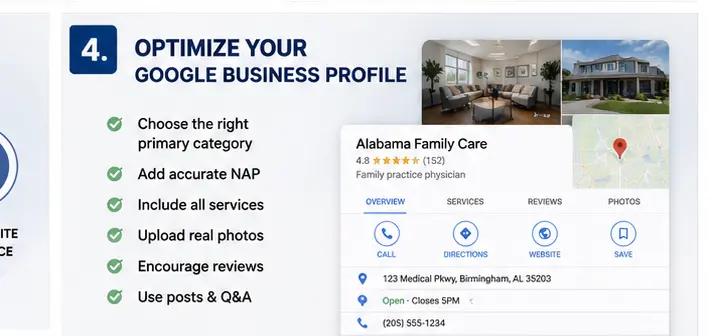
The Google Business Profile is the listing that powers the Map Pack, making it central to local SEO for healthcare practices. For most practices, fixing it is the highest-return hour of work available.
Get the primary category right
This is the most important single field on the profile. A pain management clinic listed under the generic “Doctor” category will lose to a nearby competitor listed under “Pain Management Physician” for the searches that matter most.
Pick the most specific category that describes the main service. Add secondary categories for the other services offered, but do not stack ten of them. Precision beats volume here.
Fill in every field, not just the required ones
Complete profiles outrank thin ones. That means:
- Exact practice name, with no keywords stuffed into it, since that violates Google’s rules and can get a listing suspended
- Full address including suite number
- A local phone number that rings at that office
- Hours, including holiday hours
- Services, listed individually rather than lumped together
- Insurance and accessibility attributes
- A description that explains what the practice treats and where
Add real photos on a regular schedule
Stock photos of smiling strangers do nothing. Photos of the actual waiting room, the building exterior, the parking entrance, and the real staff help patients recognize the place when they arrive. Adding a few new images every month also signals an active listing.
Use posts and the Q&A section
Google Posts keep the profile fresh. Short updates about new providers, extended hours, or a new service work well.
The Q&A section is often ignored, which is a mistake, because anyone can post an answer there. A practice should seed it with the questions the front desk answers every day. Parking. Insurance accepted. Whether walk-ins are taken. New patient wait times.
Do not stop at Google
Bing Places, Apple Business Connect, and the major health directories all feed listings into other search tools and voice assistants. They take an afternoon to set up and then mostly maintain themselves.
If the current profile has not been reviewed in a year, a free SEO audit is a reasonable place to see what is missing before rebuilding anything.
Building Location Pages That Rank and Convert
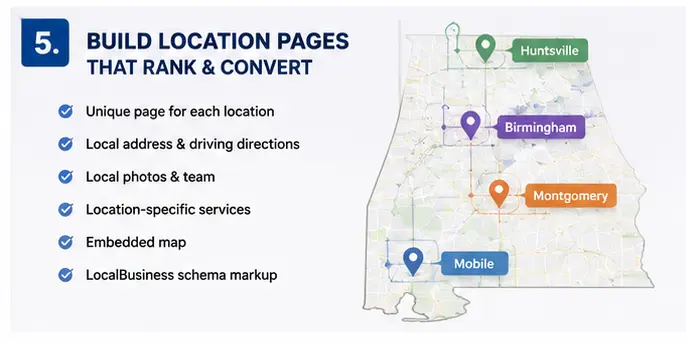
Every physical office needs its own page when building local SEO for healthcare practices. Not a shared “Locations” list with three addresses on it, but a real page per office.
The mistake almost every multi-location practice makes in local SEO for healthcare practices is building one template and swapping the city name. Google reads those pages as near-duplicates, and patients feel the emptiness immediately.
A location page that earns its ranking includes:
- The full address, embedded map, and clear parking directions
- The direct phone number for that office
- Hours specific to that office
- The providers who actually practice there, with links to their pages
- The services offered at that location, since they often differ between offices
- Real photos of that building
- Genuine local detail, like the nearest hospital or the neighborhood it sits in
- LocalBusiness or MedicalClinic schema with that office’s exact details
Each location page should target its own city or neighborhood as part of local SEO for healthcare practices. Two pages both chasing “family medicine near me” compete with each other instead of covering more ground. The on-page SEO checklist covers the title tag and heading structure side of this in more detail.
For a single-office practice in Mobile, the homepage often does this job, though a dedicated page still helps. The mechanics behind local SEO in Mobile, Alabama are the same whether the business is a clinic or a hardware store.
Provider Pages and Their Role in Local SEO
Every doctor, nurse practitioner, and physician assistant deserves a page in a strong local SEO for healthcare practices strategy, with their name in the URL and the H1.
Patients search for people. Someone who gets a referral to “Dr. Sarah Chen in Huntsville” is going to search for that exact name. If a third-party directory holds the top spot, the patient reads a profile the practice does not control, on a page that may list outdated insurance information or a phone number from two jobs ago.
A provider page should include:
- Full name and credentials
- Board certifications, medical school, residency, and fellowship
- Conditions and procedures they treat
- Which office locations they see patients at
- Languages spoken
- A real headshot
- Insurance accepted
- A direct way to book with that provider
- Physician schema markup
These pages also carry weight for Google’s quality standards. Health content sits in the category Google scrutinizes hardest, and named, credentialed authors are one of the clearest trust signals available. A blog post about knee pain written by a named orthopedic surgeon with a linked bio is treated differently than the same words with no author at all.
Service and Condition Pages for Local Search
One page per service. One page per major condition. This structure strengthens local SEO for healthcare practices. Not a single “Services” page listing twenty items with a sentence each.
A page can only rank well for what it is genuinely about. A page trying to cover knee replacement, hip replacement, shoulder repair, and sports injuries is not really about any of them. Four separate pages, each going deep, will outrank it every time.
A strong condition page covers what the condition is, what causes it, what symptoms bring people in, what treatment options exist, what recovery looks like, and when to see someone. Written plainly, in the words patients actually use. “Heart attack” gets searched far more than “myocardial infarction.”
Where it makes sense, connect the service to the location: “physical therapy in Dothan” reads naturally and captures a real search. Where it does not make sense, leave it out rather than forcing it. Choosing which terms to build pages around is easier with keyword research tools than with guesswork.
Internal links matter here too. Condition pages should link to the treatment pages, treatment pages should link to the providers who perform them, and provider pages should link back to the locations they work from. That web of connections helps patients navigate and helps Google understand how the practice fits together.
Reviews and Reputation Management for Medical Practices
Reviews do two jobs in local SEO for healthcare practices. They feed the prominence signal that affects ranking, and they decide whether a patient calls the practice that ranked first or the one that ranked third.
What matters most:
- Steady flow beats big totals. Forty reviews spread across the year looks healthier than two hundred from three years ago.
- Replies signal an active practice. Aim to respond to everything within a few days.
- Perfect scores read as fake. A 4.7 with detailed reviews builds more trust than a flat 5.0 with ten one-line entries.
The way to get reviews is to ask, consistently, right after a good visit. A card at checkout with a QR code, or a text sent the same afternoon, works better than hoping.
The privacy rule that changes everything
A medical practice cannot reply to a review the way a restaurant does. Confirming that someone was a patient, mentioning their condition, or referencing details of their visit can expose protected health information, even when the reviewer shared those details publicly first. The patient can disclose. The practice cannot.
A safe reply thanks the person for the feedback, states that the practice takes concerns seriously, and moves the conversation to a phone number or private email. No confirmation, no clinical detail, no defending the care that was given. Train whoever writes the replies on this before they write a single one. It is the most common way a well-meaning practice creates a real compliance problem.
Citations, NAP Consistency, and Local Links
NAP stands for name, address, and phone number. Those three pieces of information need to match everywhere they appear online, down to the punctuation.
“Suite 200” in one place and “Ste. 200” in another is enough to create doubt. Multiply that across a hundred directory listings and the practice looks less certain than the competitor whose data lines up perfectly.
Start with the listings that carry the most weight for healthcare:
- Google Business Profile and Bing Places
- Healthgrades, Vitals, WebMD, and Zocdoc
- Every insurance directory the practice participates in
- Hospital affiliation pages
- State medical board listings
- The local chamber of commerce
Old addresses are the usual culprit. A practice that moved offices in 2019 will often still have the old suite number sitting in twenty directories.
Local links build the other half of prominence. Sponsoring a youth sports team, speaking at a community health event, partnering with a local employer on wellness screenings, or being quoted in a regional paper all produce links that a competitor cannot easily copy. The general principles behind building quality backlinks apply, with community relationships doing most of the work in healthcare.
Showing Up in Voice Search and AI Answers
More patients now get an answer without clicking anything. They ask a phone assistant for the nearest urgent care, or they type a question into an AI tool and read the summary it produces.
Those systems pull from the same foundation local search uses. A complete Google Business Profile, consistent NAP data, clear schema markup, and pages that answer questions directly all feed into what gets quoted.
Two habits help:
Answer the question in the first two sentences of a section. A paragraph that gets to the point is easy to lift. A paragraph that builds to a conclusion three hundred words later is not.
Write headings as the questions patients actually ask. “How long does recovery from knee replacement take” is a heading. “Recovery Timeline” is a label.
Voice searches also run longer and more conversational than typed ones. Someone asking out loud says “who is the best pediatrician near me that takes Blue Cross,” not “pediatrician Mobile.” FAQ sections written in plain, spoken language capture those. The broader approach to AI search optimization for Alabama businesses goes further into this layer.
Tracking Calls, Leads, and Local SEO Performance
Rankings are a means to an end. New patients are the end. Track both.
From the Google Business Profile: calls placed from the listing, direction requests, website clicks, and how many people found the listing through a discovery search rather than by name. Rising discovery searches means new people are finding the practice.
From the website: organic traffic to location pages, provider pages, and condition pages separately, plus appointment form submissions and click-to-call taps on mobile.
From ranking data: where the practice sits in the Map Pack for its main terms, checked from different points around the service area rather than from the office. Map results change block by block, and a listing that ranks first at the front desk can be invisible four miles away.
From the front desk: the simplest and most overlooked source. Ask new patients how they found the practice and write it down. It catches things analytics never will.
Give it time. Local SEO usually shows early movement in two to three months and meaningful change in six to twelve, depending on how competitive the market is and what shape the site was in to start. Anyone promising the Map Pack in thirty days is selling something. A structured SEO audit at the start gives a baseline worth measuring against later.
How to Manage Local SEO for Healthcare Providers
Local SEO is not a project that finishes. Profiles drift, providers leave, hours change, and competitors keep working. A simple recurring schedule keeps it from falling apart.
Every week
- Reply to new reviews
- Check the Google Business Profile for edits suggested by the public, which Google sometimes applies automatically
- Ask for reviews from patients who had a good visit
Every month
- Publish one or two Google Posts
- Add new photos
- Answer any new questions in the Q&A section
- Review profile insights for calls, direction requests, and discovery searches
- Publish or update one condition or service page
Every quarter
- Audit NAP consistency across the main directories
- Update provider pages for staff changes, new certifications, and insurance updates
- Check Map Pack rankings from several points in the service area
- Review which pages bring in appointment requests and which do not
- Look at what nearby competitors have added
Every year
- Reassess primary and secondary categories
- Refresh photos across all locations
- Review the whole site for outdated information
- Rebuild any location page that has gone stale
The practices that win locally are rarely the ones with the biggest budget. They are the ones that keep doing the small things after everyone else stops.
Choosing a Healthcare Marketing Partner in Alabama
Some practices handle this in-house. Many do not have the time, especially with several locations and a dozen providers to keep current.
If outside help makes sense, a few things are worth checking:
- Does the agency understand patient privacy rules well enough to write review replies safely
- Can they show local search results for real businesses, not just traffic charts
- Do they explain what they are doing in plain language
- Do they build pages a patient would actually want to read, or just pages built for a keyword
- Do they promise specific rankings, which nobody can honestly guarantee
Alpha Digital is based at 5650 Old Pascagoula Rd in Mobile, Alabama, and works with practices and local businesses across the state. The full range of healthcare marketing services covers local search, website structure, and content, and the wider work of the digital marketing agency in Alabama covers everything around it.
Final Takeaways and Next Steps
The short version of everything above:
- The Google Business Profile is the foundation. Get the primary category right, fill in every field, and keep it active.
- Build a real page for each location, each provider, and each major service or condition. No templates with the city swapped.
- Ask for reviews every week, reply within a few days, and never confirm patient details in a public reply.
- Keep name, address, and phone identical everywhere online.
- Write in the language patients use, and answer questions in the first two sentences.
- Track calls and appointments, not just rankings.
- Keep going after the first three months, because that is when most practices quit.
A practical first step: search for the practice by name, then search for its main service plus its city, from a phone, away from the office. Whatever shows up is what patients see. That gap between what appears and what should appear is the work list.
Frequently Asked Questions
How do you manage local SEO for healthcare providers?
We at Alpha Digital, Manage our clients GMBs on a recurring schedule rather than as a one-time project. Weekly, reply to reviews and request new ones. Monthly, post updates, add photos, and refresh a service page. Quarterly, audit directory listings and update provider information. Yearly, review categories and rebuild anything outdated.
How long does local SEO take to work for a medical practice?
Early signs like more profile views and calls often show up within two to three months. Meaningful ranking change usually takes six to twelve months. Competitive markets such as Birmingham take longer than smaller ones. Any guarantee of fast top rankings should be treated as a warning sign.
Can a practice with several locations use one Google Business Profile?
No. Each physical office needs its own verified profile with its own address and local phone number. Combining them hides most locations from local results. Creating a profile for an address the practice does not actually operate from violates Google’s rules and risks suspension.
How do patient reviews affect local search rankings?
Reviews feed the prominence signal Google uses to rank local results. Volume, star rating, how recent the reviews are, and whether the business replies all contribute. Reviews also affect whether a patient calls after seeing the listing, so they influence both ranking and conversion.
What is the difference between local SEO and healthcare SEO?
Local SEO is about ranking in a specific geographic area for any type of business. Healthcare SEO covers search for medical organizations at any scale, including privacy compliance and medical accuracy. Local SEO for healthcare practices is where the two overlap, and it is what most clinics need.
Do individual doctors need their own pages, or is the practice page enough?
Each provider needs their own page. Patients search for doctors by name after a referral, and without a dedicated page a third-party directory will rank first for that name. A provider page also lets a practice control the credentials, insurance details, and booking link a patient sees.



3 Comments