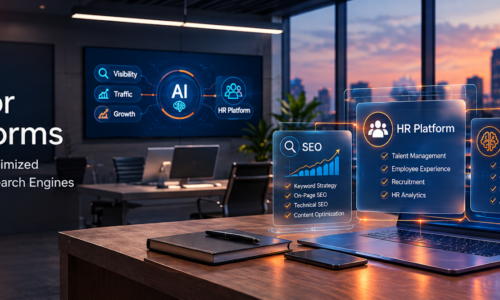
HR software buyers use AI search to do the research a sales call used to cover. Before they open a vendor’s website, they ask ChatGPT, Perplexity or Google’s AI Mode how to handle an HR problem, which tools could help and how those tools compare. G2 surveyed more than 1,000 B2B software buyers in August 2025, and half said they now start the buying journey in an AI chatbot instead of Google Search.
HR software has another complication. Most of the people buying it don’t work in HR. In Australia, 97.3% of businesses have fewer than 20 employees and 64% employ no one at all, according to the Australian Small Business and Family Enterprise Ombudsman. The owner of a 12-person café who needs to give someone a first warning doesn’t search for “HR software.” She asks an AI how to do it properly.
In this blog, we will follow those buyers through the four stages of an AI-led search. The running example is Your HR Toolkit, an AI HR platform that Kairos HR built for Australian small and medium businesses and the people leaders inside them.
How HR software buyers use AI search at each stage
Buyers move through four stages, and they don’t mention software until the third. Each stage rewards a different kind of content.
| Stage | What the buyer asks | What earns the answer |
| 1. Problem | “What notice do I give when ending someone’s employment?” | A direct, accurate answer to the question |
| 2. Type of help | “Do I need an HR consultant or HR software?” | A clear description of each option and who it suits |
| 3. Shortlist | “Best AI HR software for small businesses in Australia” | Comparison articles, review sites and third-party mentions |
| 4. Brand check | “Is Your HR Toolkit suitable for Australian employment law?” | Pages that answer the question on the brand’s own site |
Stage 1: they ask about the problem
The first query is about the situation in front of them. What notice do I give? Can I ask an employee to stop working from home? The buyer wants an answer and a next step, and the AI engine gives them both, citing whichever sources explained it most clearly.
That makes stage 1 the cheapest place for an HR platform to be seen. A short, accurate answer at the top of a help article is easy for an AI engine to lift, and the brand comes along as the source. Your HR Toolkit’s agents work on the same principle: answer first, customize second, and never open with clarifying questions. Our guide on how to get cited by AI search engines covers how to write content in that format.
Stage 2: they ask what kind of help they need
When the problem grows bigger than one letter, the question changes. Should they hire an HR consultant, buy software, or both? Can AI draft an employment contract safely? AI engines answer these by describing categories, so a platform has to be easy to place in one.
The fix is unglamorous. Describe the product the same way everywhere. For Your HR Toolkit, that line is “an AI HR platform for Australian small and medium businesses, built on nine specialist HR agents,” repeated on the website, LinkedIn, review sites and partner pages. When every source says the same thing, an engine has less reason to describe the product differently or leave it out.
Stage 3: they ask for a shortlist
Prompts like “best AI HR software for small businesses in Australia” turn the AI into a recommendation engine. Its answer usually draws on comparison articles, review sites and other pages the vendor doesn’t control, so a polished product page counts for less here than at any other stage.
For an HR platform, the useful sources are reviews from real customers, roundups written by other people, and the websites of HR consultancies that use the product. To see how these engines decide what to cite, read how ChatGPT and Perplexity choose their sources.
Stage 4: they check the brand by name
Before booking a demo, the buyer asks about the shortlisted product directly. Who built it? What does it cost? Will its advice hold up under Australian employment law?
HR raises the stakes. Bad advice about dismissal or pay can end in a Fair Work claim or a back-pay bill, so buyers check harder here than they would for a project management tool. Pages that name the people behind the product, state what it will and won’t advise on, and show pricing give an AI engine accurate material to repeat. For Your HR Toolkit, that starts with founder Annabelle Bishop’s HR experience, which grounds the platform’s knowledge base.
Where local search fits in the HR buying journey
Some owners skip the software question and search for a person, typing “HR consultant near me” or “HR advice Parramatta.” Google answers those with the Local Pack and Maps, which list businesses that have a Google Business Profile tied to a real address or service area. A software company with no local office can’t compete for those results, and Google’s guidelines don’t allow a profile for a place where a business doesn’t operate.
HR platforms reach these searchers through the consultancies that already rank for them. A local HR firm that uses a platform with its clients, and says so on its service pages, puts that platform in front of owners who were never going to search for software. It also gives Google and AI engines a third-party source that ties the product to a place.
Two smaller points apply to the platform’s own site. If the company has a genuine business address, its name, address and phone number should match exactly across the website, its Google Business Profile and directories. State-level pages are worth writing only where the rules differ, such as long service leave, which each state legislates separately. A Sydney page and a Brisbane page with identical text help nobody.
What HR SaaS brands need to publish to be found
Most HR software sites publish product pages and little else. That covers stage 4 and hands the first three stages to publishers and competitors. A site built for AI search covers every stage:
- Answer-first HR guides. Each opens with a 40 to 60 word answer to one real question. Employment-law content carries a named reviewer and a “last reviewed” date, because a buyer acting on it needs to know it’s current.
- A category page. One page that says what the product is, who it’s for and how it compares with hiring a consultant, using the same description as every external profile.
- Use-case and comparison pages. Separate pages for a business owner with no HR staff and a people leader managing a team, plus fair comparisons with established platforms.
- Third-party coverage. Review-site profiles, partner mentions and expert commentary in Australian business media.
- Trust pages. The founder and her credentials, the platform’s limits, and pricing.
- Australian signals throughout. Australian English, local terms such as award rates and unfair dismissal, and prices in AUD.
Most of this content does two jobs. The same answer-first guide can rank in Google and be quoted by an AI engine. For what that AI traffic is worth once it lands, see our look at traffic quality from AI Overviews. For the full process on a live HR platform, see our work on AI SEO for HR platforms.
How to check what AI tells your buyers today
Write down five questions your buyers ask at stage 1 and five they ask at stage 3. Run each through ChatGPT, Perplexity and Google AI Mode, and note which brands and sources every answer names. If you’re missing from the shortlist answers, work on third-party coverage first. If you’re missing from the problem answers, start with answer-first guides. Alpha Digital runs this check across a whole category as part of an SEO audit.
Frequently Asked Questions
Do businesses use ChatGPT to choose HR software?
Many do, and the share is rising. In G2’s August 2025 survey of more than 1,000 B2B software buyers, half said they now start the buying journey in an AI chatbot rather than Google Search. Small business owners often start earlier still. Their first question is usually about an HR problem, such as how to handle a resignation or write a warning letter, rather than about a product. The tools they end up considering are often the ones named in those early answers. For an HR software company, visibility in AI answers now begins well before a buyer types the word “software,” so content written for problem questions matters as much as product pages.
What questions do SMB owners ask AI before buying an HR tool?
They start with the task in front of them. Typical questions cover issuing a first warning, working out a notice period, writing an employment contract or handling a request for flexible work. Once the problem feels bigger than one document, they ask what kind of help they need, usually whether to hire an HR consultant, buy software or use both. Next come shortlist questions, such as which HR tools suit a business with fewer than 20 staff. Last, they check specific products by name: who built them, what they cost and whether they fit their country’s employment law. Each of these stages calls for a different kind of content.
How does AI search change the HR software buying journey?
It compresses the early research into a single conversation. A buyer used to read several articles, visit vendor websites and perhaps call a consultant before forming a shortlist. Now they can get an answer to an HR problem, a list of possible tools and a rough comparison from one chat, before visiting any vendor’s site. That moves the point where a brand wins or loses. Products named in those answers make the shortlist, and products left out may never be considered, however good their own website is. The sources AI engines draw on, such as review sites and comparison articles, also carry more weight than they did before.
What content do HR buyers trust in AI answers?
They trust answers they can check. That usually means an answer that cites a recognizable source, names a qualified expert and matches official guidance, such as information from the Fair Work Ombudsman. HR mistakes can lead to unfair dismissal claims, underpayment and back pay, so careful buyers click through to the cited source before acting on what an AI tells them. For HR software brands, this gives trust signals a practical job. Employment-law content should show who wrote or reviewed it, when it was last reviewed and which official rules it relies on. Content without those details gives buyers, and AI engines, less reason to rely on it.
How can HR SaaS brands show up at each stage of the buyer journey?
Publish content for each stage, not just product pages. For problem questions, write answer-first HR guides that open with a short, accurate answer and name an expert reviewer. For questions about types of help, publish one category page that explains what the product is, who it suits and how it compares with hiring a consultant. For shortlist questions, build comparison and use-case pages and earn coverage on review sites, partner websites and industry media. For brand checks, publish trust pages covering the founder, the platform’s limits and pricing. Throughout, keep the product description identical on every page and profile so AI engines connect the brand to its category.