
Logistics companies generate more B2B leads through SEO when the people responsible for choosing a freight partner, a 3PL, or a warehousing provider find that company first, before a single email or phone call happens. Procurement teams and supply chain managers now research vendors quietly online for weeks, comparing service pages, case studies, and even asking AI tools like ChatGPT which providers handle a specific lane or a specific type of cargo. A logistics company that shows up clearly during that research phase gets the meeting. One that does not show up rarely gets a chance to compete on price or service later, since it was never on the list to begin with.
This guide breaks down exactly how SEO works for a logistics or supply chain business in 2026, what makes B2B search different from consumer search, and the specific moves that turn search visibility into qualified leads a sales team can actually close.
What Makes SEO Different for Logistics Companies
SEO for a logistics company works differently than SEO for a restaurant or a retail store, because the buyer is not making a same day decision. Research on the modern B2B buying journey from Gartner found that B2B buyers complete about 80 percent of their buying journey before they ever contact a vendor directly. For a logistics company, that means a supply chain manager has usually already compared several providers and formed an opinion long before a sales rep ever hears from them.
This is why simply ranking for a broad term like “logistics company” rarely produces real leads. The buyers worth winning are searching for very specific things: a 3PL that handles temperature controlled freight, a customs broker familiar with a particular port, or a company that can manage last mile delivery across several states. A multi location SEO content strategy matters here too, since most logistics and supply chain companies operate out of several hubs, warehouses, or terminals rather than one single address, and each of those locations can be found separately when the content is built correctly.
Why Logistics Buyers Are Searching Differently in 2026
Search behavior has changed for procurement teams the same way it has changed for everyone else. Research from TrustRadius, reported by Corporate Visions, found that 94 percent of B2B buyers now use a large language model such as ChatGPT during their research, and 72 percent ran into an AI generated overview somewhere along the way. A supply chain manager comparing freight brokers is just as likely to ask an AI tool to name a few options as they are to type a search into Google.
This is why a logistics company’s content needs to work for both systems at once. Content built around clear, direct answers gets pulled into an AI generated response the same way it earns a spot on a search results page. Content written the old way, vague and generic, promising to handle every logistics need without naming a single specific service or lane, tends to get skipped by both. A closer look at using ChatGPT for SEO and content creation shows how this same shift is already playing out across other B2B industries, not just logistics.
The Core SEO Moves That Generate Logistics Leads
A handful of specific moves make the biggest difference for a logistics or supply chain company trying to generate real leads through search.
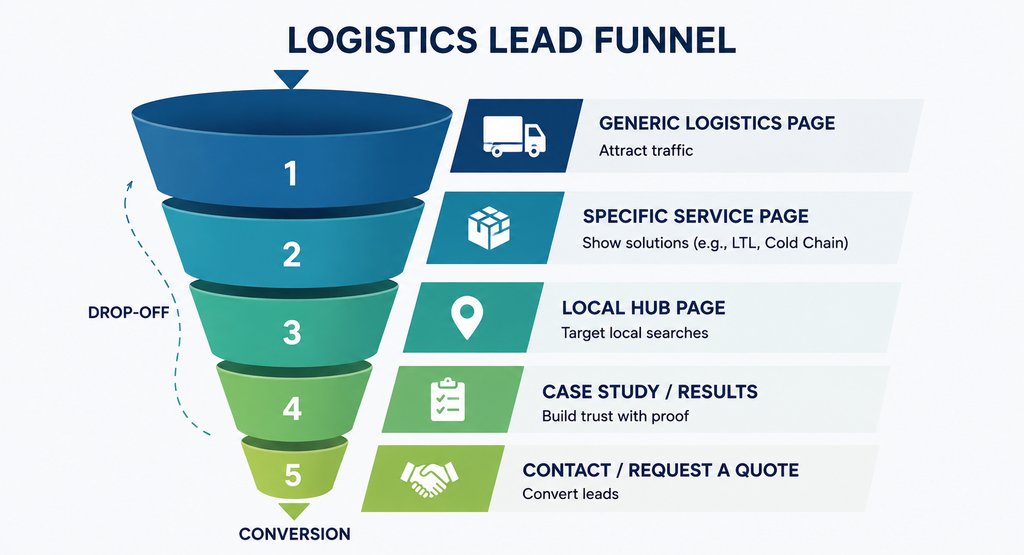
- Target the specific service, not just the industry. A dedicated page for “less than truckload freight” or “cold chain logistics” will out rank and out convert a single generic services page every time, because it matches the exact language a buyer or an AI tool is looking for.
- Build content around real buyer questions. Supply chain managers search for things like shipping lead times, capacity during peak season, or compliance requirements for a specific type of cargo. Answering these questions directly, in plain language, is what earns a spot in both a Google result and an AI generated answer.
- Treat every hub or terminal as its own local page. A local SEO strategy built for multi location businesses helps a logistics company get found separately in every city or region it actually operates in, instead of competing only on one single national page.
- Keep content current without burning a full team on it. A business process automation guide shows how AI assisted workflows can keep service pages and blog content updated as lanes, capacity, and services change, which matters since outdated logistics content loses trust fast with both readers and AI tools.
- Build proof into every page. Specific numbers, on time delivery rates, and named client industries do more for a logistics company’s credibility than broad claims of speed or reliability ever will.
Turning Search Visibility into Qualified B2B Leads
Ranking well is only half the job. The other half is making sure a visitor becomes a real, qualified lead instead of just a page view. This is where SEO needs to connect directly into the rest of a logistics company’s sales process. An AI lead qualification setup can score and route a form submission the moment it comes in, so a sales team spends time on the shippers actually worth a call instead of chasing every generic inquiry. Pairing that with marketing and sales AI integration keeps every lead moving instead of sitting in an inbox for a week, and a proper CRM and email integration makes sure no shipper who filled out a quote request gets forgotten.
This kind of full funnel approach already works outside logistics. Alpha Digital’s work with Inktel, a business process outsourcing company competing in another crowded B2B market, used a similar combination of targeted SEO and updated content to grow qualified inbound interest instead of relying only on outbound sales. The same underlying method applies just as well to a freight brokerage or a 3PL, and the full record of results across industries sits inside Alpha Digital’s case studies.
The Bottom Line for Logistics Companies
A logistics company does not need to outrank every competitor for every keyword to win more B2B leads. It needs to be the company that shows up, with a clear answer, exactly when a shipper or supply chain manager is comparing options, whether that comparison happens on Google or inside an AI tool. The logistics focused work Alpha Digital has done follows this same approach: specific pages, real proof, and content built for how buyers actually search now.
A free SEO audit is the simplest way for any logistics company to see exactly where those gaps are before a competitor closes them first.
Frequently Asked Questions
How do you monitor AI search visibility?
Monitoring AI search visibility means running the same real customer questions through ChatGPT, Perplexity, and Gemini on a regular schedule and recording which businesses get named in each answer. A monthly check is enough for most local businesses, since AI generated answers tend to shift less often than traditional search rankings do.
Why choose an AI search visibility platform?
A dedicated platform saves the time of manually testing prompts across several AI tools every month and can flag changes automatically. The tradeoff is that most platforms report visibility in fairly general terms, so pairing a platform with manual spot checks, like the method used in this report, gives a much clearer picture of what a specific Alabama customer would actually see.
What are the best AI search visibility tools?
The most useful tools combine prompt tracking across ChatGPT, Perplexity, and Gemini with alerts whenever a business gets added to or dropped from an answer. A business without budget for a dedicated tool can cover most of the same ground by manually running five or six real customer questions through each platform once a month, the exact approach behind this report.
How can a business improve brand visibility in AI search?
Improving brand visibility in AI search starts with the same groundwork as local SEO: a complete Google Business Profile, consistent business details across the web, structured data on the website, and a steady pace of new customer reviews. AI tools tend to reward the same trust signals that Google Search already rewards.
How do you measure AI search visibility?
Measuring AI search visibility means scoring how many AI platforms cite a business, out of the total number tested, for a specific customer question. This report used a three point scale across ChatGPT, Perplexity, and Gemini, the same simple method any Alabama business can run on its own with a handful of real customer questions.