
A multi location SEO content strategy is the plan that decides what content each of your locations needs, in what order, and how those pages connect to each other so every address can actually rank instead of competing with your own site. Most businesses skip this step. They build one location page per address, copy the same three paragraphs onto each one, and wonder why only the original office ever shows up in search.
This guide walks through how to build a multi location SEO content strategy that scales past ten, fifty, or five hundred locations without turning into duplicate, thin content that Google and your customers can both see through.
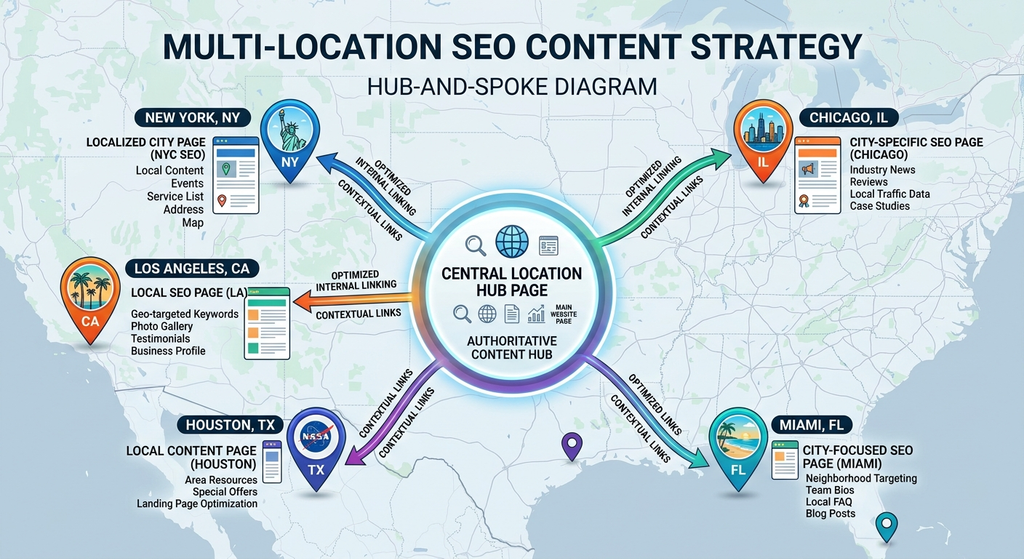
Why Most Multi Location SEO Content Strategies Fail
Most multi location content strategies fail for one simple reason: the content team treats every address like a copy paste job instead of a real page. A location page that only swaps in the city name looks thin to Google and feels thin to the person reading it, whether that’s one location or three hundred.
This is a companion problem to the maps and profile side of things covered in local SEO for multi location businesses. A strong Google Business Profile and a pile of reviews can only carry a location so far if the website content behind it is thin or duplicated. The two pieces work together, not separately.
Build a Content Architecture Before You Write a Single Page
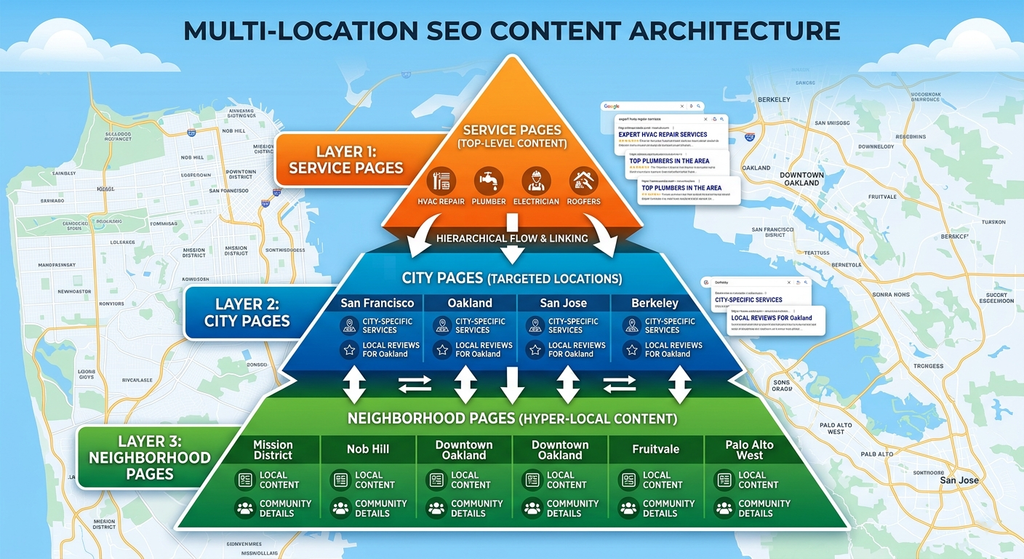
A multi location SEO content strategy starts with architecture, not a list of pages. Before writing anything, map out how your service pages connect to your city pages, and how your city pages connect to the neighborhoods inside them. This structure is what search engines use to understand your business as one connected entity instead of a scattered collection of pages.
Think of it as three layers. Core service pages sit at the top and explain what you do everywhere, the same way a page like digital marketing agency covers the whole brand. City pages sit in the middle and cover one metro area. Neighborhood or location pages sit at the bottom and cover one specific address. Each layer links to the layer above and below it, so authority flows through the whole site instead of pooling on the homepage.
This same layered approach applies across different industries too. A retail chain, a law firm, and a healthcare group all need the same three layers. Only the details inside each page change.
Give Every Location Its Own Real Page, Not a Template
A multi location seo content strategy only works if each page earns its own place in search, and a template with the city name swapped in does not earn anything. Real content means real details: staff specific to that address, services that actually differ there, and local context a copywriter sitting in another state could not fake.
Look at how this plays out across an existing set of location pages. A page built for Downtown Miami covers different foot traffic and competition than one built for Little Havana, Palmetto Bay, or Kendall. Each one needs its own primary keyword tied to its own geography, plus LocalBusiness schema markup that matches that location’s exact name, address, and phone number.
Schema markup does not replace real content. It just tells search engines and AI tools plainly what they are looking at, so they do not have to guess.
Real photos help too, actual pictures of the storefront, the team, and the neighborhood itself, rather than the same stock image swapped across every page. Google’s ranking systems and any real person reading the page can both tell the difference between a location that genuinely exists and one that only exists on paper.
Avoid Duplicate Content and Keyword Cannibalization
Two location pages competing for the exact same generic term cancel each other out instead of reinforcing the brand. If a Miami page and a Doral page both chase the same broad phrase, Google has to pick one, and neither one wins as clearly as it would alone.
The fix is a keyword map. Assign each location page its own primary term built from the city or neighborhood name plus the actual service, and check a resource like an on page SEO checklist against every new page before it goes live. Watch Search Console for pages that start competing with each other over time, since cannibalization tends to creep in slowly rather than show up all at once.
Affordable does not have to mean thin. A guide like affordable Miami SEO solutions still treats every page as unique, it just prioritizes the highest value locations first when budget is limited. This is exactly the kind of problem a solid multi location SEO content strategy prevents before it starts.
Match Content to Buyer Intent at Every Stage
A multi location SEO content strategy has to cover more than one kind of search. Someone typing “what is SEO” wants an explanation. Someone typing “SEO services near me” wants to book a call. Both searches matter, and both need a different kind of page.
Start with real keyword research tools to sort keywords by intent before writing anything. Informational searches get blog posts and guides, the kind covered in what is SEO and why is it important. Commercial and buyer intent searches get service and location pages built to convert, the kind of thinking behind why every website needs SEO.
Mixing the two on one page usually satisfies neither. A blog post trying to also sell something reads as pushy, and a service page trying to also educate reads as slow. Split the job across two pages and link them to each other instead.
Write for Zero Click Search and AI Answer Engines
A multi location content strategy built only for classic blue links is already behind. Recent research puts the share of Google searches ending without a click at well over half, and that climbs above 80 percent once an AI Overview appears. Every page in your architecture needs to answer its core question in the first sentence, not the third paragraph.
This is where SEO, AEO, and GEO meet. SEO ranks the page. AEO, answer engine optimization, gets the page quoted directly in the answer box. GEO, generative engine optimization, gets the business named when someone asks an AI tool like ChatGPT or an AI Overview for a recommendation nearby. All three depend on the same habit: open every section with a plain, self contained answer.
Google made this official rather than optional. Its spam policy update on May 15, 2026 stated plainly that manipulating AI generated answers now carries the same penalty as manipulating regular rankings. A June 2026 update went further and specifically targeted keyword stuffing and mass produced content. A proper SEO analysis done today has to check both the classic ranking factors and this newer answer engine layer.
Connect Everything With Internal Links
None of the above works in isolation. A multi location SEO content strategy needs internal links running in both directions: location pages linking up to their city and service pages, and hub content like the articles section linking back down into the specific locations that need the most support.
Look at how a complete SEO services guide for the USA can anchor an entire cluster, with every city and location page underneath it linking back up. Businesses researching the right marketing agency for multi location businesses should expect exactly this kind of connected structure, not a set of isolated pages that happen to share a domain.
Scale Content Without Losing Quality
A multi location SEO content strategy has to survive scale, not just launch. Franchise and enterprise brands run into a different problem: not too little content, but too much of it made too fast. A multi location marketing agency built for scale still writes every page like it matters, because it does. Ten locations or ten thousand, the standard does not drop.
A simple content calendar keeps this honest. Prioritize the locations with the most search volume or the weakest current rankings first, then work down the list. Full SEO services built around a franchise model plan for this from day one instead of retrofitting it later, once thin pages are already live and already ranking poorly.
Common Content Mistakes Multi Location Brands Make
Most of these mistakes trace back to the same root cause: treating one location’s content plan as good enough to copy across every other address.
- Publishing a location page that only changes the city name
- Letting two pages compete for the same broad keyword
- Writing only for search engines and forgetting the actual reader
- Skipping schema markup on new location pages
- Building pages with no internal links up or down the site structure
- Treating content as a one time task instead of an ongoing calendar
A brand can run great SEO for restaurants, salons, and local shops at one location and still lose ground everywhere else if these basics slip at the others.
How Alpha Digital Builds Multi Location Content Strategies
Alpha Digital builds multi location SEO content strategies around the same architecture covered here: real pages for every address, a keyword map that avoids cannibalization, and internal links connecting the whole structure. You can see the approach in the portfolio or read through the case studies directly.
For a closer look at how the team works, the about us page covers the background, and a free SEO audit is the fastest way to see where your current content stands. You can also get in touch directly to talk through a specific location count or industry.
Frequently Asked Questions
What is a multi location SEO content strategy?
It is a plan for what content every business location needs, in what order, and how those pages link together so each address can rank on its own instead of competing with the others.
How many location pages do I need?
One real page per physical location, at minimum. Service area businesses without a public storefront can use Google’s service area targeting instead of creating a page for an address that does not exist. A brand with only two or three locations can sometimes fold them into one services page for now, but that stops working the moment a fourth location opens.
Do I need a blog for every single location?
No. A shared blog can serve the whole brand. Location pages handle the address specific content, and blog posts handle broader questions that apply everywhere.
What is keyword cannibalization and how do I avoid it?
It happens when two pages on the same site compete for the same search term. Avoid it by giving every location page its own primary keyword tied to its own geography, then checking Search Console for overlap over time.
Does a multi location SEO content strategy work for franchises and enterprise brands?
Yes. The architecture stays the same at any scale. What changes is the calendar, since a franchise with hundreds of locations needs a prioritized rollout instead of publishing everything at once.
How does content strategy help with AI Overviews and zero click search?
Pages written with a plain, self contained answer near the top are the pages AI Overviews and other AI tools tend to pull from. Content strategy is what makes that structure consistent across every location instead of accidental on one page.
Does this apply outside the United States?
Yes. The same architecture works whether every location sits inside the US or spreads into Canada, the UK, or the UAE. The keyword research changes by market. The structure does not.



5 Comments