
Most websites have on-page SEO problems that are directly suppressing their rankings. The pages sitting below a competitor are often not worse in topic or depth. They are worse in execution: missing title tag keywords, mismatched search intent, poorly structured headings, or slow page load times that push them down regardless of content quality.
On-page SEO is the set of optimizations you make directly to your own pages to signal relevance, quality, and authority to search engines. It sits alongside off-page SEO (backlinks and external authority) and technical SEO (site infrastructure), but it is the one you have the most direct control over and the one where most ranking wins come from.
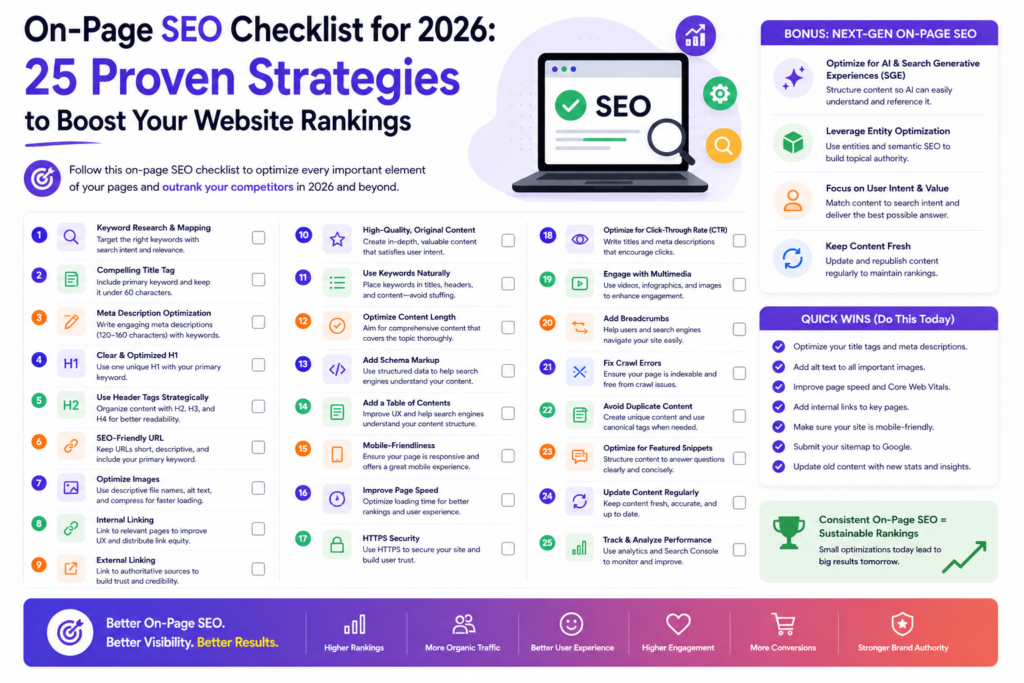
In 2026, on-page SEO also determines your visibility in Google AI Overviews, ChatGPT citations, and generative search results alongside traditional Google rankings. This checklist covers all 25 on-page factors that matter now.
What Is On-Page SEO?
On-Page SEO Definition
On-page SEO is the practice of optimizing individual web pages to rank higher in search engine results and earn more relevant organic traffic. It covers every element on the page that you control: the title tag, meta description, URL, heading structure, body content, images, internal links, schema markup, and page performance signals.
Why On-Page SEO Matters
Search engines use on-page signals to assess whether a page is relevant to a query, authoritative on the topic, and worth ranking ahead of competing pages. A page with weak on-page optimization can have quality content and still fail to rank because the signals Google reads are not aligned with what the searcher needs.
On-Page SEO vs Off-Page SEO vs Technical SEO
On-page SEO covers what is on the page. Off-page SEO covers what happens elsewhere on the web, primarily backlinks and brand mentions. Technical SEO covers the site infrastructure that determines whether pages can be crawled, indexed, and loaded properly.
All three are necessary. A well-optimized page on a technically broken site will not rank. A page with great technical foundations but no backlinks will struggle to rank for competitive terms. On-page is where you start because it is the foundation the other two build on. For a broader view of how these three components fit together, the guide to what is SEO and why it is important for your business covers the complete picture before going deep on any single component.
Why On-Page SEO Is More Important Than Ever in 2026

Google’s AI Search and AI Overviews
Google AI Overviews appear at the top of many search results pages and pull from websites with well-structured, authoritative content that directly answers the query. To be cited in an AI Overview, your page needs clear headings that match how questions are phrased, direct answers in the opening sentences of each section, structured data that helps Google understand your content’s meaning, and topical completeness that signals genuine expertise.
On-page optimization is what determines whether your content is structured for AI extraction, not just keyword matching.
EEAT and Helpful Content
Google’s E-E-A-T framework (Experience, Expertise, Authoritativeness, Trustworthiness) is now a core quality signal across all content categories, not just health and finance. Pages that demonstrate real-world experience with a topic, cite specific sources, and present accurate, useful information consistently outrank pages that cover the same topic without those signals.
On-page SEO in 2026 means building EEAT signals into the page itself: author credentials, specific examples, primary source citations, and content that goes beyond restating what every other page on the topic already says.
User Experience as a Ranking Factor
Google’s ranking algorithm uses behavioral signals from real users. Pages that consistently lose visitors quickly, generate no secondary page views, and produce no conversion events tell Google the content is not satisfying the query even if it appears to match technically. On-page optimization now includes the page’s ability to hold attention, satisfy the reader’s intent, and guide them toward the next action.
Complete On-Page SEO Checklist
1. Perform Proper Keyword Research
Every page should target one primary keyword and a cluster of semantically related secondary keywords identified through research rather than assumption. Use Google Search Console to see what queries your existing pages already rank for, then use Ahrefs, Semrush, or similar tools to identify keyword gaps and volume data.
Keyword research determines every other on-page decision: what the title tag says, how the content is structured, what angle the introduction takes, and which questions the page needs to answer.
2. Understand Search Intent
Search intent is what the person searching actually wants to find. Informational intent means they want to learn something. Navigational intent means they want a specific site. Commercial intent means they are comparing options. Transactional intent means they are ready to buy or sign up.
Before writing or optimizing any page, look at the top ten results for your target keyword. Are they blog posts, product pages, comparison guides, or how-to articles? That mix tells you what format Google is rewarding for that query. A service page targeting a keyword where every top result is an informational guide will not rank until the format matches the intent.
3. Create an SEO-Friendly URL
Your URL should be short, descriptive, lowercase, and include the primary keyword with hyphens separating words. A URL like /on-page-seo-checklist-2026/ is readable by both humans and search engines. A URL like /p?id=4929&cat=seo is not.
Avoid dates in URLs unless the content is strictly time-bound. Avoid stop words (a, the, and, of) where they are not needed. Keep URLs as short as they can be while remaining descriptive.
4. Write an Optimized Title Tag
The title tag is the single most important on-page SEO element. It appears as the clickable headline in search results and is one of the strongest relevance signals Google uses.
Place the primary keyword near the beginning of the title. Keep the total character count under 60 to avoid truncation in search results. Write the title to earn a click, not just to match the keyword. A title that explains the specific value of the page outperforms a title that is just a keyword phrase.
5. Create a High-CTR Meta Description
Meta descriptions do not directly affect rankings, but they directly affect click-through rate. A well-written meta description that describes what is on the page, includes the primary keyword, and gives the searcher a reason to click produces more organic clicks from the same ranking position than a generic or auto-generated one.
Keep meta descriptions under 160 characters. Include the primary keyword naturally. End with an action or value statement, not a product name.
6. Use One Optimized H1 Tag
Every page gets exactly one H1. It should include the primary keyword close to the beginning and accurately describe what the page covers. Do not use the H1 as a marketing tagline. Use it as a clear description of what the page is about.
Multiple H1 tags on a single page are a common error in themes and page builders. Check your page source to confirm there is only one.
7. Use a Proper Heading Structure (H2, H3, and H4)
Headings create a hierarchy that helps search engines understand which sections of your content are most important and how the page’s topics relate to each other.
H2 Best Practices
H2s are your main section headings. Each one should cover a distinct subtopic of the page’s main topic. Include secondary keywords in H2s where they fit naturally without forcing them. Aim for H2s that could stand alone as useful questions or points even if the reader only skims the headings.
H3 Best Practices
H3s sit under H2s and cover specific aspects of the H2’s section. Use H3s when a section has multiple distinct components worth separating. Do not use H3s just to add visual hierarchy to short sections that do not need subdivision.
H4 Best Practices
H4s sit under H3s. Use them sparingly, only when a section genuinely has a third level of meaningful subdivision. A page with H4s throughout often has structure imposed on content rather than structure emerging from it.
8. Write High-Quality Content
Content quality in 2026 is assessed against two standards: does it fully satisfy the search intent for this query, and does it demonstrate genuine expertise that a real expert would recognize?
Satisfying search intent means covering the topic at the depth the searcher needs, in the format they expect, with the specific information they came for. Demonstrating expertise means including specific examples, citing primary sources, giving concrete numbers rather than vague generalizations, and addressing aspects of the topic that less thorough sources ignore.
9. Optimize Your Introduction
The introduction determines whether a visitor reads the page or leaves immediately. Google uses early engagement signals as a quality indicator, so an introduction that holds attention directly affects ranking over time.
Write an introduction that immediately identifies the reader’s problem or goal, signals that the page addresses it specifically, and gives the reader a reason to continue. Avoid lengthy preambles that delay the point. The first two sentences should earn the third.
10. Improve Content Readability
A page that is difficult to read loses visitors regardless of how accurate its information is. Readability factors that affect both user experience and SEO include sentence length, paragraph length, use of subheadings, and the vocabulary level relative to the target audience.
Keep paragraphs to three to four sentences. Use short sentences for important points. Vary sentence length to avoid robotic rhythm. Write at the reading level of your actual audience, not at the level that sounds most impressive.
11. Optimize Images
Image File Names
Name image files descriptively before uploading them. A file named on-page-seo-checklist-2026-alpha-digital.webp tells search engines what the image shows. A file named IMG_4923.jpg tells them nothing.
Alt Text
Write alt text that accurately describes what the image shows and includes the primary keyword where it fits naturally. Alt text serves two functions: it gives search engines a text signal about the image, and it describes the image for users who cannot see it. Both functions require the same thing: an accurate, specific description.
Image Compression
Uncompressed images are one of the most common causes of slow page load times, which directly suppresses rankings through Core Web Vitals scores. Compress every image before uploading. Tools like Squoosh, TinyPNG, or ShortPixel compress images without visible quality loss.
WebP Images
WebP is Google’s preferred image format. It delivers smaller file sizes than JPEG or PNG at the same visual quality. Most modern CMS platforms either convert images to WebP automatically or support manual WebP uploads. Use WebP as your default format for all photography and illustration.
12. Internal Linking Strategy
Internal links distribute ranking authority across your site and help search engines understand the relationship between your pages. Every new page you publish should link to at least two existing pages, and at least two existing pages should link to it.
Use descriptive anchor text that matches the topic of the destination page rather than generic phrases. Link to your highest-priority service and pillar pages from multiple other pages across the site.
The top SEO strategies for organic traffic guide covers how internal linking strategy fits within a complete organic growth approach. If you want professional support building an internal link architecture that supports your most valuable pages, Alpha Digital’s SEO services include link mapping as a standard part of every site audit.
13. External Linking Best Practices
Linking to authoritative external sources where relevant strengthens your content’s credibility. A page that cites primary research, industry data, or authoritative publications reads as more trustworthy than one that makes claims without any external reference.
Link to high-quality sources that support specific claims. Do not link to competitors’ commercial pages. Add rel=”nofollow” to sponsored or paid links. Open external links in a new tab to keep the visitor on your site.
14. Add Schema Markup
Schema markup is structured data added to your page’s HTML that helps search engines understand what your content is and enables rich result formats in search results.
Article Schema
Article schema tells Google that a page is a news article, blog post, or how-to guide. It enables byline information, publication date, and breadcrumb display in search results.
FAQ Schema
FAQ schema marks up question-and-answer sections. Pages with properly implemented FAQ schema often earn expanded FAQ results in Google that take up significantly more SERP real estate than a standard blue link.
Breadcrumb Schema
Breadcrumb schema tells Google how a page fits within your site hierarchy. It enables breadcrumb display in search results, which improves click-through rates by giving searchers context about the page’s location within the site.
Organization Schema
Organization schema marks up your business name, logo, contact information, and social profiles. It helps Google build a clear knowledge panel for your brand and supports brand entity recognition in AI search systems.
15. Optimize Core Web Vitals
Largest Contentful Paint (LCP)
LCP measures how long it takes for the largest visible content element to load. Google recommends under 2.5 seconds. Common causes of slow LCP are uncompressed images, render-blocking JavaScript, and slow server response times.
Interaction to Next Paint (INP)
INP replaced First Input Delay as a Core Web Vitals metric in 2024. It measures how quickly the page responds to user interactions like clicks and taps. Poor INP is usually caused by heavy JavaScript execution blocking the main thread.
Cumulative Layout Shift (CLS)
CLS measures how much the page layout shifts during loading. A score above 0.1 is considered poor. Common causes are images without defined dimensions, ads loading after the page has rendered, and web fonts that swap after text has already appeared.
16. Optimize for Mobile Devices
Google indexes the mobile version of your site first. A site that is difficult to use on a phone has a structural ranking disadvantage that on-page content optimization cannot overcome.
Test your mobile experience on a real device, not just a browser emulator. Check that text is readable at 16px or larger without zooming, that tap targets are at least 44px wide, and that the navigation works without a mouse.
17. Improve Page Speed
Page speed affects both rankings and conversion rates. A one-second improvement in load time reduces bounce rates measurably across most industry categories.
The highest-impact speed improvements are image compression, browser caching, elimination of render-blocking resources, reduction of unused JavaScript and CSS, and CDN implementation to serve content geographically close to the visitor.
18. Keep Content Fresh
Content that was accurate two years ago may now be outdated. Google’s freshness signals reward pages that update their content to reflect current information, particularly for topics where best practices, statistics, or recommendations change over time.
Review your most important pages annually. Update statistics to current data, add sections covering recent developments, and republish with an updated date. A refreshed page with an existing backlink profile recovers its ranking faster than a new page built from scratch.
19. Optimize for Featured Snippets
Featured snippets appear at position zero, above all organic results. To earn a snippet, your page needs to answer a specific question in a concise, directly extractable format.
The most snippet-eligible content formats are: a direct one-to-two sentence answer immediately following a heading that matches the query, a numbered list for process or ranking queries, and a table for comparison queries. Structure your content to match these formats for your most important target keywords.
20. Optimize for Voice Search
Voice search queries are longer and more conversational than typed queries. They are often phrased as complete questions: “What is the best way to optimize a meta description?” rather than “meta description optimization.”
To rank for voice search, create FAQ sections that match natural question phrasing, answer questions directly in the first sentence rather than building to the answer, and optimize your Google Business Profile for local voice queries that include a location.
21. Optimize for AI Search (AEO)
Answer Engine Optimization prepares your content to be cited in AI-generated responses from ChatGPT, Perplexity, Gemini, and Google AI Overviews. The content formats that earn AI citations share three characteristics: they answer questions directly in the first sentence, they are structured with clear headings that match how questions are phrased, and they demonstrate topic authority through comprehensive coverage.
For each important keyword cluster, write content that answers the most common questions around that topic completely, not just the primary keyword. AI systems extract answers from comprehensive content more readily than from narrow single-keyword pages.
22. Optimize for GEO (Generative Engine Optimization)
Generative Engine Optimization builds the authority and entity signals that cause AI systems to treat your website as a trusted source worth citing in generated responses. Where AEO addresses content format, GEO addresses content authority.
GEO requires building topical authority through interconnected content clusters, earning citations from authoritative external sources, ensuring your brand entity is clearly defined across your website and external profiles, and using structured data that helps AI systems accurately identify and attribute your content.
23. Build EEAT Signals
EEAT signals tell Google that the content comes from a genuine expert with real experience of the topic. The most concrete on-page EEAT signals are: author bylines with credentials and relevant experience, specific first-person examples from the author’s or organization’s actual work, citations of primary sources and original research, and content that addresses aspects of the topic only someone with direct experience would know.
Add author profile sections to every blog post and article. Link author names to author profile pages that list credentials, publications, and relevant background. Include specific examples and case references throughout the content.
24. Add Strong Calls-to-Action
Every page should have a clear next action for the visitor. A reader who finishes a page and has no obvious next step is a missed conversion opportunity.
The strongest calls-to-action are specific about what the reader gets (“Get a free 30-minute SEO audit that shows exactly which pages are suppressing your rankings”) rather than generic (“Contact us”). They appear above the fold for high-intent pages, at logical pause points within long content, and at the conclusion of the page.
25. Optimize for Sitelinks and Breadcrumbs
Breadcrumb navigation tells both users and search engines how a page fits within the site hierarchy. Properly structured breadcrumbs with breadcrumb schema markup enable breadcrumb display in search results, which increases click-through rates by giving searchers immediate context about where the page sits within the site.
Common On-Page SEO Mistakes to Avoid
Keyword Stuffing
Placing the primary keyword in every other sentence does not improve rankings. It reduces content readability, triggers spam filters in Google’s algorithm, and produces a worse user experience that depresses engagement signals. Use keywords where they fit naturally: in the title, the H1, one or two H2s, the introduction, and throughout the body where they belong contextually.
Duplicate Content
Two pages covering the same topic with near-identical content split ranking authority between them. Google selects one to rank and typically deprioritizes or ignores the other. Audit for duplicate content across your site using Screaming Frog and consolidate near-duplicate pages through 301 redirects or canonical tags.
Missing Internal Links
New pages published without internal links from other pages have no authority flow and are harder for search engines to discover. Every page should receive internal links from at least two existing pages within the first few weeks of publication.
Slow Website Speed
A page that takes more than three seconds to load on mobile loses a significant portion of visitors before they ever read a word. Speed problems compound because slow pages produce higher bounce rates, which Google reads as a quality signal over time.
Missing Alt Text
Images without alt text are invisible to search engines and inaccessible to screen readers. Every image needs an accurate descriptive alt text that serves both functions.
Poor Mobile Experience
Text too small to read, buttons too close together to tap, and content that requires horizontal scrolling all produce negative engagement signals on mobile that feed back into ranking decisions. Google’s mobile-first indexing means mobile experience directly determines how the page ranks even for desktop searches.
Missing Schema
Schema markup is one of the few on-page factors that is still underused by most websites. Pages with properly implemented FAQ, Article, Breadcrumb, and Organization schema consistently earn richer search result formats that increase click-through rates without requiring any improvement in ranking position.
Best On-Page SEO Tools in 2026
Google Search Console
Free and essential. Shows which queries trigger impressions for each page, what position each page ranks at, and what click-through rate each position earns. The Core Web Vitals report and Index Coverage report surface technical issues that suppress rankings. Every on-page SEO workflow starts here.
Google Analytics 4
Tracks what organic visitors do after they land on your page. Time on page, scroll depth, conversions, and exit patterns all tell you whether the page is satisfying its intent after the ranking has been earned. Rankings without conversion data are incomplete information.
Ahrefs
The strongest tool for keyword research, content gap analysis, and competitive benchmarking. The Site Audit feature identifies on-page issues at scale. The Content Explorer identifies what content in your category earns the most backlinks and engagement.
SEMrush
Comprehensive SEO platform covering keyword research, site auditing, on-page optimization scoring, and competitor analysis. The On-Page SEO Checker produces page-specific recommendations based on what top-ranking competitors are doing differently.
Screaming Frog
Website crawler that exports every on-page element across all pages simultaneously. Missing title tags, duplicate meta descriptions, broken internal links, missing alt text, and redirect chains are all surfaced in a single crawl report.
PageSpeed Insights
Google’s official tool for measuring Core Web Vitals and page performance on both mobile and desktop. Provides a prioritized list of specific improvements with estimated impact for each.
Rich Results Test
Tests whether a page’s structured data is valid and eligible for rich result formats in Google search. Run every page with schema markup through this tool before publishing to confirm the implementation is correct.
On-Page SEO Checklist: Quick Reference
| Element | Check |
| URL | Short, descriptive, lowercase, keyword included |
| Title Tag | Primary keyword near the start, under 60 characters |
| Meta Description | Keyword included, under 160 characters, action-oriented |
| H1 | One per page, includes primary keyword |
| H2/H3/H4 | Logical hierarchy, secondary keywords included naturally |
| Content | Matches search intent, demonstrates expertise, comprehensive |
| Introduction | Hook in first two sentences, no preamble |
| Images | Descriptive file names, alt text, compressed, WebP format |
| Internal Links | At least two per page, descriptive anchor text |
| External Links | Cites authoritative sources, nofollow on paid links |
| Schema | Article, FAQ, Breadcrumb, and Organization schema implemented |
| Mobile | Readable without zoom, tappable buttons, no horizontal scroll |
| Speed | LCP under 2.5s, INP under 200ms, CLS under 0.1 |
| Core Web Vitals | All three metrics in “Good” range in Search Console |
| EEAT | Author credentials, specific examples, primary source citations |
| AEO | Direct answers, question-matching headings, comprehensive coverage |
| GEO | Entity signals, topic clusters, structured data |
| Featured Snippet | Direct answer immediately after heading for priority keywords |
| Voice Search | FAQ format, conversational phrasing, local Business Profile complete |
| CTA | Specific, action-oriented, present above the fold and at page end |
Why Choose Alpha Digital for Professional SEO Services?
Alpha Digital has audited and optimized pages across industries from local service businesses to platforms with millions of users. Our on-page SEO work is not a checklist run against a template. It starts with understanding what your specific pages need to rank above the specific competitors appearing above them.
Every engagement begins with a full technical and on-page audit. The audit identifies which of the 25 factors on this checklist are missing or underperforming, and our team prioritizes fixes by their estimated ranking impact rather than by how easy they are to implement.
If you want to see where your pages stand against this checklist right now, a free SEO audit shows the specific gaps before you commit to any work. Our SEO services page covers what a full on-page optimization engagement includes. For businesses that want SEO coordinated with paid advertising and content, the digital marketing services overview connects all three. And if you are ready to discuss your site specifically, contact our team and we will start with what matters most for your market.
Final Checklist and Next Steps
On-page SEO is not a one-time task. It is an ongoing process of ensuring your pages are the best available answer to the queries you are targeting, structured in ways that search engines and AI systems can accurately extract and evaluate.
The 25 factors on this checklist address every controllable element that affects where your pages rank in 2026. Some take an hour to implement across a single page. Others are site-wide projects. The right place to start is always an audit that tells you which factors are missing, underperforming, or actively suppressing your rankings before you spend time on changes that are already done correctly.
A free SEO audit from Alpha Digital shows exactly where your pages stand against this checklist, with specific findings prioritized by their estimated impact on your rankings. If you are ready to move from the checklist to the work, our SEO services team is ready to start.
Frequently Asked Questions
What is on-page SEO?
On-page SEO is the optimization of individual web pages to rank higher in search results. It covers every element you control on the page: title tags, meta descriptions, URL structure, heading hierarchy, content quality, images, internal links, schema markup, and performance signals like page speed and Core Web Vitals. On-page SEO is what makes a page relevant and readable to both search engines and the people searching.
What are the most important on-page SEO ranking factors?
Title tag optimization, content that matches search intent, heading structure, page speed, and Core Web Vitals are consistently among the highest-impact on-page factors. In 2026, EEAT signals, schema markup, and AEO-formatted content for AI Overviews have become increasingly important alongside the traditional factors. No single factor determines rankings alone: all 25 factors on this checklist contribute to the overall quality signal a page sends.
How many keywords should I target per page?
One primary keyword and a cluster of three to eight semantically related secondary keywords per page. Targeting more than one primary keyword splits the page’s focus and often results in ranking for neither term well. Secondary keywords should appear naturally throughout the content where they are topically relevant, not forced into every section for coverage.
Does on-page SEO help AI Overviews?
Yes. Google’s AI Overviews pull from well-structured pages with clear headings, direct answers in the opening sentences of each section, and comprehensive topic coverage. Proper schema markup, particularly FAQ schema, also increases the likelihood of being cited. On-page optimization specifically for AI Overviews means structuring content to answer questions directly and completely rather than building to the answer.
Is schema markup important?
Yes. Schema markup is one of the most consistently underused on-page SEO factors, which means implementing it gives your pages a genuine advantage over competitors who have not. FAQ schema earns expanded search results that take up significantly more SERP space than standard listings. Article schema enables rich result display. Organization schema supports brand entity recognition. All of these improve click-through rates at the same ranking position.
How many internal links should a page have?
Enough to give search engines a clear path to your most important related pages, and enough to give human readers useful next steps. For most blog posts and service pages, three to eight internal links distributed throughout the content is appropriate. Avoid stuffing internal links into every paragraph: one or two per major section is sufficient for most pages.
How often should I update on-page SEO?
Audit your most important pages quarterly. Update any page that has dropped more than five positions from its peak ranking, any page with outdated statistics or information, and any page whose content no longer matches the current search intent for its target keyword. Freshness updates on high-value pages that already have backlinks recover ranking faster than rebuilding from scratch.
Does page speed affect rankings?
Yes, directly. Google uses Core Web Vitals (LCP, INP, and CLS) as ranking signals, and these metrics are primarily determined by page speed and visual stability. A slow page that produces poor Core Web Vitals scores ranks lower than a technically equivalent fast page. Page speed also affects conversion rates independent of rankings: a one-second improvement in load time reduces bounce rates measurably across most industries.
What is the ideal content length?
Long enough to fully satisfy the search intent for the target keyword, and no longer. For competitive informational keywords, top-ranking pages typically contain 1,500 to 3,000 words. For transactional keywords, shorter and more conversion-focused pages often rank better than long informational ones. Check the word count of the top five results for your target keyword and use that as your baseline rather than a universal number.
What is the difference between on-page SEO and technical SEO?
On-page SEO covers what is visible on the page: content, headings, title tags, images, internal links, schema, and readability. Technical SEO covers the site infrastructure: crawlability, indexing, site speed, server configuration, HTTPS, XML sitemaps, and robots.txt. Both affect rankings, but they address different problems. A page with excellent on-page SEO on a site with technical indexing issues will not rank. A technically perfect site with weak on-page optimization will rank poorly for competitive terms.


6 Comments