
Social media has transformed the way people discover brands, communicate with businesses, share experiences, and make purchasing decisions. For companies, platforms such as Instagram, Facebook, LinkedIn, TikTok, and X are no longer simply channels for posting updates. They have become important parts of brand building, customer service, lead generation, and digital marketing.
Behind a successful social media presence is often a Responsibilities of a Social Media Manager who plans the content, manages conversations, monitors performance, and makes strategic decisions based on audience behavior. That professional is the social media manager.
A modern social media manager does much more than publish posts. They combine content creation, audience research, community management, analytics, social media advertising, brand communication, and strategic planning to help businesses achieve measurable marketing goals.
In this guide, we will explore what are the Responsibilities of a Social Media Manager, what they do, the skills they need, the tools they use, and how their role contributes to business growth in 2026.
What Is Social Media Management?
Social media management is the process of planning, creating, publishing, monitoring, and analyzing content across social media platforms.
It includes activities such as developing content calendars, writing captions, creating visual content, responding to comments and messages, monitoring brand mentions, analyzing engagement, researching competitors, and measuring campaign performance.
However, effective social media management is not simply about being active every day.
The objective is to ensure that every social media activity supports a larger business goal. Depending on the company, that goal could be increasing brand awareness, generating leads, driving website traffic, improving customer relationships, launching products, increasing sales, or building an online community.
This is why professional social media management services involve both creative execution and strategic decision making.
Social media should also work alongside SEO, content marketing, paid advertising, and website optimization. A coordinated approach helps businesses create a consistent digital presence across multiple channels. Businesses looking to build this broader strategy can explore digital marketing services.
Why Is Responsibilities of a Social Media Manager Important for a Business?
Social media platforms move extremely quickly. Trends change, algorithms evolve, customers expect faster responses, and competitors are constantly publishing new content.
Without a dedicated strategy, businesses can easily end up posting inconsistently or creating content without understanding whether it contributes to meaningful business results.
A social media manager provides structure.
They help a business maintain a consistent brand voice, understand its audience, create relevant content, respond to customers, identify opportunities, and use performance data to improve future campaigns.
A skilled manager also understands that follower count alone is not a reliable measure of success. A smaller audience that actively engages with a brand, visits its website, requests information, and purchases products can be significantly more valuable than a large audience with little interest in the business.
Core Responsibilities of a Social Media Manager
The Responsibilities of a Social Media Manager vary depending on the organization, industry, and business objectives. However, several responsibilities are common across most professional social media roles.
Content Strategy and Planning
One of the most important responsibilities of a social media manager is developing a content strategy.
Before creating posts, the manager needs to understand who the target audience is, what problems they have, which platforms they use, what type of content they engage with, what competitors are publishing, and what business goals the content should support.
The manager then converts this research into a structured content calendar.
A content calendar may include educational posts, promotional content, customer stories, product demonstrations, industry insights, short videos, polls, testimonials, behind the scenes content, and community focused posts.
The objective is to create a balanced content mix rather than repeatedly promoting the same product or service.
For businesses that want to improve their content strategy, our guide to creating engaging social media content provides additional ideas for developing content that attracts and retains attention.
Content Creation and Curation
Social media managers are often responsible for creating or coordinating different types of content.
This can include social media captions, images, graphics, Instagram Reels, short form videos, carousels, Stories, polls, educational posts, product demonstrations, customer testimonials, user generated content, and company announcements.
The type of content depends heavily on the platform.
For example, LinkedIn may require a more professional and educational approach, while Instagram can rely more heavily on visual storytelling and short form video.
The manager must understand these differences instead of copying exactly the same post across every platform.
Content creation should also have a clear purpose. Some posts may build awareness, others may encourage engagement, while others may drive traffic or generate leads.
Businesses can also learn how to improve their content performance through our guide on becoming a pro in social media content creation.
Community Engagement and Customer Care
Social media is fundamentally a two way communication channel.
Publishing content is only one part of the job. A social media manager also monitors comments, direct messages, mentions, reviews, and other interactions.
When a customer asks a question, the manager may provide an answer. When someone complains about a product or service, the manager may acknowledge the issue and move the conversation toward an appropriate resolution.
This responsibility requires strong communication and judgment.
A professional social media manager should know when to respond publicly, when to move a conversation into direct messages, and when an issue needs to be escalated to another department.
Consistent community management can help humanize a brand and demonstrate that the company actually listens to its customers.
Analytics and Performance Tracking
Modern social media management relies heavily on data. Managers use tools like Meta Business Suite, Google Analytics, or Sprout Social to measure how well posts perform. They track engagement rates, clicks, reach, and conversions. These numbers help identify what is working and what needs improvement.
By studying analytics, a social media manager can make smarter decisions about timing, tone, and type of content. For example, if video posts are getting more engagement, they might plan more of them in the future.
Collaboration with Marketing Teams
Social media does not work in isolation. It is part of a bigger marketing strategy that includes advertising, SEO, and branding. A social media manager often works closely with marketing and design teams to ensure everything aligns.
They help promote new products, share company updates, and create campaigns that support business goals. Good communication and teamwork make sure that social media reflects the brand’s identity across all platforms.
Strategic Responsibilities of a Social Media Manager in Brand Growth
The Responsibilities of a Social Media Manager are not just content creators; they are strategists who guide how a brand grows online. Their role is to plan, execute, and adjust campaigns that attract attention and drive real results.
Building a Consistent Brand Voice
Every brand has a personality, and social media managers help express it clearly. They make sure posts, visuals, and replies all sound like they come from the same source. Whether the tone is friendly, professional, or playful, consistency helps audiences recognize and trust the brand.
Developing a Long-Term Strategy
A strong social media strategy starts with business objectives.
Instead of asking only how often a company should post, the manager needs to ask what the business wants social media to accomplish.
The objectives could include increasing brand awareness, generating qualified leads, increasing website traffic, improving customer retention, promoting products, or establishing industry authority.
Once objectives are defined, the social media manager can select appropriate platforms, content formats, publishing frequencies, campaigns, and performance metrics.
This strategic approach prevents businesses from wasting time producing content that does not contribute to meaningful outcomes.
Businesses can learn more about developing a complete approach through how to build a powerful social media marketing strategy.
Researching Audiences and Competitors
Understanding who the audience is and what they care about helps managers craft relevant content. They use insights from surveys, analytics, and social listening to learn what followers enjoy and what topics are trending.
They also keep an eye on competitors to see how others in the industry engage with audiences. This helps them find new opportunities to stand out.
Measuring ROI and Proving Impact
At the end of the day, businesses want to know how social media affects their bottom line. A good manager connects their work to measurable results such as higher engagement, more leads, or stronger brand awareness. By presenting clear reports, they show how social media directly supports company goals.
Social Media Analytics and Performance Tracking
Modern social media management depends heavily on analytics.
The responsibilities of a social media manager needs to understand whether the content being produced is actually achieving its intended purpose.
Important metrics can include:
- Reach
- Impressions
- Engagement rate
- Likes
- Comments
- Shares
- Saves
- Video watch time
- Profile visits
- Website clicks
- Leads
- Conversions
- Follower growth
However, metrics should always be interpreted in context.
A post with thousands of views may look successful, but if the objective was lead generation and it produced no meaningful traffic or inquiries, its business value may be limited.
This is why experienced social media managers connect platform metrics with broader marketing and business objectives.
Developing Social Media Campaigns
In Responsibilities of a Social Media Manager may also plan and execute campaigns around specific objectives.
A campaign could promote a new product, service launch, seasonal promotion, company announcement, event, lead magnet, brand awareness initiative, or customer appreciation campaign.
Campaigns usually require more planning than individual posts.
The manager may establish campaign messaging, creative concepts, publishing schedules, target audiences, hashtags, calls to action, paid promotion, and measurement criteria.
A well planned campaign gives the business a clear objective and makes it easier to evaluate whether the investment produced meaningful results.
Social Media Advertising
Organic social media is only one part of modern social media marketing.
Many businesses also use paid advertising on platforms such as Meta, LinkedIn, TikTok, and other networks.
A social media manager may work with advertising specialists to coordinate organic and paid campaigns or may manage paid campaigns directly.
This can involve audience targeting, creative testing, campaign monitoring, budget allocation, retargeting, and performance analysis.
Businesses interested in paid promotion can also learn more from our guide comparing Google Ads and Facebook Ads.
The key is to ensure that advertising supports the overall marketing strategy instead of operating separately from organic content.
Collaboration With Other Marketing Teams
Social media managers rarely work alone.
They often collaborate with SEO specialists, content writers, graphic designers, video editors, paid advertising specialists, sales teams, customer service teams, web developers, and brand managers.
For example, an SEO specialist may identify an important search topic, a content writer may create a detailed article, and the social media manager may turn that article into multiple social posts and short videos.
This creates a connection between search visibility, content marketing, and social media.
Businesses can strengthen this connection by combining social media with professional SEO services.
Tools and Technologies Shaping Social Media Management
Technology has completely transformed how social media managers work. Today, managing multiple platforms is faster and more organized thanks to modern tools. These tools help with everything from scheduling posts to tracking performance and understanding audience behavior.
Scheduling and Automation Tools
Platforms like Buffer, Hootsuite, and Later allow managers to plan posts days or even weeks in advance. This helps maintain consistency and saves time, especially when managing several accounts. Automation tools also make it easier to post at times when followers are most active, ensuring better engagement.
While automation helps, good managers still keep a personal touch. They monitor comments, reply in real time, and make sure scheduled posts fit current events or trends.
Analytics and Reporting Tools
Understanding what works is a big part of effective social media management. Tools like Sprout Social, Google Analytics, and Meta Business Suite give detailed insights into performance. These tools show which posts perform best, what kind of content people like most, and when they are most active online.
By studying these reports, social media managers can make data-driven decisions. They can adjust strategies, test new ideas, and improve results over time.
Content Creation and Design Tools
Visuals matter in today’s digital world. Tools like Canva, Adobe Express, and CapCut help create eye-catching graphics and videos quickly. These tools make it easy to design posts that look professional and fit the brand’s style, even without a full design team.
Some platforms also use artificial intelligence to suggest templates, captions, or hashtags. This saves time and helps maintain a fresh, modern look.
Social Listening and Trend Tracking
Listening tools such as Brand watch and Mention help social media managers track what people are saying about their brand online. They also monitor trends and hashtags to identify new opportunities for engagement. This information helps managers respond faster to customer feedback and join trending conversations at the right moment.
What Skills Does a Social Media Manager Need?
The modern role requires a combination of creative, analytical, technical, and communication skills.
Communication Skills
Social media managers communicate with customers, employees, creators, influencers, and business leaders.
Clear writing and professional communication are therefore essential.
Creativity
The social media landscape is crowded.
Creative thinking helps brands produce content that stands out while remaining consistent with their identity.
Analytical Thinking
Managers need to interpret performance data and turn it into practical decisions.
They should be comfortable identifying patterns, comparing results, and testing new approaches.
Organization
Managing multiple platforms, campaigns, deadlines, and content formats requires strong organization.
A content calendar and clear workflow can help prevent missed deadlines and inconsistent publishing.
Adaptability
Social platforms change constantly.
Managers need to learn new features, formats, tools, and audience behaviors while remaining flexible when a strategy stops producing results.
Strategic Thinking
The best managers understand how individual posts contribute to larger business objectives.
They do not judge success only by likes or followers. They consider how social media contributes to awareness, engagement, traffic, leads, sales, and customer relationships.
Social Media Manager vs Social Media Marketer
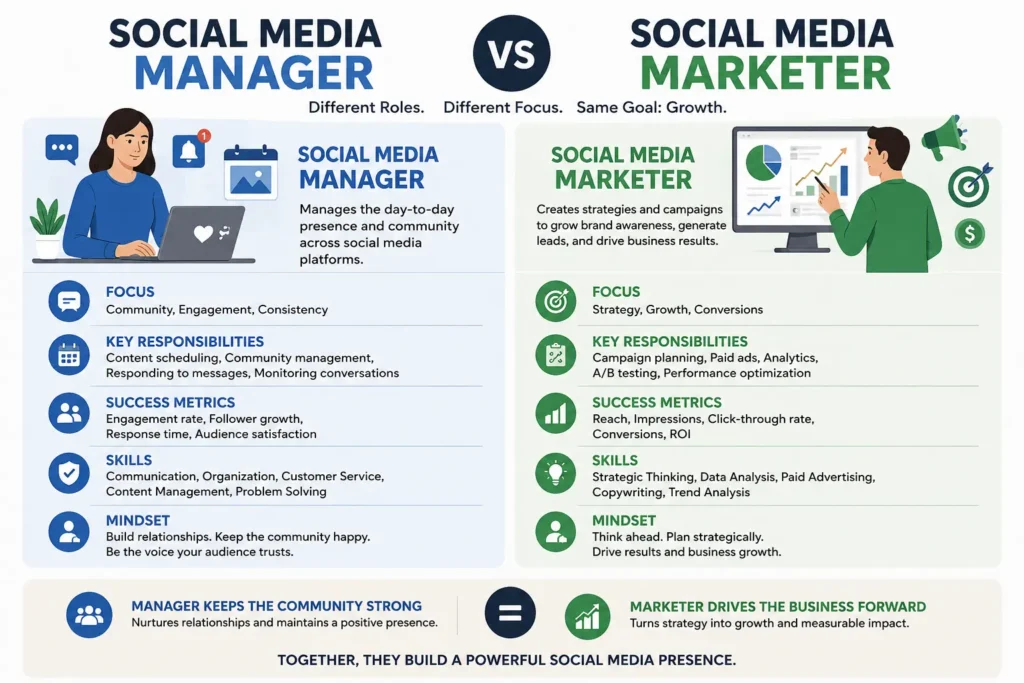
These roles can overlap, but they are not always identical.
A social media manager generally focuses heavily on the day to day operation of social channels, including content publishing, community management, engagement, and reporting.
A social media marketer may have a broader focus that includes campaign strategy, paid advertising, audience acquisition, lead generation, and integration with other marketing channels.
In smaller companies, one person may perform both roles.
The exact responsibilities depend on the organization’s size, industry, marketing structure, and business goals.
How Social Media Managers Contribute to Business Growth
The Responsibilities of a Social Media Manager can contribute to business growth in several ways.
They can increase brand visibility by consistently publishing valuable content.
They can strengthen customer relationships through direct communication.
They can support lead generation by directing users toward relevant landing pages and offers.
They can improve brand credibility through educational content, testimonials, expert insights, and customer experiences.
They can also provide valuable customer and market feedback to other departments.
Most importantly, they can turn social media activity into a structured marketing process instead of random posting.
For companies looking for professional support, social media management services can help create a more consistent strategy covering content planning, publishing, engagement, analytics, and ongoing optimization.
How Social Media Fits Into a Broader Digital Marketing Strategy
Social media performs best when it is connected to the rest of a company’s digital marketing ecosystem.
For example, a business may publish an SEO optimized blog article, promote it through LinkedIn and Facebook, turn its key points into Instagram carousel content, create a short video for Reels, and use paid advertising to reach a relevant audience.
This approach allows one piece of content to generate value across several channels.
Social media can also support SEO indirectly by increasing content visibility, encouraging engagement, and helping brands build awareness.
For businesses that want to combine multiple digital channels, a comprehensive digital marketing strategy can provide a more coordinated approach.
Final Thoughts
Social media management has become one of the most important parts of modern marketing. The Responsibilities of a Social Media Manager combines creativity, strategy, and technology to help brands grow, connect, and stay relevant.
When done right, social media management is not just about posting online. It is about building real relationships and making a lasting impression in a world that is always scrolling.
FAQs
What are the Responsibilities of a Social Media Manager for daily Tasks?
A social media manager creates and schedules posts, responds to comments and messages, tracks engagement, and analyzes performance data. They also plan campaigns, manage brand voice, and stay updated on trends to keep the brand active and relevant online.
Why is social media management important for businesses?
Social media management helps businesses build brand awareness, engage with customers, and drive sales. It allows companies to connect directly with their audience, share their story, and stand out in a competitive digital space.
What skills are needed to be a successful social media manager?
A good social media manager should have strong communication, writing, and design skills. They also need to understand analytics, know how to use digital tools, and have a creative mindset to plan engaging and effective content.
How can social media management improve customer relationships?
By responding quickly to comments and messages, social media managers show customers that their opinions matter. This builds trust, improves satisfaction, and encourages loyal, long-term relationships with the brand.
Which tools are best for managing social media accounts?
Popular tools include Hootsuite, Buffer, Sprout Social, and Canva. These platforms help schedule posts, design content, and track results. The best choice depends on your brand’s goals and the platforms you use most.