
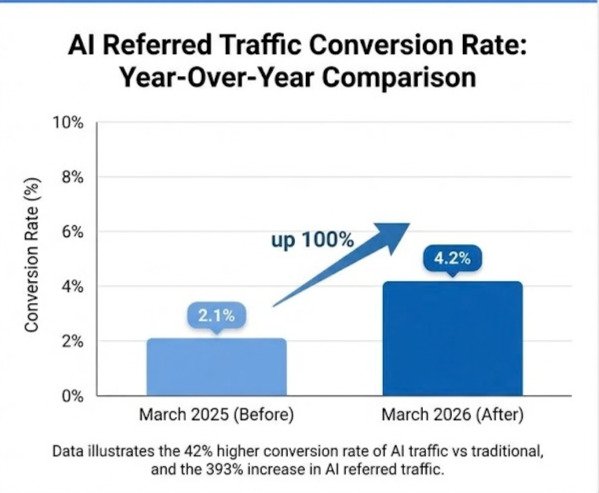
According to Adobe Analytics, which tracked more than a trillion visits to US retail sites, AI referred traffic rose 393 percent year over year in the first quarter of 2026. That traffic also converted 42 percent better than traditional visitors and generated 37 percent more revenue per visit in March alone. This AI Shopping Search Report breaks down a shift that is already measurable, not theoretical: shoppers are asking AI tools what to buy instead of typing a query into a search bar, and the brands those tools name are pulling ahead of the ones they skip.
A year earlier, AI traffic was converting worse than human shoppers and generating far less revenue per visit. That reversal is the real story behind this AI Shopping Search Report: AI shopping assistants went from a curiosity to a channel that outperforms the traffic brands have spent years optimizing for. This guide covers what changed, how AI tools actually pick which products to recommend, and the specific steps a brand takes to show up in that recommendation instead of getting skipped over.
The State of AI Shopping Search in 2026
The numbers behind this AI Shopping Search Report point to adoption that moved faster than most retailers planned for. Roughly 39 percent of shoppers surveyed say they already use AI tools for online shopping research, and 85 percent of that group say it improved their experience. That is not a small early adopter segment. It is a meaningful share of buyers who now ask a chatbot or an AI Overview before they ever open a retailer’s website.
What makes this different from a normal traffic channel is the intent behind it. A person asking an AI assistant to compare two products, find a gift within a budget, or recommend something similar to an item they already own is closer to a purchase decision than someone typing three words into a search bar. That buyer intent is part of why AI referred shoppers convert at a higher rate once they do land on a retailer’s site. The AI already did a round of filtering before the person ever clicked.
The same Adobe data shows AI shoppers browsing 13 percent more pages per visit and staying on site 48 percent longer than traditional visitors, with engagement running 12 percent higher overall. That pattern makes sense once the intent behind the visit is clear. A shopper who arrives already narrowed down to two or three options spends that extra time comparing specifics, not bouncing around trying to figure out what they even want.
Which Product Categories Are Moving Fastest
Not every category is affected equally yet. Products that involve a comparison step before purchase, electronics, apparel, home goods, and gifts in particular, show the heaviest AI assisted research, since a shopper benefits the most from an assistant that can weigh specs, prices, and reviews across several options at once. Categories built on habit or urgency, like groceries or emergency repairs, are moving more slowly, simply because there is less to compare before buying. The broader pattern behind consumer AI adoption, covered in the future of AI in digital marketing, shows the same comparison of heavy categories leading across other parts of search too, not just shopping. A brand selling into a comparison heavy category has the most to gain from fixing its AI shopping search readiness now, before competitors in that same category do it first. This AI Shopping Search Report treats that readiness as a near term priority rather than a future project precisely because the Adobe numbers above show the shift already happening in live purchase data, not in a forecast.
Why Classic Ecommerce SEO Isn’t Enough Anymore
Classic ecommerce SEO still matters. A fast site, clean category pages, and solid technical SEO are the foundation everything else sits on. But a product page ranking well in classic search can still lose the sale if an AI shopping assistant never surfaces it as an option at all, because answer engine optimization, generative engine optimization, and large language model optimization now sit on top of that foundation as their own discipline.
AEO, answer engine optimization, is what gets a product named directly inside an AI generated answer instead of buried in a list of links a person has to click through one at a time. GEO, generative engine optimization, is what gets a brand mentioned by name when a shopper asks an AI tool for a recommendation rather than a search term. LLMO, large language model optimization, covers the technical side of making sure a model can actually read and trust a brand’s product data in the first place. A brand treating these as optional extras on top of SEO is optimizing for a shrinking share of how people actually shop now.
How AI Shopping Assistants and Agents Actually Choose Products
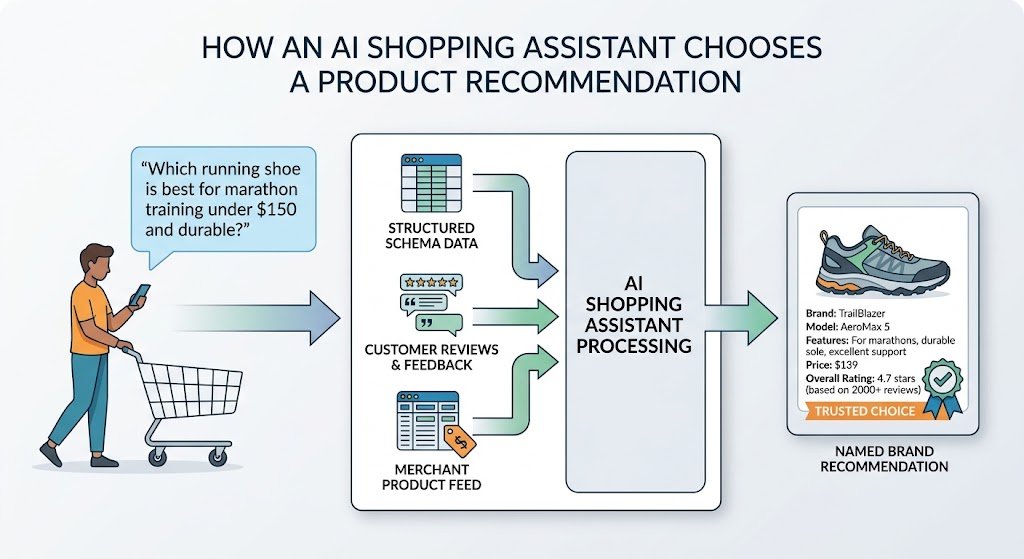
An AI shopping assistant does not browse a storefront the way a person does. It reads structured data, cross checks trust signals, and pulls from a product feed that may never touch a brand’s own website design at all. Understanding that process is the core of any real AI Shopping Search Report, because it explains exactly where most brands lose the recommendation before a shopper ever sees their product.
Structured Product Data and Schema Come First
Product schema, the structured markup that labels price, availability, brand, and reviews in a format a machine can parse without guessing, is often the single biggest gap between a brand that gets recommended and one that gets skipped. The mechanics behind what actually counts as an AI citation apply just as directly to a product listing as they do to a local business profile. If an AI system cannot confirm a price or a stock status instantly, it tends to move to a competitor whose data is easier to trust.
Product Feeds and Merchant Center Data Feed the Model Directly
A clean, current product feed does double duty now. It feeds Google Shopping the way it always has, and it increasingly feeds the AI shopping assistants and agents that pull directly from that same structured data rather than crawling a storefront page by page. Category mismatches between a brand’s own taxonomy and the one a feed expects are a common, quietly expensive mistake, since a product filed under the wrong category can become invisible to an AI tool even while it ranks fine in classic search.
Conversational Content Answers the Actual Question Being Asked
People do not type three word search fragments into an AI assistant. They ask full questions: which of these two products lasts longer, what is the best option under a specific budget, or which brand actually ships internationally without a markup. Product pages and category content written to answer that exact phrasing, in one direct sentence near the top, are the ones an AI model can lift cleanly into its answer.
Reviews and Independent Mentions Still Carry the Trust Signal
An AI model cannot physically inspect a product, so it leans on the same signals a careful shopper would check: genuine reviews with real detail, consistent pricing and availability across channels, and independent mentions on sites the brand did not write itself. A product with thin or inconsistent reviews gets quietly passed over in favor of one an AI system can verify with more confidence, the same E-E-A-T pattern that already governs local and informational search.
Visual and Multimodal Search Are Already Live
A growing share of product discovery starts with an image rather than a word: a photo of an item someone wants to match, or a screenshot from a social feed. Multimodal AI tools that can read an image and return a shopping result need clean, well labeled product photography and alt text that actually describes the product, not a generic filename. Brands skipping this layer are invisible to an entire category of search that has nothing to do with typed keywords at all.
Autonomous Shopping Agents Are the Next Layer, Not a Future One
Shopping agents that can compare prices, check stock, and complete a purchase on a person’s behalf are no longer theoretical. These agents depend on the exact same structured data and crawler access covered above, just applied with less human oversight in the loop. A brand with clean product data today is already positioned for agents that act more independently tomorrow, without needing a separate technical project later.
7 Ways Brands Are Preparing for the Next Search Revolution
- Auditing product schema and feed accuracy first. Before writing new content, a brand checks whether an AI system can even confirm price, availability, and core product attributes without guessing. An on page SEO checklist adapted for product pages usually surfaces this gap fast, alongside a general SEO audit of the catalog as a whole.
- Rewriting product and category pages to answer real questions. Direct, self contained answers near the top of a page outperform a long marketing introduction every time an AI system is deciding what to quote.
- Treating reviews as a visibility asset, not an afterthought. Genuine, detailed reviews feed directly into the trust signals an AI model checks before naming a product, the same way they feed into E-E-A-T for any other kind of content.
- Cleaning up product photography and alt text for visual search. Clear, accurately labeled images are no longer a nice to have once multimodal search is part of how people shop.
- Confirming crawler access for AI bots, not just search engines. A blocked robots.txt file or content rendered entirely through JavaScript with nothing readable underneath keeps an AI shopping assistant out just as effectively as it keeps out a classic search crawler.
- Measuring AI shopping visibility directly, not just rank. Checking the real questions a shopper would ask an AI tool, then noting whether a brand actually gets named, is the retail version of the share of model tracking that already matters for local and informational AI search.
- Building the reporting habit around revenue, not position. Since AI referred traffic already converts better and spends more per visit according to the Adobe data above, tracking that traffic as its own segment, separate from classic organic, is what shows whether the work in this AI Shopping Search Report is actually paying off.
None of these six steps work well in isolation. A brand that fixes product schema but never updates its photography for visual search closes one gap while leaving another wide open, which is why most teams that succeed here treat it as one coordinated project instead of six separate tickets.
Common Mistakes Brands Make Preparing for AI Shopping Search
- Treating AEO and GEO as a content afterthought instead of a technical and content project together
- Leaving product feed categories mismatched with the site’s own taxonomy
- Publishing product pages that lead with brand story instead of the direct answer a shopper actually needs
- Ignoring image alt text and treating visual search as optional
- Letting reviews sit thin or unmanaged while competitors build real review volume
- Measuring only classic keyword rank and never checking what an AI tool actually recommends
Any one of these can quietly cost a brand the recommendation this AI Shopping Search Report is built around, even when its classic SEO looks solid on paper. A broader look at how AI tools decide what to cite covers the same pattern outside of retail, and the mechanics carry over directly.
How Alpha Digital Helps Brands Prepare for AI Shopping Search
Alpha Digital builds the same structured data, schema, and content layer covered in this report into its ecommerce SEO services, scoped for brands that need to show up in both classic search and AI shopping recommendations at the same time. The approach follows the broader SEO services built for the USA market, applied specifically to product feeds, review management, and the crawler access checks that decide whether an AI shopping assistant can even read a brand’s catalog.
A free SEO audit is the simplest way to see where a product catalog currently stands against the gaps this AI Shopping Search Report covers in detail. Past results are on view in the portfolio and case studies, and a specific question about a product catalog or feed can go through the contact page directly.
Frequently Asked Questions
What is the AI Shopping Search Report 2026 about?
It covers how AI traffic to retail sites grew through early 2026, why that traffic converts better than classic search traffic, and the specific steps brands take to get recommended by AI shopping assistants and agents. The short version of this AI Shopping Search Report is that the brands showing up in those recommendations fixed their product data before the traffic arrived, not after.
How big is the shift to AI shopping search right now?
According to Adobe Analytics, AI referred traffic to US retail sites rose 393 percent year over year in the first quarter of 2026, converting 42 percent better than traditional visitors in March.
Does good classic SEO already cover AI shopping search?
No, not fully. Classic SEO is still the foundation, but AEO, GEO, and LLMO add a separate layer focused on structured data, direct answers, and trust signals an AI model checks before naming a product.
What is the single biggest gap most brands have right now?
Incomplete or inconsistent product schema and feed data. If an AI system cannot confirm a price or stock status instantly, it usually moves on to a competitor whose data is easier to trust.
Does visual search really matter for a typical retail brand?
Yes, increasingly. A growing share of product discovery starts with an image rather than a typed search term, which means product photography and accurate alt text now double as search infrastructure.
Are autonomous shopping agents actually in use yet?
Early versions already are, handling tasks like price comparison and stock checks on a shopper’s behalf. They depend on the same structured product data and crawler access that AI shopping assistants need today.
How does a brand measure whether it shows up in AI shopping search?
By checking the real questions a shopper would ask an AI tool and noting whether the brand gets named in the answer, since classic rank tracking does not show this layer at all.
Which product categories should prioritize this AI Shopping Search Report first?
Categories where shoppers naturally compare options before buying, like electronics, apparel, home goods, and gifts, see the heaviest AI assisted research right now and have the most to gain from fixing product data early.
The brands ahead in this AI Shopping Search Report did not wait for AI shopping search to become mainstream before fixing their product data. They treated structured feeds, genuine reviews, and direct answer content as infrastructure, the same way a fast website became infrastructure a decade ago, and the traffic numbers behind this report are the result.