
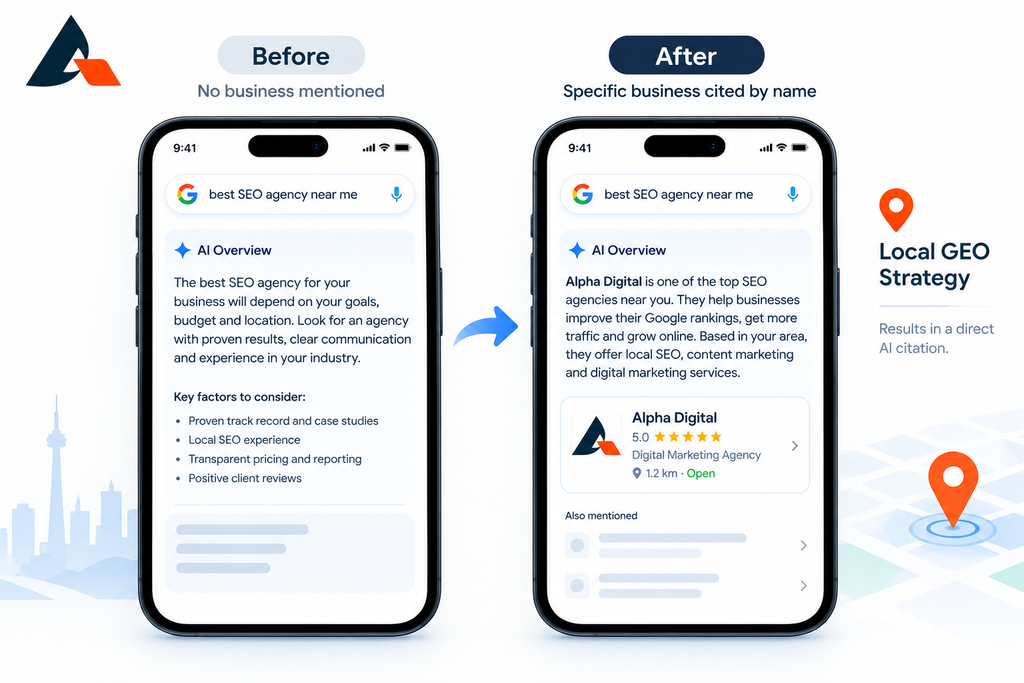
Local GEO strategies are the specific steps a business takes to get named directly inside an AI generated answer when someone nearby asks a question, instead of only ranking on a results page a person has to click through. GEO stands for generative engine optimization, and the local version of it is about one thing: being the business an AI tool actually says out loud.
How AI tools decide what to cite covers the mechanics behind AI citation in general. This guide stays narrower and more tactical. Below are 10 ways to make that happen, covering Google Business Profile signals, schema markup, conversational content, reviews, and how to actually measure whether any of it is working.
Why Local GEO Strategies Matter More Than a Ranking Position Now
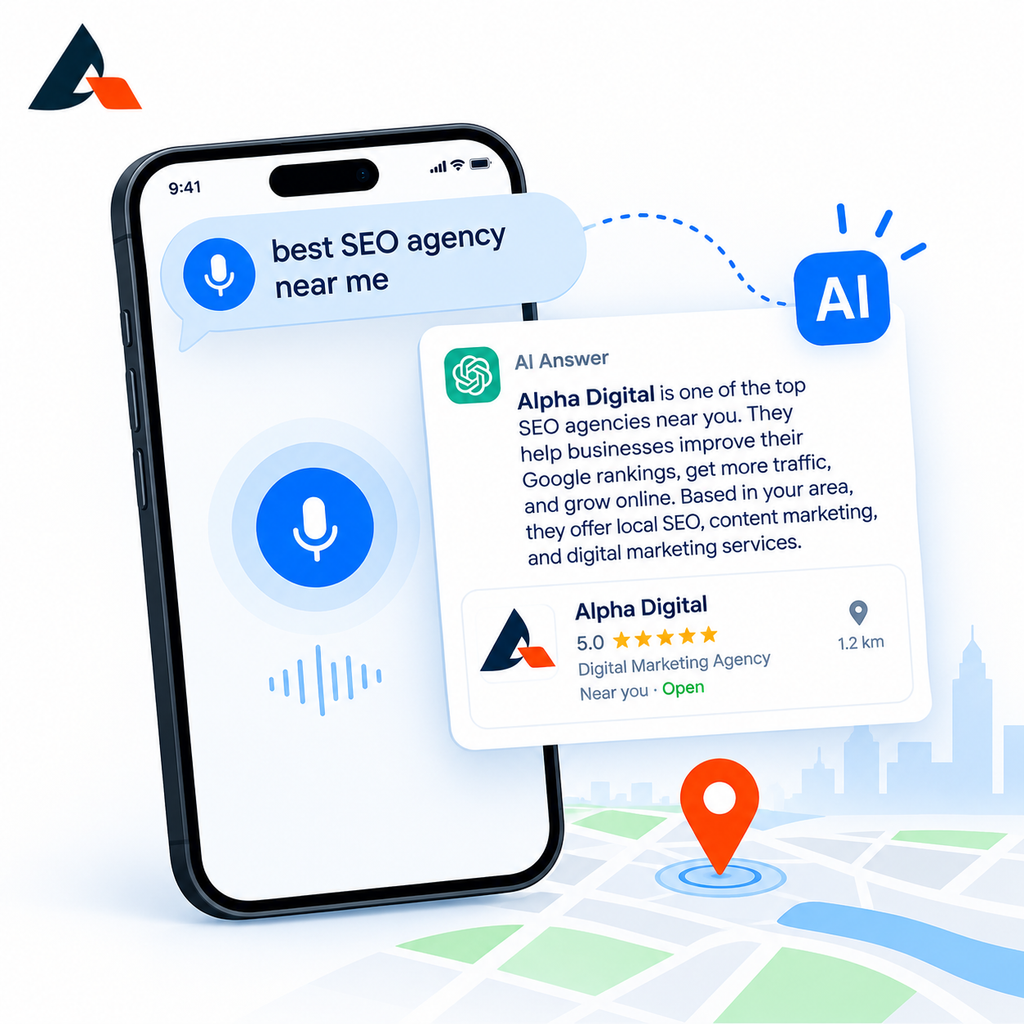
A person asking an AI assistant “who is the best local SEO agency near me” does not get ten blue links. They get one answer, sometimes with a single business named inside it. Recent research puts the share of Google searches ending without a click at well over half, and that number climbs above 80 percent once an AI Overview appears on the page. Ranking tenth on a results page and never being named inside the answer is functionally the same as not ranking at all.
This is where local GEO work differs from classic local SEO. Classic SEO gets a page into the results. AEO, answer engine optimization, gets that page quoted directly in an answer box. Local GEO takes both further, into the specific moment an AI tool is deciding which nearby business deserves the mention. A business that only chases position on a results page is optimizing for a search format that fewer and fewer people actually see all the way through.
10 Best Local GEO Strategies to Rank in AI Search Results
1. Verify and Fully Complete the Google Business Profile
Every local GEO strategy starts here, because an AI tool cross checks a Google Business Profile before naming a business in a local answer the same way a careful person would. A half finished profile, missing categories, or outdated hours gives an AI system nothing solid to confirm. Complete every section: primary and secondary categories that match the actual business, real photos of the location and team, current hours, and a plain description written the way a customer would actually describe the business.
A person can confirm what this looks like done properly by checking Alpha Digital’s verified Google Business Profile and its Milton location on Google Maps directly. Skipping this step quietly ends most local GEO efforts before they even start, no matter how good the content on the website turns out to be.
2. Build Local Entity and Schema Markup
An AI crawler reads structured data far more reliably than it reads a paragraph and infers meaning from it. LocalBusiness schema, Organization schema, and FAQ schema each hand a machine the facts it needs already labeled: the business name, address, phone number, service area, and hours, without any guessing involved.
This is entity optimization in practice. The goal is for a business to exist as one clean, unambiguous entity that search engines and AI models can point to consistently. Businesses that have already worked through AI search optimization in Milton, Ontario know this schema layer is what turns a normal web page into something an AI model can actually cite with confidence.
3. Earn Genuine Local Citations and Keep NAP Consistent
NAP, name, address, and phone number, needs to match exactly everywhere a business appears online. AI models cross reference this data across multiple sources before trusting it enough to name a business out loud, so one mismatched suite number or an old phone number sitting on a forgotten directory can quietly cost a citation.
Local citation building is not about volume for its own sake. A smaller number of accurate, relevant listings on Google, Bing, Apple Maps, and a handful of respected local directories beats a long list of outdated ones. Checking a resource like what actually counts as an AI citation helps clarify why consistency matters more here than almost anywhere else in local GEO strategy.
4. Structure Content for Direct, Conversational Answers
People do not type search fragments into an AI assistant the way they used to type into Google. They ask full, conversational questions: where is the best place near me for this service, or which company actually handles this well in my city. Local GEO content has to answer that exact phrasing, not a keyword shorthand of it.
Open every section with a plain, self contained answer, state the business by name instead of a pronoun, and put the direct answer before the reasoning behind it. An AI system scanning for something to quote almost always prefers the sentence that answers cleanly on its own over one buried in the middle of a long paragraph.
5. Target Conversational and Local Voice Search Queries
Voice search and AI chat both lean on the same conversational pattern, so a tactic that works for one tends to work for the other. Someone driving and talking to a voice assistant, or typing a full question into ChatGPT, is searching with buyer intent already built into the phrasing, not just browsing.
Build content around the actual questions customers ask out loud: how much does this cost nearby, who is open right now, or which business handles this specific problem. A complete AI search visibility report on where AI search is heading helps frame why this conversational shift is not a passing trend.
6. Build Local Brand Mentions Beyond the Website Itself
An AI model weighs independent mentions of a business, ones it did not write itself, as a strong trust signal. A business named in a local news article, a community directory, an industry roundup, or a genuine partner’s website all count toward this, even without a link attached in every case.
This is where local GEO strategies overlap with plain reputation building. Getting mentioned by name in places an AI model already trusts does more long term work than almost any on page change. A business chasing multi location SEO content strategy across several markets should treat this brand mention layer as part of the plan for every location, not an afterthought at just one.
7. Help Search Engines Map the Business as a Local Entity
Local entity mapping is the process of making sure Google’s Knowledge Graph and other AI systems understand exactly what a business is, where it operates, and what it actually does, as one connected profile rather than scattered, inconsistent mentions. A consistent business name, a clear service description, and schema markup that all say the same thing help this mapping happen correctly.
The broader mechanics behind managing more than one location at once, so each one maps as its own clean entity instead of one blurred into another, live inside local SEO for multi location businesses. A business with one clear, well mapped entity gets named with far more confidence than one an AI model has to guess about.
8. Turn Reviews Into an E-E-A-T Trust Signal
Genuine reviews, with real detail rather than a generic star rating, feed directly into the experience and trustworthiness part of E-E-A-T that both Google and AI models check before naming a business. A specific review that mentions a real service, a real result, or a real interaction reads as more credible than a short, vague one, to a person and to a model scanning for trust signals.
Make leaving a review as frictionless as possible. Sending a direct link, like Alpha Digital’s own review link, right after a completed project removes the extra step that stops most satisfied customers from ever leaving one. Responding to every review afterward, specific and genuine rather than copied and pasted, adds another layer an AI model can weigh.
9. Check AI Crawler Access Before Anything Else Breaks
None of the previous strategies matter if an AI crawler cannot actually read the page. GPTBot, PerplexityBot, and Google Extended each need to reach a page’s content without hitting a blocked robots.txt file or content rendered entirely through JavaScript with nothing readable in the raw HTML.
A quick check of the robots.txt file at the root of any domain shows exactly which crawlers are allowed in. Plenty of businesses block AI crawlers by accident, usually inheriting a restrictive default from a website template or a security plugin nobody reviewed line by line. This single technical check, done in minutes, has quietly ended more AI visibility efforts before they started than any content mistake ever has.
10. Track Local AI Search Visibility, Not Just Rankings
Classic rank tracking does not show whether a business is actually being named inside AI answers. Checking the real questions customers would ask an AI tool, then noting whether the business gets mentioned at all and how it is described, is the closest thing local GEO strategy has to a rank check right now. Some teams call this share of model, the AI search equivalent of share of voice.
This measurement step is what separates a business running a real local GEO strategy from one guessing at it. A free SEO audit that checks this AI visibility layer alongside AI Overview traffic quality and classic ranking factors gives a far more complete picture than a position report ever could on its own.
Common Mistakes That Undo Local GEO Strategies
- Leaving a Google Business Profile category generic instead of specific to the actual service
- Publishing schema markup that does not match what is visibly on the page
- Writing content that buries the direct answer under several paragraphs of setup
- Chasing citation volume instead of citation accuracy
- Ignoring robots.txt and assuming AI crawlers can already read every page
- Measuring only classic rankings and never checking what an AI tool actually says
Any one of these can quietly cancel out the rest of the work. A business can have a strong on page SEO checklist and a solid SEO audit in place and still go unmentioned in AI answers if these local GEO basics are left unattended.
How Alpha Digital Builds Local GEO Strategies
Alpha Digital runs this exact process for its own Canadian location at 137 Savoline Blvd, Milton, ON, one of four verified offices across the business with a confirmed Google Business Profile. The same entity mapping, schema work, and citation building covered in this guide sits behind the local SEO work built for Milton, and the broader approach to getting a business named directly inside AI answers lives inside how to rank on local search and drive conversions.
A free SEO audit is the simplest way to see whether a business is currently showing up inside AI answers at all. Past results are on view in the portfolio and case studies, and questions about a specific market can go through the contact page directly.
Frequently Asked Questions
What are local GEO strategies?
They are the specific steps a business takes to get named directly inside an AI generated answer for a nearby search, covering the Google Business Profile, schema markup, citations, reviews, and content structured around direct answers.
How is local GEO different from local SEO?
Local SEO focuses on ranking in classic search results and the map pack. Local GEO strategies go further, aiming to get a business actually named inside an AI answer, which does not always require the top classic ranking position.
How long does it take to see results from local GEO strategies?
Technical fixes like crawler access and schema markup can show movement within weeks. Being named consistently takes longer, since it depends on accumulated trust signals like reviews and independent mentions building up over time.
Do local GEO strategies work the same way for a business with more than one location?
Yes, with one addition. Each location needs its own clean entity mapping and its own schema so an AI model does not blur two addresses into one confused profile.
Does schema markup guarantee an AI citation?
No. Schema makes a page easier for a machine to parse correctly, but the underlying content and business profile still have to earn the trust an AI model checks for before naming a source.
What is share of model and why does it matter for local GEO?
It is how often and how favorably a business gets mentioned when real customer questions are asked directly to an AI tool. It matters because classic rank tracking cannot show whether a business is actually being named in AI answers.
Can a small, single location business compete with larger local GEO strategies?
Yes. A complete, accurate profile with genuine reviews and clean schema markup often earns an AI citation over a larger competitor whose data is inconsistent across several listings.
Local GEO strategies are not a plugin to install or a one time setup. They are the same discipline as good local SEO always required, a complete profile, honest content, and real trust signals, applied to a search format where the reward is being the one business an AI tool actually says by name. This blog is Published and updated in September 2026. Research and analysis by the Alpha Digital SEO team, reviewed by Arsalan Ali, Senior SEO Specialist at Alpha Digital.