
Search behavior has shifted faster in the last eighteen months than at almost any point since Google introduced featured snippets. AI Overviews now appear across a large share of Google searches, and for many site owners the immediate reaction has been panic over falling clicks. That reaction misses a more useful question: is the traffic that does arrive actually worth anything? AI Overview traffic quality, not raw click volume, is the metric that determines whether generative search is a threat or an opportunity for a given brand.
What Is AI Overview Traffic Quality?
AI Overview traffic quality describes how valuable the visitors are who land on a page after seeing a Google AI Overview, either because they clicked a citation link inside the summary or because they searched again after reading it. Two pages can each receive 100 AI-referred visits and produce completely different outcomes. One page might convert at a rate several times higher than average organic traffic, while the other bounces immediately. Judging this metric means looking past impressions and clicks toward engagement, dwell time, and conversion activity once a visitor actually lands on the page.
This distinction matters because zero-click search has changed what a “good” click even looks like. Recent clickstream research from SparkToro found that of every 1,000 Google searches, only a few hundred end in a click to the open web at all. When a click does happen after an AI Overview, it tends to come from someone who wanted more than a quick answer, which is exactly the kind of high-intent AI Overview traffic worth optimizing for.
AI Overview User Behavior: Daily, Weekly, Monthly, and Occasional Users
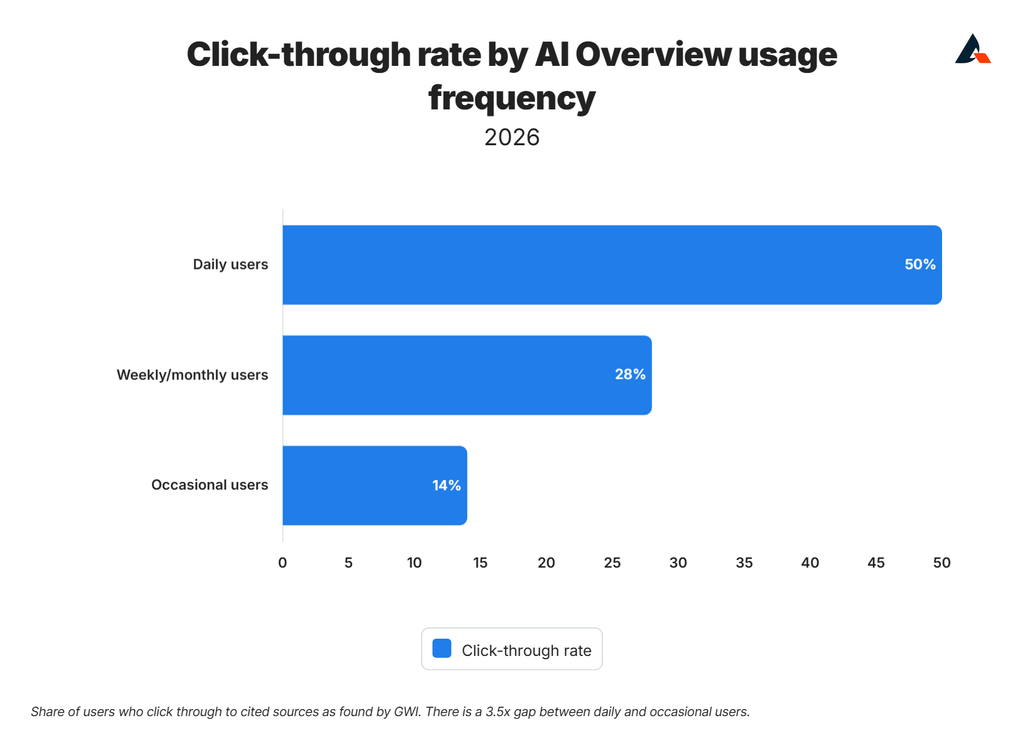
Not every searcher interacts with AI Overviews the same way. GWI research on generative AI search behavior separates users into daily, weekly, monthly, and occasional groups, and each group behaves differently once an AI-generated response appears. Daily AI Overview users tend to trust the summary and rarely click through, treating the feature as a replacement for a full search session. Occasional users are more likely to click a citation, often because they are unfamiliar with the format or need to verify a claim before acting on it.
This pattern has direct implications for AI Overview traffic quality. A page that is cited frequently in queries used mostly by daily AI Overview users may show high impressions in Google Search Console but very few actual sessions. A page cited in queries favored by occasional or monthly users may see a smaller citation count but a proportionally larger share of real, engaged visits. Segmenting traffic by this behavior, rather than treating all AI Overview clicks the same way, is one of the more overlooked steps in AI Overview optimization.
AI Overview Click-Through Rates: What the Data Actually Shows
Click-through rate on AI Overview queries has moved considerably over the past year. Seer Interactive’s tracking of more than 5 million queries found that CTR on AI Overview searches fell to roughly 1.3% at the end of 2025 before recovering to around 2.4% by February 2026, a sharp rebound, though still well below the 3% to 3.8% CTR typical of searches with no AI Overview present. Pew Research’s earlier analysis of nearly 69,000 searches found an even starker contrast: an organic result was clicked in about 15% of visits when no AI summary appeared, compared with roughly 8% when one did, and a source cited directly inside the summary was clicked barely 1% of the time.
Ahrefs’ analysis of 300,000 keywords put the average organic CTR decline at 34.5% when an AI Overview appears at the top of the page, with some high-volume terms losing far more. None of this means organic search traffic has become worthless. It means AI Overview traffic quality has to be evaluated on its own terms, separate from legacy organic CTR benchmarks that no longer apply to queries where a generative summary sits above the fold.
AI-Referred Traffic vs. Organic Search: A Direct Comparison
The organic search comparison worth making is not clicks versus clicks; it is intent versus intent. Semrush data on AI-referred visitors found they convert at several times the rate of traditional organic traffic, a pattern consistent with the idea that people who click through an AI-generated answer are already past the research stage and looking for something specific: a provider, a product, or a next step. That is the definition of high-intent AI Overview traffic, and it is why treating every AI-referred session as a lost opportunity misunderstands the shift underway.
At the same time, AI Overview coverage is uneven across industries. BrightEdge’s tracking shows the feature now appears on roughly half of all searches overall, with healthcare, education, and B2B technology queries triggering an overview far more often, in some cases on eight or nine out of every ten relevant searches. Any organic search comparison needs to be run at the industry and query level, not as a single blanket statistic.
Measuring AI Overview Traffic Quality in Google Search Console and GA4
Google Search Console does not label AI Overview clicks as a distinct channel, so identifying them takes a bit of manual work. Filtering the Performance report by queries known to trigger AI Overviews, then comparing click-through rate and average position against similar non-AI-Overview queries, is the most direct way to spot the gap. Pages with high impressions and unusually low clicks are strong candidates for AI Overview citation without meaningful traffic, worth flagging for a content refresh through a resource like a free SEO audit rather than ignoring.
In GA4, AI referral sources typically show up as direct or unattributed traffic unless referral exclusions and channel groupings are configured carefully. Setting up a custom channel group for known AI referral domains, including ChatGPT, Perplexity, Gemini, and Bing Chat, makes it possible to track AI traffic segmentation over time and connect it to actual conversion tracking rather than guessing at attribution. This is also where mid-funnel CTAs matter: a visitor arriving from an AI Overview citation has already had a question answered, so the page needs a clear next action rather than another summary of the same information.
What Makes Content AI-Citation Ready
Google’s systems, along with ChatGPT, Perplexity, and Gemini, tend to favor content with clear signals of E-E-A-T: named authors with visible credentials, original data the brand generated rather than aggregated from elsewhere, and case studies that name a real client or outcome instead of speaking in generalities. Ahrefs’ review of AI Overview citations found a shrinking overlap between cited pages and top-10 organic rankings, which suggests citation criteria are diverging from traditional ranking factors. Step-by-step processes, specific numbers, and expert quotes attributed to a real person all improve AI citation readiness, while thin, templated content is increasingly passed over even when it ranks well organically.
Brands investing in SEO services built around this kind of original, well-sourced content tend to see steadier AI Overview citation rates than those relying on rewritten competitor content, since generative systems appear to weight originality and depth more heavily than keyword matching alone.
Turning AI Overview Traffic Into Conversions
Once a visitor lands on a page after an AI Overview citation, page performance and mobile experience determine whether that visit turns into anything. Slow-loading pages, intrusive pop-ups, and unclear next steps waste exactly the high-intent traffic AI Overviews are capable of sending. A mobile-first layout, a fast first paint, and a CTA placed above unnecessary scrolling all protect conversion rate on this traffic segment. Businesses building broader AI solutions into their marketing stack are increasingly pairing this kind of on-page optimization with automated conversion tracking, so AI Overview traffic quality can be measured continuously instead of audited once a quarter.
Zero-Click Search and Why Visibility Still Matters Without a Click
Zero-click search did not start with AI Overviews; featured snippets, knowledge panels, and People Also Ask boxes were already keeping a growing share of searches on the results page years earlier. What has changed is scale. With a large and rising share of Google searches now ending without any click to the open web, brand visibility inside the AI Overview itself has become a goal on its own, separate from traffic. A brand cited by name inside a summary, even without a click, builds familiarity that can influence a later, more direct search or a branded query. Treating citation frequency as a companion metric to AI Overview traffic quality, rather than ignoring it because it does not show up in a session count, gives a fuller picture of how a page is actually performing in AI search. This wider view of AI Overview traffic quality is especially useful for brands with strong name recognition but modest click volume from any single query.
AI Overview Optimization Strategies for 2026
A handful of practical steps consistently improve both citation rates and the quality of the traffic that follows:
- Structure pages around a direct answer near the top, followed by the supporting depth and original data that keep a reader engaged past the summary.
- Use step-by-step formatting and clear subheadings, since generative systems tend to pull structured, scannable sections into summaries more reliably than dense paragraphs.
- Publish original research, survey data, or named case studies rather than aggregating figures from other sites, since originality appears to weigh heavily in what gets cited.
- Keep author bylines and credentials visible on every page to reinforce E-E-A-T signals that both Google and other AI search tools reference.
- Monitor AI Overview citation identification monthly rather than quarterly, since coverage and citation criteria are both shifting quickly in 2026, and log changes in AI Overview traffic quality alongside citation counts to spot which pages are converting and which are simply visible.
- Pair AI search optimization with a broader digital marketing strategy so paid, social, and email channels are not left to absorb the full impact of declining organic CTR alone.
Final Thoughts
This measurement approach will keep evolving as AI Overview coverage expands and citation logic shifts, but the core steps stay consistent: track clicks by query type, segment by user behavior, connect sessions to real conversion tracking in GA4, and build content around original expertise rather than surface-level summaries. Brands that treat AI Overview clicks as a distinct, measurable channel, rather than folding them into general organic performance, are the ones positioned to benefit as zero-click search continues to reshape how people find information online.
Frequently Asked Questions
Does AI Overview reduce website traffic?
For many queries, yes. Click-through rates on searches with an AI Overview present are consistently lower than on searches without one, since a portion of users get their answer directly from the summary. The effect varies by query type and industry, and some pages still see meaningful traffic when they earn a prominent citation.
Why are my clicks going down because of AI?
A drop in clicks usually means more of a site’s ranking queries are now triggering an AI Overview, and users are satisfied by the summary before scrolling to organic results. Checking Google Search Console for rising impressions alongside falling CTR on specific queries is the fastest way to confirm whether AI Overviews are the cause.
How to measure traffic quality from AI Overviews?
Segment sessions from AI referral sources in GA4, then compare bounce rate, dwell time, and conversion rate against the site average. High-intent AI Overview traffic typically converts at a noticeably different rate than general organic traffic, which is the clearest sign of AI Overview traffic quality versus raw volume.
Are AI Overviews bad for SEO?
Not inherently. They change what counts as success. Ranking and citation both matter now, and content built for depth, originality, and clear answers tends to perform well in both organic rankings and AI Overview citations at the same time.
How to track AI Overview traffic?
Set up a custom channel grouping in GA4 for known AI referral domains, filter Google Search Console queries known to trigger AI Overviews, and compare performance against a baseline of similar non-AI-Overview queries over the same period.
How to turn off Google AI Overview?
Google does not currently offer a permanent setting to disable AI Overviews for standard search. Some users find that adding certain search operators or switching to a non-personalized search mode reduces how often the feature appears, though results are inconsistent and can change without notice.
Is 2026 the year AI Overview becomes the default search experience?
AI Overview coverage has expanded substantially through 2026 and continues to grow across most verticals, with some industries such as healthcare and education already seeing it on the large majority of relevant searches. Whether it becomes the universal default depends on how Google balances the feature against organic result quality and publisher feedback going forward.



5 Comments