
Running a business today means making quick decisions with limited resources. Small and medium businesses face pressure from all sides. Customers expect instant responses. Competitors move faster. Teams handle more tasks with fewer people.
This is where AI automation services become essential. AI is no longer just for large corporations with big budgets. Smart automation tools now help businesses of all sizes reduce manual work, improve accuracy, and scale operations without hiring more staff.
In this blog, we will break down what AI automation actually does, which areas create the most impact, and how to choose the right partner without wasting your budget.
What AI Automation Services Do for Your Business
AI automation services handle repetitive tasks that drain your team’s time and energy. Instead of manually processing data, responding to common questions, or updating spreadsheets, AI systems do this work automatically. This frees your team to focus on strategy, customer relationships, and growth.
AI business automation solutions work across different functions. They can manage customer support through chatbots, process invoices without human input, send personalized emails based on user behavior, and analyze sales data to predict trends. The goal is not to replace people. The goal is to remove bottlenecks and speed up operations.
What makes AI automation services different from basic software is intelligence. Traditional tools follow fixed rules. AI learns from patterns. It adapts to new information. It improves over time. For example, a basic chatbot answers preset questions. An AI-powered chatbot understands context, learns from past conversations, and handles complex requests without constant updates.
Many business owners worry that automation feels cold or impersonal. The opposite is true. When AI handles routine tasks, your team has more time for meaningful customer interactions. Response times improve. Errors decrease. Customers get faster, more accurate service.
Core Areas Where AI Automation Solutions Create Impact
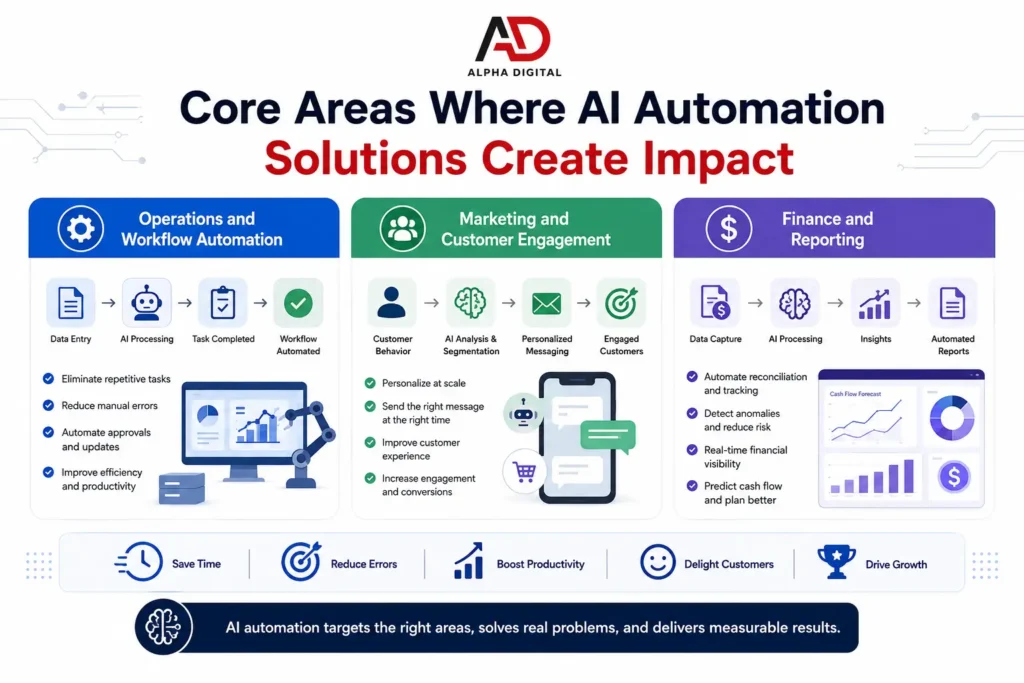
AI does not automate everything at once. It targets specific pain points where manual work slows growth or creates errors. Understanding where intelligent process automation services deliver the most value helps you prioritize investment.
Operations and Workflow Automation
Operations often involve repetitive processes. Data entry, invoice processing, inventory tracking, and report generation all take time. AI workflow optimization removes these manual steps.
For example, an AI system can read incoming invoices, extract data, match it with purchase orders, and update accounting software without human touch. What used to take hours now happens in minutes. Errors caused by manual data entry disappear.
Workflow automation also improves internal processes. Task assignments, approval routing, and status updates happen automatically based on triggers. Teams spend less time chasing updates and more time completing work.
Marketing and Customer Engagement
Marketing requires personalization at scale. Customers expect messages that feel relevant to their needs. AI digital transformation services make this possible without creating extra work for your team.
AI tools analyze customer behavior, segment audiences, and send targeted messages at the right time. If someone abandons a shopping cart, AI triggers a reminder email. If a customer engages with specific content, AI suggests related products or services.
Customer support also improves with AI. Chatbots handle common questions instantly. AI routes complex issues to the right team member. Response times drop. Customer satisfaction increases.
Finance and Reporting
Finance teams spend significant time on reconciliation, expense tracking, and report generation. AI-powered business systems handle these tasks with higher accuracy and speed.
AI can categorize expenses, flag unusual transactions, and prepare financial reports automatically. It reduces the risk of errors that come from manual entry. It also gives business owners real-time visibility into financial performance instead of waiting for end-of-month reports.
Predictive analytics powered by AI helps with cash flow forecasting and budget planning. Instead of guessing, you make decisions based on data patterns and trends.
How to Choose the Right AI Automation Services Partner
Not all AI automation companies deliver the same value. Choosing the right partner requires clear criteria and realistic expectations.
Start by defining your biggest pain points. Do not automate everything at once. Focus on one or two high-impact areas first. For example, if customer support consumes too much time, prioritize chatbot implementation. If manual data entry creates bottlenecks, focus on workflow automation.
Ask potential partners about their experience in your industry. Generic solutions often miss specific business needs. A custom AI integration company should understand your operations and tailor solutions accordingly.
Evaluate their approach to implementation. Good partners do not just install software and leave. They provide training, monitor performance, and adjust systems based on results. AI consulting for enterprises and smaller businesses should include ongoing support, not just initial setup.
Check references and case studies. Ask about measurable results. Did response times improve? Did error rates drop? Did teams save time? Concrete outcomes matter more than technical jargon.
Finally, understand the pricing structure. Some providers charge based on usage. Others offer fixed monthly fees. Make sure costs align with expected ROI. The right partner will help you calculate realistic savings and growth projections before you commit.
Custom AI Integration for Your Existing Systems
Many businesses already use software for accounting, CRM, project management, and communication. Replacing these systems is expensive and disruptive. This is where custom AI Automation services becomes valuable.
Instead of forcing you to switch platforms, enterprise AI implementation connects AI capabilities to your current tools. For example, AI can pull data from your CRM, analyze patterns, and send insights directly to your sales team without changing their workflow.
Integration also ensures data consistency. When systems talk to each other automatically, you avoid duplicate entries and version conflicts. Updates in one system reflect across all connected platforms.
A skilled AI software development firm will audit your current tech stack, identify integration points, and build connections that feel seamless. Your team continues using familiar tools while gaining AI capabilities in the background.
Custom integration also supports scalability. As your business grows, AI systems adapt without requiring complete rebuilds. New features connect to existing infrastructure instead of creating separate silos.
Intelligent Process Automation Services That Scale With You
Growth creates new challenges. What works for a team of ten does not work for a team of fifty. Scalable AI solutions for companies ensure automation grows with your business instead of becoming a limitation.
Intelligent process automation services are built with flexibility in mind. They handle increasing volume without performance drops. They support new workflows without requiring full reconfigurations.
For example, if your customer base doubles, your AI chatbot should handle the extra conversations without delays. If you expand to new markets, your automation should adapt to different languages and time zones.
Scalability also means adding new capabilities over time. You might start with basic email automation and later add predictive analytics or advanced reporting. A well-designed system allows phased expansion instead of forcing you to rebuild from scratch.
Working with an experienced AI automation company ensures your foundation supports long-term growth. They design systems that evolve with your needs instead of requiring expensive replacements every few years.
How to Hire AI Automation Experts Without Wasting Budget
Hiring the wrong team leads to delays, cost overruns, and systems that do not deliver value. Knowing how to hire AI automation experts saves time and money.
Start by defining clear project goals. What specific problem are you solving? What does success look like? Vague requirements lead to vague results.
Look for teams with proven experience in your industry or use case. Ask for references. Review past projects. Make sure they understand your business context, not just AI technology.
Evaluate their communication style. Technical expertise matters, but so does the ability to explain concepts clearly. You should understand what is being built, why it matters, and how it will impact your operations.
Discuss timelines and milestones. A good team will break the project into phases with clear deliverables. This allows you to track progress and make adjustments before small issues become big problems.
Avoid teams that promise instant results or universal solutions. AI implementation takes time. It requires testing, iteration, and optimization. Teams that overpromise often underdeliver.
Finally, ensure ongoing support is part of the agreement. AI systems need monitoring, updates, and adjustments based on real-world performance. A one-time build without support creates future problems.
Final Thoughts
AI automation services is not about replacing people. It is about removing obstacles that slow growth and drain resources. Small and medium businesses that adopt AI automation services strategically gain speed, accuracy, and scalability without massive budgets.
The key is starting with focused goals, choosing the right partner, and building systems that grow with your business. Whether you need workflow optimization, customer engagement tools, or custom integrations, the right approach turns AI from a buzzword into a business advantage.
If you are ready to explore how AI can improve your operations, now is the time to move from planning to action. The businesses that adapt today will lead their markets tomorrow.
Frequently Asked Questions
What are AI automation services and how do they help small businesses?
AI automation services use artificial intelligence to handle repetitive tasks automatically. They help small businesses by reducing manual work, improving accuracy, and speeding up operations. Common applications include customer support chatbots, automated data entry, personalized email marketing, and financial reporting. This allows teams to focus on strategy and growth instead of routine tasks.
How much do AI business automation solutions cost for medium-sized companies?
Costs vary based on complexity, scope, and customization needs. Basic automation tools start around $500 to $2,000 per month. Custom enterprise AI implementation can range from $10,000 to $100,000+ depending on integrations and features. Most providers offer phased pricing, allowing businesses to start small and scale investment as they see results and ROI.
Can AI automation integrate with my existing business software?
Yes. Custom AI integration connects AI capabilities to your current systems without requiring platform changes. AI can work with CRM, accounting software, project management tools, and communication platforms. This ensures data consistency, reduces duplicate work, and allows your team to keep using familiar tools while gaining AI benefits in the background.
What is the difference between basic automation and intelligent process automation?
Basic automation follows fixed rules and requires manual updates. Intelligent process automation uses AI to learn from patterns, adapt to new information, and improve over time. For example, a basic system sends the same email to everyone. An AI system analyzes behavior and sends personalized messages based on individual customer actions and preferences.
How long does it take to implement AI automation in a business?
Implementation time depends on project scope and complexity. Simple automation like chatbots or email workflows can launch in 2 to 4 weeks. Custom AI integration with multiple systems typically takes 2 to 4 months. Phased rollouts allow businesses to start seeing benefits quickly while building more advanced capabilities over time. Ongoing optimization continues after initial launch.