
Building a startup in 2026 is not about launching big. It is about launching smart. MVP Development Agency for Early-Stage Startups fixes tight go through. Startups today face tighter budgets, faster competition, and higher user expectations. A Minimum Viable Product gives founders a focused way to enter the market without overbuilding. Instead of guessing, teams learn directly from users. This approach makes MVP development services for startups a practical necessity, not a luxury.
That is where MVP Development comes in. MVP Development Agency helps startups test ideas with real users before time, money, and energy run out.
In this blog, we will explore how startups use MVPs to reduce risk, validate demand, and build products that actually solve problems.
What Are MVP Development Services and What Do Startups Actually Get
MVP Development Services are structured services that help startups turn an idea into a functional product that can be tested in the market. These services go beyond basic development. A reliable MVP Development Agency helps startups make the right decisions at the right time.
At a high level, MVP Development Services include product discovery, scope planning, design, development, and validation. Unlike simple prototypes, MVP Software Development delivers a usable product that early adopters can interact with and provide feedback on. This feedback drives future iterations.
Core components of MVP Development Services include:
- Product discovery for MVP to define the real user problem
- MVP scope definition to avoid unnecessary features
- Feature prioritization for MVP based on business impact
- Design-driven MVP development focused on usability and clarity
- Agile sprints for MVP to release and test in short cycles
- Clearly defined MVP development stages from idea to launch
For startups, the biggest value is guidance. Early-stage founders often struggle with deciding what to build first. An experienced startup MVP development agency helps reduce this uncertainty by aligning business goals with technical execution.
The result is a product that is lean, testable, and ready for real-world learning. This approach keeps development efficient and makes MVP Software Development a strategic investment instead of an expensive experiment.
Need expert guidance, not just developers? Work with a startup MVP development agency that understands early-stage product building.
Startup MVP Development Agency Roadmap: From Idea to First Users
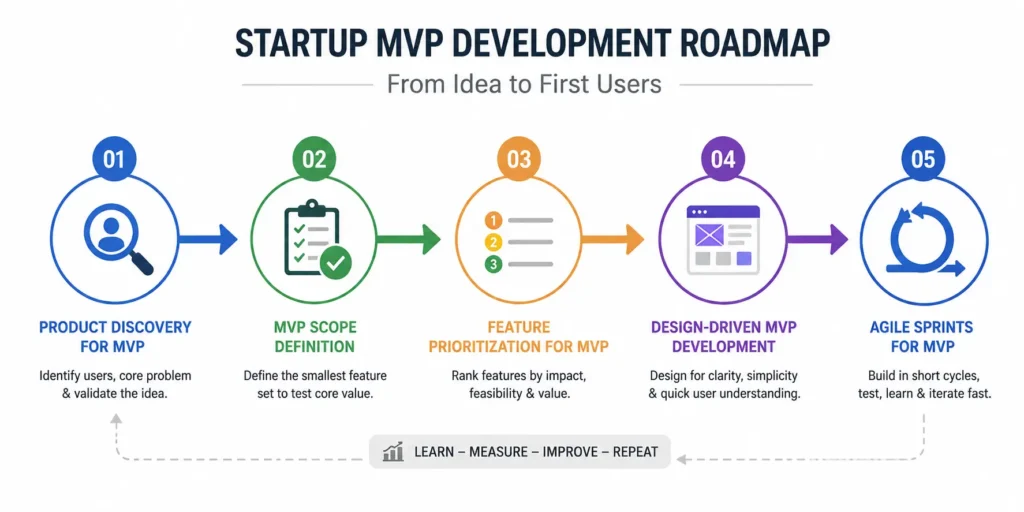
A clear roadmap keeps startups focused and prevents overbuilding. Without structure, MVPs often turn into half-finished products that solve no clear problem. A well-defined startup MVP development agency roadmap breaks the process into manageable steps so teams can move forward with confidence.
The goal of this roadmap is not perfection. It is learning. Each phase exists to reduce uncertainty and help founders make informed decisions before scaling.
Product discovery for MVP
This is where assumptions are challenged. Teams identify the target user, the core problem, and why existing solutions fall short. Interviews, market research, and simple validation exercises help ensure the idea is worth testing before development begins.
MVP scope definition
Once the problem is clear, the next step is deciding what not to build. MVP scope definition focuses on the smallest feature set needed to test the core value. This protects startups from wasted effort and rising MVP Development Cost later.
Feature prioritization for MVP
Not all features matter equally. Teams rank features based on user impact, feasibility, and business value. This step ensures development time is spent on what moves learning forward, not on nice-to-have ideas.
Design-driven MVP development
Design is not about looks alone. It is about clarity and ease of use. Design-driven MVP development helps early adopters understand the product quickly, so feedback is meaningful.
Agile sprints for MVP
Development happens in short cycles. Agile sprints for MVP allow teams to release, test, and adjust quickly. This keeps momentum high and risk low.
How MVPs Are Validated in the Real World
Validation is the true purpose of an MVP. Building without learning defeats the point. The build measure learn loop MVP helps startups turn real user behavior into actionable insights.
This loop keeps teams grounded in reality. Each cycle improves the product based on evidence, not opinions.
Build
Startups build only what is needed to test a specific assumption. This could be a core feature, onboarding flow, or pricing model. MVP Software Development focuses on functionality that supports learning, not polish.
Measure
Once users interact with the product, startups track meaningful data. This includes usage patterns, drop-off points, and user feedback. Vanity metrics are avoided. The focus is on signals that show whether the problem is truly being solved.
Learn
Learning is where decisions happen. Startups review results and decide whether to improve, pivot, or stop. This step supports smarter planning for future MVP development stages.
MVP validation with early adopters
Early adopters play a critical role. They provide honest feedback and help startups understand real-world needs. MVP validation with early adopters often reveals gaps that were not obvious during planning.
Over time, this loop builds confidence. Startups gain clarity on product direction, pricing, and user expectations. This makes scaling less risky and more predictable.
Ready to validate your idea with real users? Hire MVP development services that prioritize learning and measurable results.
MVP Development Cost, Timelines, and Common Tradeoffs
Understanding MVP Development Cost helps startups plan realistically. Costs are not fixed because every MVP is different. What matters is knowing which factors influence pricing and timelines so expectations stay aligned.
An MVP is designed to be lean, but lean does not mean cheap at all costs. Cutting the wrong corners often leads to rework later. The smartest approach balances speed, quality, and learning.
What impacts MVP Development Cost
Several factors shape the final cost. These include product complexity, number of features, platform choice, design depth, and team structure. MVP Software Development that involves integrations, data security, or scalability planning will naturally require more effort.
Typical MVP timelines
Most MVPs are built in phases. A basic MVP may take 6 to 10 weeks, while more complex products can take longer. Agile sprints for MVP allow teams to deliver usable versions early instead of waiting for a final release.
Key tradeoffs startups face
Startups often choose between speed and depth. Moving fast helps validate ideas sooner, but skipping product discovery for MVP can create blind spots. Investing early in scope definition and design-driven MVP development usually reduces long-term cost.
A transparent MVP Development Company explains these tradeoffs upfront. This clarity supports better decisions and prevents budget surprises.
Final Thoughts
MVP Development Services play a critical role in helping startups move from ideas to evidence-based decisions. In the world of competition and AI, you have to be specfic, you just cannot go laongside Claude or other AI crawlers. And, Instead of relying on assumptions, startups can test their core value proposition with real users and learn what actually works. This approach reduces wasted effort and keeps teams focused on solving the right problem from the beginning.
By investing in proper product discovery for MVP, clear MVP scope definition, and feature prioritization for MVP, startups gain clarity and direction early on. The build measure learn loop MVP ensures continuous improvement through real feedback, while agile sprints for MVP keep development flexible and efficient. These practices make MVP Software Development a strategic step, not a one-time experiment.
If you want a partner who understands startup realities, work with a trusted startup MVP development agency and build with confidence.
Frequently Asked Questions
What is the main goal of MVP Development Services?
The main goal of MVP Development Services is to help startups validate their product idea with real users before full-scale development. Instead of building everything at once, startups test core assumptions, gather feedback, and learn what truly matters, saving time, budget, and effort early on.
How are MVP development services for startups different from regular development?
MVP development services for startups focus on learning and validation, not just delivery. They include product discovery, MVP scope definition, and feature prioritization for MVP. Regular development often starts with full requirements, while MVP development evolves through feedback and iteration.
How long does MVP Software Development usually take?
MVP Software Development timelines vary based on scope and complexity. Most MVPs take between 6 to 10 weeks when built using agile sprints for MVP. The goal is to deliver a usable product quickly so startups can begin testing and learning as early as possible.
How does the build measure learn loop MVP help startups?
The build measure learn loop MVP helps startups make decisions based on real data. Teams build a small feature, measure user behavior, and learn from results. This process reduces guesswork, supports MVP validation with early adopters, and guides smarter product improvements over time.
When should a startup hire an MVP Development Company?
A startup should hire an MVP Development Company when it needs structure, guidance, and technical expertise to validate an idea. This is especially helpful when founders want help with product discovery for MVP, MVP development stages, and balancing speed with long-term product goals.