CRM And Email AI Integration Use Case
Overview
CRM and email integration helps businesses capture and manage customer data automatically. Instead of manually copying details from emails into a CRM system, AI reads incoming messages and updates records in real time.
This AI integration use case explains how AI extracts contact details, creates or updates records, and keeps customer data accurate. The goal is to improve lead capture, reduce manual work, and ensure that no important information is lost.
The Problem
Many businesses rely on email as a primary communication channel for leads and customers. New inquiries, follow ups, and requests often arrive directly in inboxes. While this makes communication easy, it creates challenges when managing customer data.
In many cases, teams must manually transfer information from emails into a CRM system. This includes entering names, email addresses, company details, and notes about the conversation. This process takes time and requires careful attention to avoid mistakes.
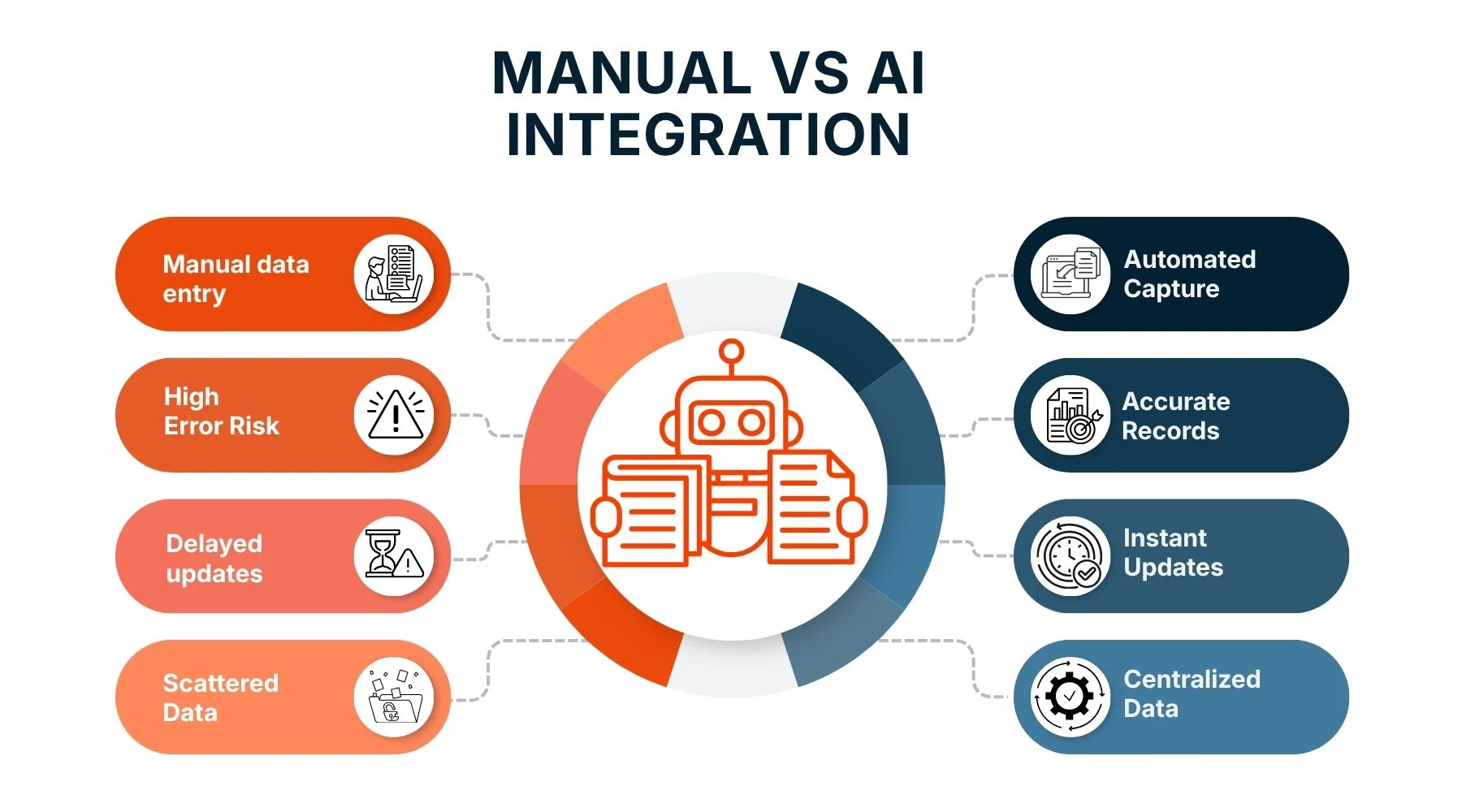
Manual data entry increases the risk of errors. Important details may be missed, entered incorrectly, or duplicated. Over time, this leads to incomplete or inconsistent records. Poor data quality makes it harder for teams to track interactions, understand customer needs, and make informed decisions.
Another issue is delay in lead capture. When emails are not entered into the CRM right away, there can be a gap between receiving a lead and taking action. This delay can reduce the chances of a successful follow up, especially when response speed is important.
There is also a lack of visibility. If email conversations are not linked to CRM records, it becomes difficult to see the full history of a customer interaction. Teams may need to search through inboxes to find context, which slows down communication and reduces efficiency.
As the volume of emails grows, these problems become more serious. More messages mean more manual work, more chances for error, and more missed opportunities. This limits the ability of teams to manage relationships effectively and scale their operations.
The AI Solution
CRM and email integration creates a seamless connection between communication and data management. It ensures that every email is captured and reflected in the CRM without manual effort.
Trigger
A new email or lead is received.
AI Action
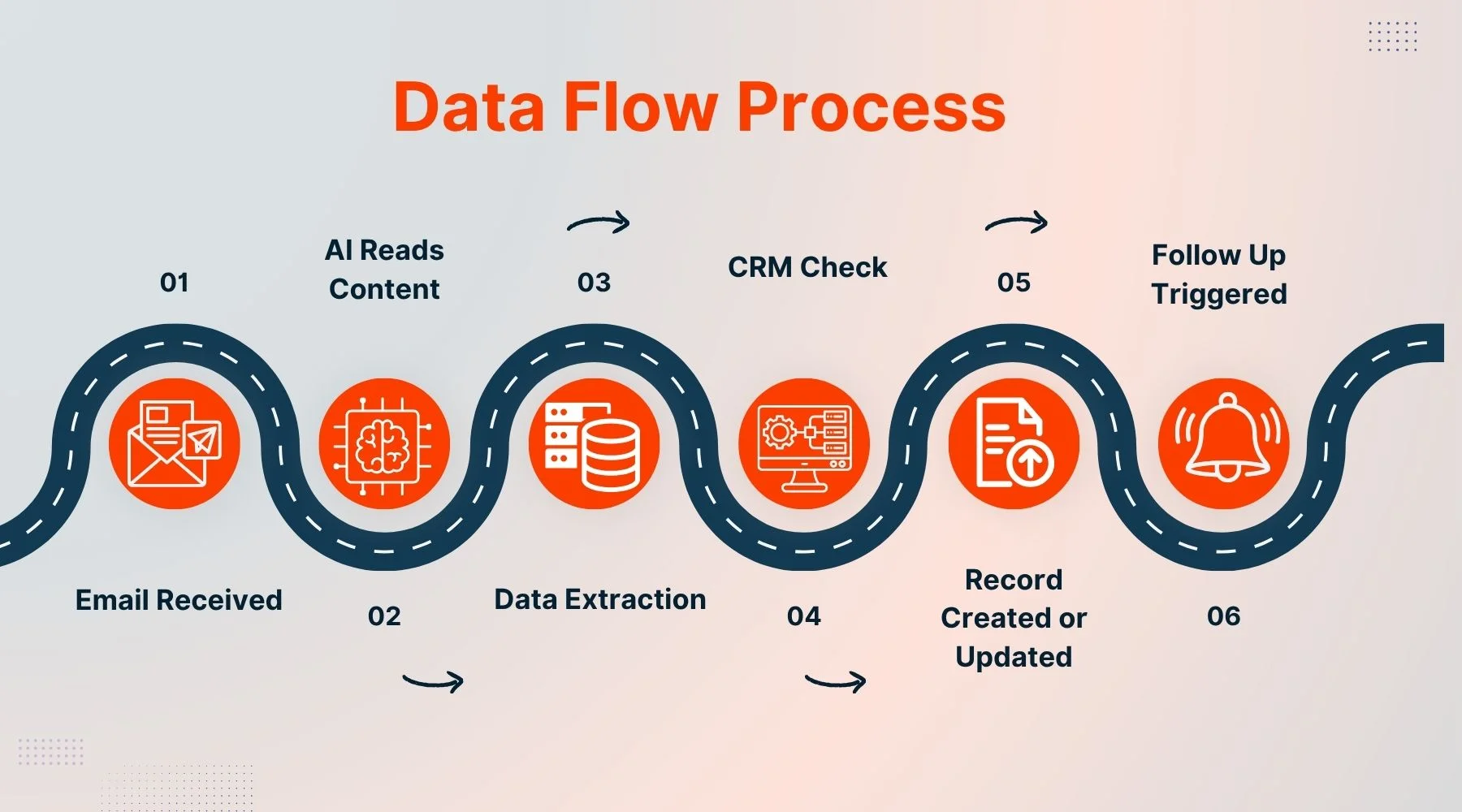
- Capture the incoming email or lead: The system detects new messages or form submissions as soon as they arrive. It gathers the content, sender details, and any attachments.
- Read and analyze the content: The AI scans the email body and subject line to understand the context. It identifies whether the message is a new lead, a follow-up, or an existing customer interaction.
- Extract key contact details: The system pulls important information such as name, email address, phone number, company, and job role. It ensures that all relevant data points are captured accurately.
- Check for existing records: The AI searches the CRM to see if the contact already exists. It compares extracted data with existing records to avoid duplication.
- Create or update CRM records: If the contact is new, the system creates a new record. If the contact already exists, it updates the record with new information and interaction history.
- Log communication history: The email content is stored as part of the contact’s timeline. This creates a complete view of all interactions in one place.
- Assign tags and categories: The system labels the contact based on source, intent, or stage in the sales process. This helps in organizing and segmenting data.
- Trigger follow-up actions: Tasks, reminders, or notifications can be created for the sales or support team. This ensures timely response and engagement.
- Sync across systems: The updated data is synchronized across connected tools, ensuring consistency in all platforms.
- Maintain data quality: The system continuously checks for duplicates, missing fields, or inconsistencies to keep the CRM clean and reliable.
Outcome
With CRM and email integration in place, lead capture becomes faster and more reliable. As soon as an email is received, the system processes it and updates the CRM without delay. This ensures that no lead is missed and that all information is recorded accurately.
Data accuracy improves significantly because the system extracts and updates information automatically. This reduces the risk of human error and ensures that records remain consistent over time. Teams can rely on the CRM as a single source of truth for customer information.
Response time also improves. Since leads are captured instantly and linked to the CRM, teams can take action without waiting for manual data entry. This helps businesses respond while interest is still high, which increases the chances of conversion.
Visibility across customer interactions becomes much clearer. All communication is stored in one place, making it easy to track conversations and understand context. This helps teams provide better and more personalized responses.
Over time, this leads to better relationship management and improved efficiency. Teams spend less time on administrative tasks and more time engaging with customers. The system also supports growth by handling increasing volumes of data without adding complexity.
Data Flow Process
Manual vs AI Integration
Business Impact

Why Trust This Approach
CRM and email integration is built on proven data processing and automation technologies that are widely used in modern business systems. These technologies are designed to handle communication data accurately and efficiently.
The system improves over time by learning from past interactions and data patterns. It becomes better at extracting information and matching records, which increases accuracy and reliability.
Transparency is a key feature. Every update to the CRM is tracked, allowing teams to see how data is captured and changed. This helps maintain trust and ensures accountability.
Security and data protection are also built into the system. Customer information is handled with care, and access can be controlled to protect sensitive data.
Many businesses have already adopted CRM and email integration and have seen improvements in data accuracy, response time, and overall efficiency. These results show that the approach is practical and effective.
Conclusion
CRM and email integration transform how businesses manage customer data. It seamlessly connects communication with data systems, removing the need for manual entry.
By capturing and updating information automatically, the system ensures that every interaction is recorded and accessible. This improves accuracy, saves time, and supports better decision-making.
The benefits extend beyond efficiency. Teams gain a clearer view of customer relationships, which helps them respond more effectively and build stronger connections.
As businesses grow, managing data becomes more complex. AI-powered integration provides a scalable solution that keeps systems aligned and information accurate.
In simple terms, it helps businesses capture leads faster, maintain clean data, and work more efficiently every day.