
Social media marketing jobs are growing faster than most digital roles, and the people getting hired are not necessarily the ones with the best degrees but they have the top skills for social media marketing jobs. They are the ones who can prove they know what they are doing.
In 2026, platforms change their algorithms every few months, AI Tools like Claude are reshaping content production, and brands expect measurable results from every channel. The skills needed for social media jobs have evolved well past “knowing how to post on Instagram.” Employers and clients want strategists who understand data, can run paid campaigns, write content that converts, and adapt when the playbook changes.
This guide covers the core skills, technical knowledge, and soft skills that actually get people hired or help agencies retain clients in social media marketing today.
Why Social Media Marketing Skills Matter in 2026
The industry has changed more in the last two years than it did in the five years before that. Short-form video took over every major platform. AI tools entered every part of the content workflow. Organic reach on most platforms declined while paid social became more complex. And audiences became faster at identifying content that feels manufactured rather than genuine.
What this means for anyone in a social media marketing role is that the baseline has moved. Basic scheduling and caption writing are table stakes. The skills that differentiate candidates and practitioners now are strategic thinking, fluency with data, AI tool literacy, and the ability to produce content that earns attention in a crowded feed.
Social media marketing skills in 2026 are not just about the platforms. They are about understanding audience behavior, interpreting performance data, and making decisions that connect social activity to business outcomes.
Core Top Skills for Social Media Marketing Jobs
Content Creation and Storytelling
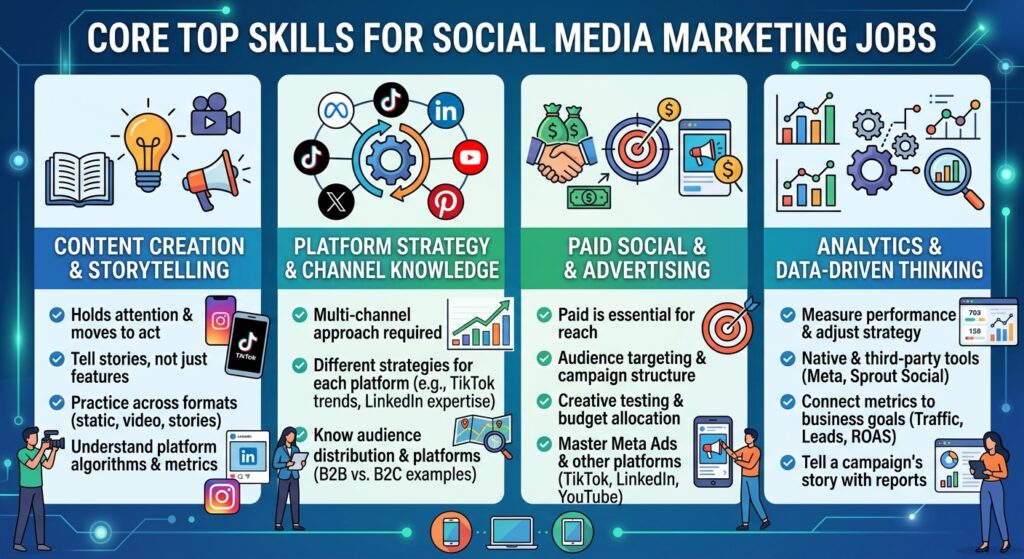
Every social media role, regardless of seniority, involves content. What separates strong performers from average ones is not just the ability to produce content but the ability to produce content that holds attention and moves people to act.
Storytelling is the skill underneath content creation. A product post that leads with a customer problem and ends with a solution will consistently outperform one that leads with a product feature. A behind-the-scenes video that shows real people and real process will hold attention longer than a polished corporate reel. The ability to find the story in any brief and tell it in the format the platform rewards is what makes a content creator genuinely valuable.
Becoming a professional in social media content creation means practicing across formats: static images, carousels, short-form video, long-form video, stories, and written posts. Each format has its own rhythm and each platform has its own audience expectations. The marketers who can write, shoot, and edit across all of them have a significant advantage over those who specialize in only one.
Creating engaging social media content also requires understanding what the algorithm rewards on each platform at any given time. Hook length, caption structure, posting frequency, comment velocity, and save rate all factor into distribution. A marketer who understands these mechanics produces content that gets seen, not just content that looks good.
Platform Strategy and Channel Knowledge
Knowing one platform well is not enough. Brands operate across multiple channels simultaneously, and each one requires a different strategy, different content formats, and different metrics for success.
Instagram rewards visual quality and community engagement. TikTok rewards trend participation and fast hooks. LinkedIn rewards expertise and professional insight. X (Twitter) rewards speed and voice. YouTube rewards search optimization and watch time. Pinterest rewards evergreen visual content with strong SEO. Facebook still drives the highest paid social volume for many industries despite its reputation for decline.
Choosing the right social media platforms for a brand requires understanding where that brand’s audience actually spends time, not just which platforms are currently popular. A B2B software company and a restaurant chain need completely different platform strategies. Knowing how to make that decision and how to build a channel-specific approach for each platform is a skill employers pay for.
Paid Social and Advertising
Organic reach on most major platforms has declined consistently. For most brands, paid social is now a required part of the strategy, not an optional addition to it.
Top Skills for Social Media Marketing Jobs cover audience targeting, campaign structure, creative testing, budget allocation, bid strategy, pixel implementation, and performance optimization. Running a Facebook or Instagram campaign effectively requires understanding how the Meta Ads auction works, how to build audiences from first-party data and lookalikes, how to test creative variables at scale, and how to read ROAS data and make decisions from it.
Facebook’s advertising infrastructure is the most sophisticated in social media and the most widely used by brands of every size. A social media marketer who can plan and execute Meta campaigns competently is significantly more hireable than one who only handles organic content.
TikTok Ads, Pinterest Ads, LinkedIn Ads, and YouTube Ads each have their own interfaces and mechanics. A working knowledge of at least two paid platforms, plus a deep understanding of at least one, is the standard most employers and agencies expect.
Analytics and Data-Driven Thinking
Posting content and calling it a day is not a job. Posting content, measuring what it produced, understanding why it performed the way it did, and adjusting the next round of content based on that analysis is a job.
Social media analytics skills cover platform native analytics (Meta Business Suite, TikTok Analytics, LinkedIn Campaign Manager), third-party tools (Sprout Social, Hootsuite, Later), and the ability to connect social metrics to actual business outcomes like website traffic, lead volume, and revenue.
The metrics worth tracking depend on the campaign goal. Brand awareness campaigns are measured by reach, impressions, and share of voice. Engagement campaigns track comments, shares, saves, and engagement rate. Conversion campaigns track click-through rate, cost per click, cost per lead, and ROAS.
A social media marketer who can build a report that tells the story of a campaign, not just a table of numbers, is someone a client or employer will trust with more budget and more responsibility.
Technical and AI Skills for Modern Social Media Roles
AI is changing social media marketing in ways that directly affect what employers expect from their social media hires.
Content production that previously took a full day now takes a few hours with the right AI tools in the workflow. AI writing assistants draft captions and scripts. AI image tools generate creative variations for testing. AI video editors cut and reformat footage automatically. A social media marketer who can direct these tools accurately and edit their output for quality and brand voice produces significantly more output per week than one who does not use them.
AI-powered tools for Instagram growth now handle tasks that previously required hours of manual work: audience analysis, hashtag research, optimal posting time prediction, comment moderation, and performance trend identification. Fluency with these tools is increasingly a baseline expectation rather than a bonus skill.
The technical skills social media roles now require alongside AI literacy include basic graphic design in Canva or Adobe Express, short-form video editing in CapCut or Premiere, familiarity with scheduling tools like Buffer or Later, and comfort with Meta Business Suite and Creator Studio for campaign management.
Understanding how algorithms work mechanically, not just observationally, is a technical skill that separates practitioners who know what they are doing from those who are guessing. Why does a video get pushed to the For You Page? What signals does Instagram use to decide whether to show a post to non-followers? How does LinkedIn’s algorithm treat native documents versus external links? Knowing the answers makes every content decision more informed.
Soft Skills That Set Great Social Media Marketers Apart
Hard skills get you through the interview. Soft skills determine whether you last in the role and how quickly you grow.
Communication is the one soft skill that shows up in every part of a social media marketer’s day. Writing copy that sounds like a human wrote it. Explaining campaign performance to a client who does not speak marketing. Briefing a designer on what the creative needs to do. Managing a comment section during a PR crisis. All of these require different kinds of communication, and social media marketers who are strong across all of them are rare.
Adaptability is non-negotiable. A platform changes its algorithm and the strategy that worked last month stops working. A new format emerges and brands that ignore it fall behind. A crisis hits and the content calendar becomes irrelevant until it is resolved. Social media marketers who adapt quickly and without panic are worth significantly more than those who need stability to perform well.
Trend awareness is part of the job description for most social media roles, but it is more than following what is popular. It is understanding which trends are worth participating in for a specific brand, which ones would feel off-brand or inauthentic, and how to move fast enough to participate in trends before they peak. Timing in social media is everything, and trend awareness is the skill that makes the right timing possible.
Community management is undervalued as a skill and overestimated as a simple task. Responding to comments in a way that reflects the brand’s voice, handling complaints without escalating them, encouraging genuine conversation in the comments, and building real relationships with the people who engage consistently are all skills that take time to develop and directly affect brand perception and customer loyalty.
The Role of a Social Media Manager Today
The social media manager title covers more ground in 2026 than it did five years ago. The responsibilities of a social media manager now typically include strategy development, content production, paid campaign management, analytics reporting, influencer coordination, and community management, often simultaneously and sometimes alone.
The evolving role of a social media manager has moved from execution-focused to strategy-focused. The best social media managers today are not just content creators. They are channel strategists who understand how social activity connects to broader marketing goals and business metrics.
In larger organizations, the social media manager role splits into specialists: a content creator, a paid social specialist, a community manager, and an analytics lead. At smaller companies and agencies, one person holds all of those responsibilities. Knowing which version of the role you are hiring for, or applying to, shapes which skills matter most.
How to Build These Skills
Top Skills for Social Media Marketing Jobs are built through doing more than through studying, but structured learning accelerates the process.
The best social media marketing courses in 2026 include Meta Blueprint for paid social fundamentals, Google Digital Garage for broader digital marketing context, HubSpot Academy for content marketing and inbound strategy, and platform-specific creator courses on TikTok and YouTube. These are all free or low-cost and provide recognized credentials that signal baseline competency to employers.
For analytics specifically, Google Analytics 4 certification is worth getting regardless of how much social media work you do, because understanding how traffic converts on a website is essential context for understanding why social media performance matters.
The fastest way to build portfolio work is to manage social media for a small local business, a nonprofit, or your own personal brand. Real results from a real account, even a small one, demonstrate more to a prospective employer or client than any certification.
Turning These Skills Into a Career or Agency Strategy
For individuals, the path from skilled social media practitioner to hired or freelance marketer is shorter than it has ever been. Employers and clients can find practitioners anywhere, which means portfolio, results, and demonstrated platform knowledge matter more than geography or institution.
Building a social media marketing strategy that connects channel activity to business outcomes is the skill that moves a practitioner from junior to senior level. A junior social media marketer posts content. A senior one can explain why that content will produce what the business needs and prove it with data after the fact.
For businesses, social media management is central to brand consistency across channels. The businesses that treat social media as a checkbox exercise post inconsistently, respond to comments sporadically, and produce content that looks different every week. The ones that treat it seriously build audiences that stay engaged and convert.
Hiring or Outsourcing? When to Use an Agency Instead
Some businesses reach a point where the gap between the social media results they need and what their in-house team can deliver is wide enough that outsourcing makes more financial sense than hiring.
Choosing the right social media marketing agency requires looking for the same skills this guide covers: strong content across formats, paid social competency, analytics capability, and a demonstrable track record with brands in your category. An agency that produces generic content at volume is not a substitute for a skilled in-house hire. An agency with a genuine content strategy, channel expertise, and transparent reporting is.
Alpha Digital’s digital marketing services include social media management for businesses that want the skills covered in this guide working for their brand without the overhead of building an internal team to deliver them.
Ready to Build or Hire for Social Media?
Whether you are building your own skills, staffing a social media role, or considering outsourcing your brand’s social presence to a team that already has these skills in place, the starting point is the same: be clear about what outcome you need and choose accordingly.
Alpha Digital works with brands that want social media to do more than generate likes. If you want a content and channel strategy built around actual business goals, contact our team and we will walk you through what that looks like for your specific business and audience.
Frequently Asked Questions
What are the most important Top Skills for Social Media Marketing Jobs today?
The highest-demand hard skills in 2026 are short-form video creation and editing, paid social campaign management across Meta and TikTok, analytics reporting using platform native tools and Google Analytics 4, content strategy development, and AI tool proficiency for content production and performance analysis. Employers consistently prioritize candidates who can demonstrate results from real campaigns over those who list skills without evidence of how they applied them.
Do I need to know how to run paid ads, or is organic social media enough?
Organic social media alone is not enough for most professional roles in 2026. Platform organic reach has declined significantly across Facebook, Instagram, and LinkedIn. Employers and clients expect social media marketers to understand paid amplification, even if they are not the primary ads manager. Knowing how to build an audience, write ad copy, read campaign performance data, and communicate with a paid specialist about strategy makes any social media marketer significantly more valuable than someone who only handles organic.
How important are AI skills in modern social media marketing roles?
AI skills are now a standard expectation rather than a differentiator. Social media marketers who use AI tools for caption drafting, content ideation, image generation, video editing, and performance trend identification produce more output at higher consistency than those who do not. More importantly, AI literacy helps marketers move faster when trends emerge and test more creative variables with the same time budget. Job listings in 2026 increasingly name specific AI tools as preferred skills.
How can I showcase these social media skills if I do not have professional experience?
Build your own portfolio through real work. Manage social media for a local business, a charity, a sports club, or your own personal brand account. Document what you did, what results it produced, and what you learned from the data. Screenshots of analytics showing growth, engagement rate improvements, or paid campaign performance tell a clearer story than a resume line item. Prospective employers and clients want evidence that you can do the work, not just that you have studied it.
What soft skills are essential for succeeding in social media marketing?
Adaptability is the most important. Social media changes constantly and practitioners who need stability to perform well struggle in the role. Strong written communication is essential because every caption, comment, and client update reflects on the brand. Trend awareness, meaning knowing which trends are worth participating in and which ones will feel off-brand, separates practitioners who protect brand reputation from those who chase every moment. Community management composure, specifically the ability to handle negative comments professionally without escalating them, matters significantly more than most job descriptions acknowledge.